


There are two major, and not unrelated, challenges when reporting on the climate crisis.
The first is its complexity. Between the science, the range of data and the sheer scale of the problems we face, it can be hard to distil the vast vat of information into something easy to grasp.
The second is the sense that, in all its multifaceted, multifarious density, it can feel overwhelming. There is always the worry that the audience is left simply thinking that we might as well give up; why even try to fix it when the situation is just hopeless?
Ahead of Cop26, I’ve been pondering this, especially after a summer in which climate-related disasters have dominated the headlines. From devastating wildfires in Greece, Italy, Turkey and California, through to deadly floods in western Germany and New York, the sense that the climate emergency is well and truly home to roost has been inescapable.
As world leaders head to Glasgow, there is pessimism from some quarters, most notably from activist Greta Thunberg and US climate envoy John Kerry, and a clear effort to manage expectations in others, with UK Prime Minister Boris Johnson conceding he is "very worried" that the summit will not be a success.
The stakes could scarcely be higher. We can certainly feel that here in the UAE, where warnings of future "super" and "ultra-extreme" heatwaves have been heard this year. The UAE’s recent announcement that it is committing to net-zero carbon emissions by 2050, the first country in the Middle East to do so, is a clear signal that this troubling future is being taken seriously.
But we can already see the danger more acutely in the Global South, where the human impact of climate change is being felt as extreme weather and drought trigger more pressure on resources and lead to greater migration. When a Biden administration report is naming climate change as a national security challenge, the interconnectedness of all this is laid bare.
If you’re reading this and starting to feel hopeless, you’re probably getting the point I made at the top; it does feel overwhelming. But this week at CNN’s Dubai Expo studios, I had a conversation that made me think that, perhaps, there is a simple way to address at least part of this infernal equation.

David Beasley, the executive director of the World Food Programme (WFP), has been looking at the numbers of people who are migrating due to food insecurity, largely brought about through climate change.
He says that the resources countries such as the US are ploughing into feeding and sheltering the migrants arriving at its borders are running into the tens of millions of dollars a week; he told me it was as much as $30 million, and up to $4,000 per person. All this so people could live in shelters on the border. What’s more, he says, it is going to get worse.
“We see what's happening, droughts and flooding and more cyclones, and the list goes on,” he told me. “Last year, we had 30 million people displaced because of climate. But in the next 30 years, with the climate expectations that we're looking between 200 [million] and a billion people being displaced.”
Given those eye-widening numbers, the need to take a different approach to the problem becomes clear. It is a little like the dichotomy between medicine and public health: as a society we spend vastly more on the former than the latter, despite troves of evidence that preventing illness is often far more effective than treating it.
-
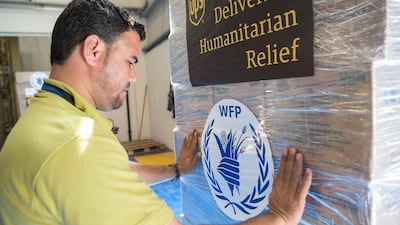
The World Food Programme loads trucks with food and supplies in response to the drought in Somalia at the International Humanitarian City Warehouses in Dubai. Antonie Robertson / The National -
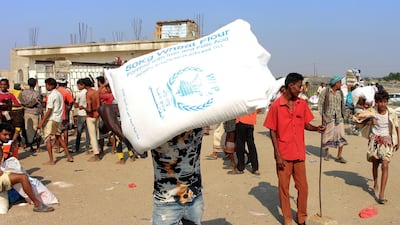
Displaced Yemenis receive humanitarian aid, donated by the World Food Programme (WFP) in cooperation with the Danish Refugee Council ( DRC), in the northern province of Hajjah on December 30, 2019. AFP -
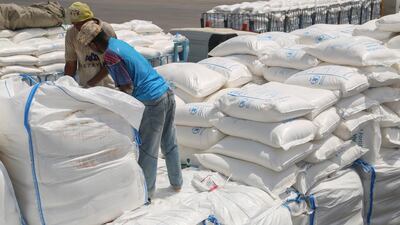
Yemenis receive sacks of food aid packages from the World Food Programme in the Yemeni port city of Hodeida on June 25, 2019. AFP -
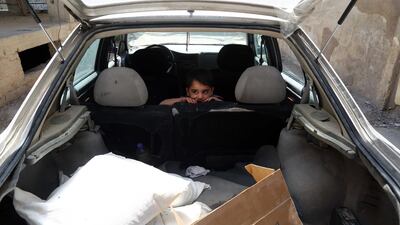
A Syrian boy sits in a car after his family received from the local council aid parcels provided by the UN World Food Programme and the Syrian Arab Red Crescent on May 11, 2016, in the rebel-held village of Saqba, on the eastern outskirts of the capital Damascus. AFP -
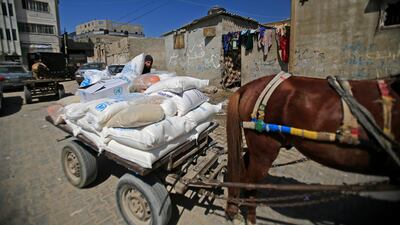
A Palestinian loads a cart with aid food provided by the UN's World Food Programme and its agency for Palestinian refugees, UNRWA, in the Gaza Strip's al-Shati refugee camp on May 15, 2019. AFP -
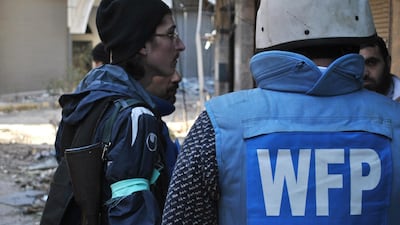
A United Nations World Food Programme worker talks to rebel fighters on February 8, 2014 on the second day of a humanitarian mission in a besieged district of the central city of Homs, Syria. AFP -
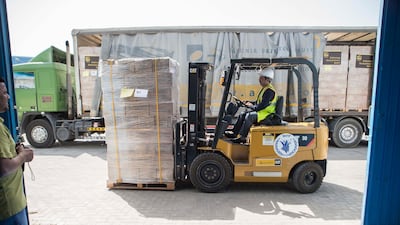
The World Food Programme loads trucks with food and supplies in response to the drought in Somalia at the International Humanitarian City Warehouses in Dubai. Antonie Robertson / The National -
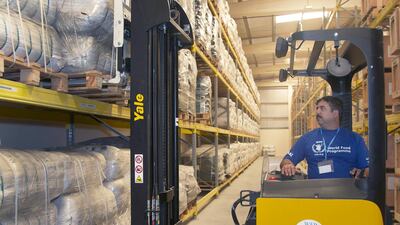
Ali Goahr, a forklift operator for the United Nations World Food Programme, moves blankets in the World Food Programme Warehouse in International Humanitarian City, Dubai. Kevin J. Larkin / The National


Mr Beasley contends that his organisation can tackle the issues of food security and resilience at source, and way more cost effectively, meaning people will not need to leave their homes in the first place. A $1-2 a week per head programme will, he claims, be enough.
The problem is finding that money, especially at a time when governments are continuing to spend their way out of the Covid-19 pandemic.
But Mr Beasley says he has an answer to that, too. Another story that has been hard to avoid in recent months is the new space race, largely contested by the billionaires Jeff Bezos and Elon Musk. These two individuals have seen their net worth rise as astronomically as their rockets in the past year, and Mr Beasley is calling on them and other billionaires to consider using their money in a different way.
“Just last week, Elon Musk had a $6bn net worth increase,” he said on my show. “The top 400 billionaires in the United States, their net worth increase was $1.8 trillion in the past year.”
Mr Beasley says as many as 42 million people in 43 countries "are literally going to die if we don’t reset". What he needs to prevent that, he believes, is a one-off donation from these wealthy individuals of $6bn. "I'm not asking them to do this every day, every week, every year. We have a one-time crisis, a perfect storm of conflict, climate change, and Covid. It's a one-time phenomenon."
-
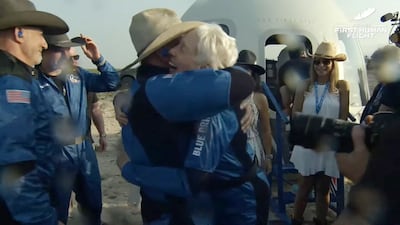
Billionaire businessman Jeff Bezos embraces veteran aviator Wally Funk after Blue Origin’s reusable New Shepard craft capsule returned from space on Tuesday, July 20, 2021. -

Jeff Bezos, Funk and and gap-year student Oliver Daemen, 18, disembark after Blue Origin’s reusable New Shepard capsule returned from space. -
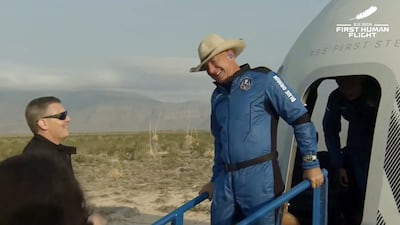
Jeff Bezos disembarks after the flight. -

New Shepard touches down on Earth. -

New Shepard approaches the ground. -
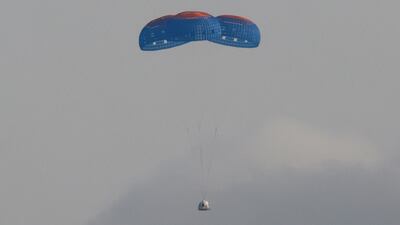
The capsule carrying Jeff Bezos and three crew members returns to Texas by parachute. -
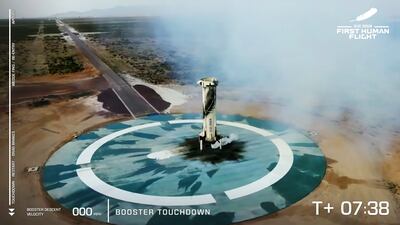
The booster rocket returns to the launch pad. -
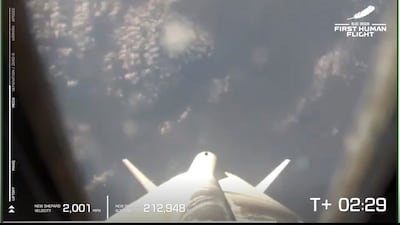
The rocket lifts off. -
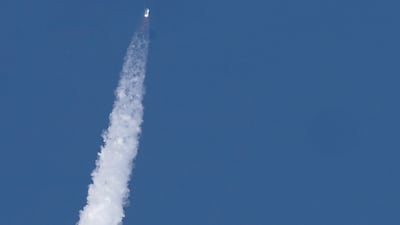
The launch viewed from far. -

The rocket is launched on the world’s first unpiloted suborbital flight. -
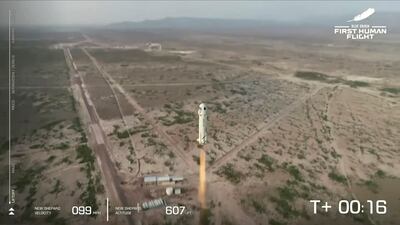
It took off from Blue Origin’s launch site, near Van Horn in western Texas, US. -
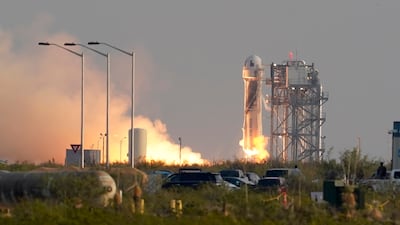
Blue Origin’s New Shepard rocket is launched from its spaceport. -
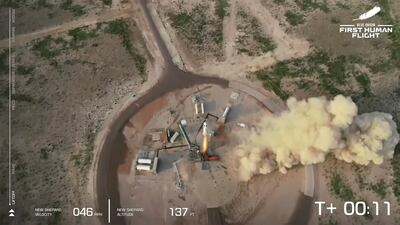
The rocket lift-off. -
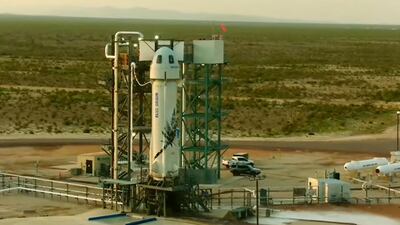
The launch pad. Blue Origin’s first crewed mission was an 11-minute flight from Texas and back. Reaching an altitude of 106 kilometres, it coincided with the 52nd anniversary of the first Moon landing. -

People watch on a television screen as the rocket sits on the launch pad. -

The crew members prepare for the flight. -
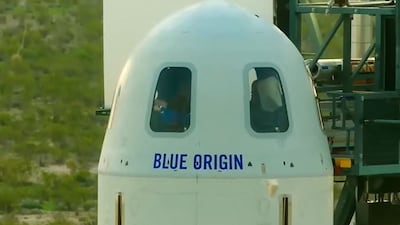
The crew members prepare for the flight. -
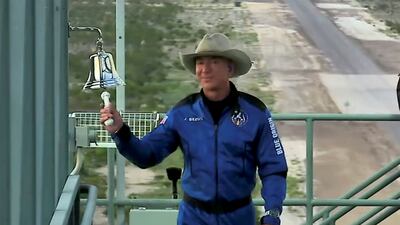
Jeff Bezos, the founder of Amazon.com, rings a bell before boarding the flight. -
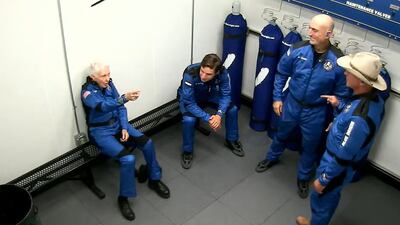
This still image taken from video by Blue Origin shows Funk, Daemen and the Bezos brothers before they leave for the flight. -

A monitor in a zone reserved for the media shows Wally Funk being interviewed. -
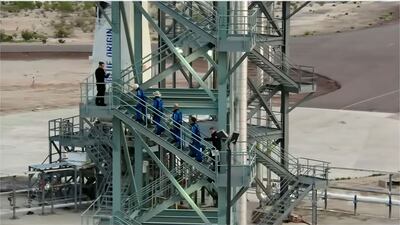
This still image taken from video by Blue Origin shows Funk, Jeff and Mark Bezos, and Daemen as they ascend the crew tower for the flight. -
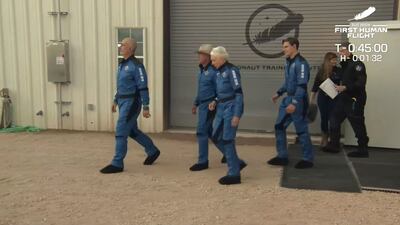
This still image taken from video by Blue Origin shows, from left, Mark Bezos, Jeff Bezos, Wally Funk and Oliver Daemen as they travel to the launch pad. -

Jeff Bezos, his brother Mark Bezos, a private equity executive, Wally Funk and Oliver Daemen pose in an undated photograph.


Such a donation would, Mr Beasley says, put the WFP out of business, and go a long way towards solving one of the most alarming impacts of the climate emergency.
Put in such terms, what seems like an insurmountable and fiendishly complicated problem feels easy to solve.
To their credit, companies such as Mr Bezos's Amazon have led the way with commitments to a carbon-neutral future, albeit one that their founder's space exploits might appear to contradict. What these private individuals and companies have is something that many of the politicians gathering in Glasgow do not: the simple ability to act and act fast.
Of course, Mr Beasley is talking about treating the effects of the climate crisis, rather than the cause. But, perhaps, if the billionaires were to take up his challenge, they could inspire those attending Cop26 to achieve the consensus and commitment needed to tackle the bigger, even more complex problem we all face at source, too.

