It is only on days like Monday, when the app suffered a prolonged outage that my hatred starts to feel validated. Reuters


How we can all prevent the next WhatsApp outage


  • English
  • Arabic

October 05, 2021

I can’t make so much as a dentist appointment without turning to WhatsApp. It is incredibly convenient – far more than logging into a clunky online portal and navigating a slow-loading calendar of available appointments.

Daily life in the UAE, and across the Middle East in general, is often a WhatsApp-based existence.

It is useful and yet I hate it. I hate the dependency on a single piece of infrastructure that is largely unaccountable to any public authority.

And it is only on days like yesterday, when the app, along with Facebook and Instagram, which are owned by the same company, suffered a prolonged outage that my hatred starts to feel validated.

If tomorrow all the phone lines in the world went dead or GPS satellites fell from the sky, the firing of those responsible would only be the beginning. Inquiries would be held, compensation would be paid and new laws would be passed in the US, Europe and elsewhere to ensure that these things would never happen again.

It is not an entirely trivial comparison. We still don’t know the full extent of the consequences of WhatsApp going dark, but we will come to know, I’m sure, that they were many. To give just one example, reports have already emerged telling how vulnerable Afghans trying to escape the Taliban were unable to reach those trying to co-ordinate their rescue, causing potentially dangerous delays.

But Facebook, the company founded by Mark Zuckerberg that owns WhatsApp, is unlikely to see much in the way of lasting consequences. An executive few have heard of may be fired, the stock price will fall for a time, but not much else will happen.

The only thing we have seen so far is a simple “We’re sorry”, posted by Facebook’s official account, ironically, on Twitter.

But we ought to be past the point of dry apologies. They are not cute.

For the past decade – first running a tech-based non-profit and then as a reporter covering the industry – I have grown increasingly distrustful of Mr Zuckerberg’s social media empire. Not that I deserve a gold medal, but I deleted my Facebook and Instagram accounts years ago. Deleting WhatsApp, as most of the 600 million people who live in the Middle East know, is next to impossible.

Facebook, the company founded by Mark Zuckerberg that owns WhatsApp, is unlikely to see much in the way of lasting consequences. Reuters

The harm caused by social media apps and the lack of regulation and consequences for them feels like the first draft of the Digital Revolution. Like the noxious fumes and servile rhetoric many of our ancestors inhaled in factories during the Industrial Revolution, our grandchildren will be scandalised to learn about the lives we led under the Big Tech regime.

We are the first generation, the pioneers, and the reforms and protections we need have not yet arrived. So it seems wise to proceed with caution.

Instead, however, we have rushed forward. One in three people on the planet uses Facebook. And they do so without proper regulatory oversight.

This week, a whistleblower who was formerly employed as a product manager for Facebook told reporters that the company actively fails to protect users. “Facebook over and over again chose to optimise for its own interests like making more money,” she said.

One study included in documents the whistleblower revealed shows that Facebook took action on as little as 3 per cent to 5 per cent of hate speech on its platform, and on less than 1 per cent of content classified under “violence and incitement”.

So we have a platform, or series of platforms owned by a private individual, that works to monopolise communication in our lives, fails to protect us from the most harmful communication it propagates and then offers little more than an apology when it accidentally shuts down communication altogether.

What kind of regulations are needed? There are many ideas, but there is little agreement. That is why nothing has been done yet. The best ideas in concept involve treating Facebook like any other public utility, which would mean making its governance structure directly accountable to governments and putting controls in place to ensure that its profit incentives do not grow out of hand.

But this would be no ordinary public utility with obvious borders or boundaries. It is a global one, and national governments do not have much luck – or authority ­– in governing global phenomena. At the moment, Facebook, something many would consider to be a critical piece of infrastructure for people in the Middle East, is becoming increasingly harmful because of the failure of politicians in Washington to regulate it. But should politicians in Washington be the ones to regulate a piece of critical infrastructure in the Middle East anyway? It is a tough question, but one way or another oversight is needed. The status quo is not the right way to start the Digital Revolution.

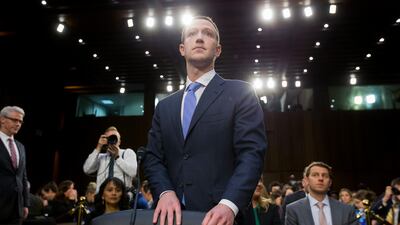
  • Facebook CEO Mark Zuckerberg takes his seat to testify before the Senate Commerce, Science and Transportation Committee and the Senate Judiciary Committee joint hearing on 'Facebook, Social Media Privacy, and the Use and Abuse of Data' on Capitol Hill in Washington, DC, USA. Michael Reynolds / EPA
    Facebook CEO Mark Zuckerberg takes his seat to testify before the Senate Commerce, Science and Transportation Committee and the Senate Judiciary Committee joint hearing on 'Facebook, Social Media Privacy, and the Use and Abuse of Data' on Capitol Hill in Washington, DC, USA. Michael Reynolds / EPA
  • Facebook CEO Mark Zuckerberg takes his seat following a break in testifying before the Senate Commerce, Science and Transportation Committee and the Senate Judiciary Committee. Michael Reynolds / EPA
    Facebook CEO Mark Zuckerberg takes his seat following a break in testifying before the Senate Commerce, Science and Transportation Committee and the Senate Judiciary Committee. Michael Reynolds / EPA
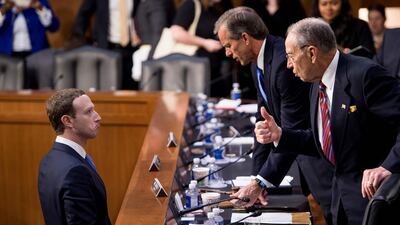
  • Facebook CEO Mark Zuckerberg speaks with Senator John Thune and Senator Chuck Grassley following a joint hearing of the Senate Commerce, Science and Transportation Committee and Senate Judiciary Committee. Brendan Smialowski / AFP
    Facebook CEO Mark Zuckerberg speaks with Senator John Thune and Senator Chuck Grassley following a joint hearing of the Senate Commerce, Science and Transportation Committee and Senate Judiciary Committee. Brendan Smialowski / AFP
  • Facebook CEO Mark Zuckerberg departs after the hearing. Alex Brandon. AP Photo
    Facebook CEO Mark Zuckerberg departs after the hearing. Alex Brandon. AP Photo
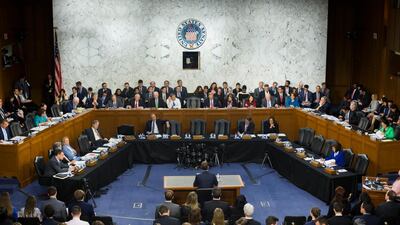
  • Facebook CEO Mark Zuckerberg testifies before the Senate Commerce, Science and Transportation Committee and the Senate Judiciary Committee. Michael Reynolds / EPA
    Facebook CEO Mark Zuckerberg testifies before the Senate Commerce, Science and Transportation Committee and the Senate Judiciary Committee. Michael Reynolds / EPA
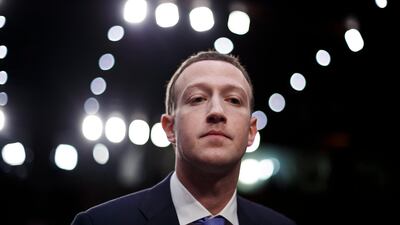
  • Facebook CEO Mark Zuckerberg testifies before the Senate Commerce, Science and Transportation Committee and the Senate Judiciary Committee. Shawn Thew / EPA
    Facebook CEO Mark Zuckerberg testifies before the Senate Commerce, Science and Transportation Committee and the Senate Judiciary Committee. Shawn Thew / EPA
  • Facebook CEO Mark Zuckerberg testifies during a Senate Commerce, Science and Transportation Committee and Senate Judiciary Committee. Jim Watson / AFP
    Facebook CEO Mark Zuckerberg testifies during a Senate Commerce, Science and Transportation Committee and Senate Judiciary Committee. Jim Watson / AFP
So we have a platform, or series of platforms owned by a private individual, that works to monopolise communication in our lives, fails to protect us from the most harmful communication it propagates and then offers little more than an apology when it accidentally shuts down communication altogether.

Last month, US outlets carried a wonderful story of an indigenous Tatuyo woman, living in the middle of the Amazon rainforest, who has found viral stardom educating the world on TikTok about what life is like for her community. That is a mission that could only be achieved in the social media age. Using these platforms to broaden our horizons is the best realisation of their capabilities.

But we need to be honest: at the moment, big tech companies are not driving us in that direction. For most of us, our time using social media is not exposing us to diverse opinions or lives. It is, as Facebook’s whistleblower says, dedicated to activities and opinions that are causing us harm without us even knowing it. And the October 4 outage reminded us just how dependent we have become on that system. And it showed us, most of all, that we can expect little more from that system than an empty apology.


MATCH INFO

Manchester United 2 (Heaton (og) 42', Lindelof 64')

Aston Villa 2 (Grealish 11', Mings 66')

In%20the%20Land%20of%20Saints%20and%20Sinners
%3Cp%3E%3Cstrong%3EDirector%3A%20%3C%2Fstrong%3ERobert%20Lorenz%3C%2Fp%3E%0A%3Cp%3E%3Cstrong%3EStarring%3A%3C%2Fstrong%3E%20Liam%20Neeson%2C%20Kerry%20Condon%2C%20Jack%20Gleeson%2C%20Ciaran%20Hinds%3C%2Fp%3E%0A%3Cp%3E%3Cstrong%3ERating%3A%20%3C%2Fstrong%3E2%2F5%3C%2Fp%3E%0A
UAE currency: the story behind the money in your pockets
Where to donate in the UAE

The Emirates Charity Portal

You can donate to several registered charities through a “donation catalogue”. The use of the donation is quite specific, such as buying a fan for a poor family in Niger for Dh130.

The General Authority of Islamic Affairs & Endowments

The site has an e-donation service accepting debit card, credit card or e-Dirham, an electronic payment tool developed by the Ministry of Finance and First Abu Dhabi Bank.

Al Noor Special Needs Centre

You can donate online or order Smiles n’ Stuff products handcrafted by Al Noor students. The centre publishes a wish list of extras needed, starting at Dh500.

Beit Al Khair Society

Beit Al Khair Society has the motto “From – and to – the UAE,” with donations going towards the neediest in the country. Its website has a list of physical donation sites, but people can also contribute money by SMS, bank transfer and through the hotline 800-22554.

Dar Al Ber Society

Dar Al Ber Society, which has charity projects in 39 countries, accept cash payments, money transfers or SMS donations. Its donation hotline is 800-79.

Dubai Cares

Dubai Cares provides several options for individuals and companies to donate, including online, through banks, at retail outlets, via phone and by purchasing Dubai Cares branded merchandise. It is currently running a campaign called Bookings 2030, which allows people to help change the future of six underprivileged children and young people.

Emirates Airline Foundation

Those who travel on Emirates have undoubtedly seen the little donation envelopes in the seat pockets. But the foundation also accepts donations online and in the form of Skywards Miles. Donated miles are used to sponsor travel for doctors, surgeons, engineers and other professionals volunteering on humanitarian missions around the world.

Emirates Red Crescent

On the Emirates Red Crescent website you can choose between 35 different purposes for your donation, such as providing food for fasters, supporting debtors and contributing to a refugee women fund. It also has a list of bank accounts for each donation type.

Gulf for Good

Gulf for Good raises funds for partner charity projects through challenges, like climbing Kilimanjaro and cycling through Thailand. This year’s projects are in partnership with Street Child Nepal, Larchfield Kids, the Foundation for African Empowerment and SOS Children's Villages. Since 2001, the organisation has raised more than $3.5 million (Dh12.8m) in support of over 50 children’s charities.

Noor Dubai Foundation

Sheikh Mohammed bin Rashid Al Maktoum launched the Noor Dubai Foundation a decade ago with the aim of eliminating all forms of preventable blindness globally. You can donate Dh50 to support mobile eye camps by texting the word “Noor” to 4565 (Etisalat) or 4849 (du).

Avatar: Fire and Ash

Director: James Cameron

Starring: Sam Worthington, Sigourney Weaver, Zoe Saldana

Rating: 4.5/5

Ferrari 12Cilindri specs

Engine: naturally aspirated 6.5-liter V12

Power: 819hp

Torque: 678Nm at 7,250rpm

Price: From Dh1,700,000

Available: Now

Pox that threatens the Middle East's native species

Camelpox

Caused by a virus related to the one that causes human smallpox, camelpox typically causes fever, swelling of lymph nodes and skin lesions in camels aged over three, but the animal usually recovers after a month or so. Younger animals may develop a more acute form that causes internal lesions and diarrhoea, and is often fatal, especially when secondary infections result. It is found across the Middle East as well as in parts of Asia, Africa, Russia and India.

Falconpox

Falconpox can cause a variety of types of lesions, which can affect, for example, the eyelids, feet and the areas above and below the beak. It is a problem among captive falcons and is one of many types of avian pox or avipox diseases that together affect dozens of bird species across the world. Among the other forms are pigeonpox, turkeypox, starlingpox and canarypox. Avipox viruses are spread by mosquitoes and direct bird-to-bird contact.

Houbarapox

Houbarapox is, like falconpox, one of the many forms of avipox diseases. It exists in various forms, with a type that causes skin lesions being least likely to result in death. Other forms cause more severe lesions, including internal lesions, and are more likely to kill the bird, often because secondary infections develop. This summer the CVRL reported an outbreak of pox in houbaras after rains in spring led to an increase in mosquito numbers.

The National's picks

4.35pm: Tilal Al Khalediah
5.10pm: Continous
5.45pm: Raging Torrent
6.20pm: West Acre
7pm: Flood Zone
7.40pm: Straight No Chaser
8.15pm: Romantic Warrior
8.50pm: Calandogan
9.30pm: Forever Young

While you're here
At a glance

Global events: Much of the UK’s economic woes were blamed on “increased global uncertainty”, which can be interpreted as the economic impact of the Ukraine war and the uncertainty over Donald Trump’s tariffs.


Growth forecasts: Cut for 2025 from 2 per cent to 1 per cent. The OBR watchdog also estimated inflation will average 3.2 per cent this year


Welfare: Universal credit health element cut by 50 per cent and frozen for new claimants, building on cuts to the disability and incapacity bill set out earlier this month


Spending cuts: Overall day-to day-spending across government cut by £6.1bn in 2029-30 


Tax evasion: Steps to crack down on tax evasion to raise “£6.5bn per year” for the public purse


Defence: New high-tech weaponry, upgrading HM Naval Base in Portsmouth


Housing: Housebuilding to reach its highest in 40 years, with planning reforms helping generate an extra £3.4bn for public finances

Updated: October 06, 2021, 5:27 AM