


“Focus on the data, not the drama,” urged Dr Sultan Al Jaber, Minister of Industry and Advanced Technology and managing director and group chief executive of Adnoc, in his address to the Adipec global energy conference in Abu Dhabi earlier this month.
That line stayed with me. Because behind the data are real people.
Let’s imagine the fictional, yet very realistic, case of Safiya, a seasoned operator working in a cutting-edge Adnoc control room. She is in charge of one of the world’s most advanced energy facilities. Every decision she makes, sometimes in fractions of a second, keeps the system safe and efficient.
But like every human being, Safiya has limits. Towards the end of her shift, physical and cognitive fatigue kick in. Stress or personal issues can blur attention. Each micro-moment of distraction can have major consequences.
AI can make a critical difference here. But only if it can understand, in real time, how Safiya feels by scientifically monitoring her behaviour and decisions and adapt proactively to predict potential errors and mitigate them.
At Adipec, and earlier at the Enact Majlis, I heard a lot about computing, grids and capital expenditure. All critical. But what struck me most were the conversations that moved beyond algorithms and infrastructure to people like Safiya and how it is the human factor that determines whether technology truly delivers safety and performance.
Peer-reviewed analyses of safety incidents reported by the International Association of Oil and Gas Producers show that human-factor contributors such as fatigue, cognitive overload or communication breakdowns can be involved in up to 90 per cent of cases. Benchmarked against its IOGP peers, Adnoc achieved a 22 per cent reduction in its recordable injury rate between 2020 and 2022, placing it among the world’s top quartile health, safety and environment performers.
This achievement is remarkable. It demonstrates how leadership, innovation and system-level discipline can translate into tangible results such as safer operations, higher performance and a relentless pursuit of continuous improvement. The next step is to use AI systems that adapt not only to processes but to people.
Imagine if Safiya’s workstation could sense her mental workload and automatically simplify displays, preventing errors. If her helmet could pick up changes in voice stress, head and eye movements, and even brainwaves. If her safety alerts could adapt, becoming more visual when auditory attention drops, or less repetitive when she has already acknowledged them.
It’s already happening in the military, professional sports, construction, entertainment, education and healthcare. This is neuro-adaptive AI: technology that interprets human signals, understands context and responds intelligently to enhance performance while safeguarding both physical and mental health.
At the Mohamed bin Zayed University of Artificial Intelligence, our team of Human-Computer Interaction researchers works with colleagues in robotics, machine learning, natural language processing and computer vision to improve these existing solutions, making them even more capable of decoding how humans feel, focus and perform as they work.
We call this field neuro-adaptive safety: embodied and empathic AI that protects people by understanding them like never before. This is AI that enhances performance while providing unprecedented levels of personalised physical and psychological safety.
For more than two years, together with Inclusive Brains, Biotech Dental Group, and the International Knee and Joint Centre Abu Dhabi, we have been testing neuro-responsive AI with surgeons in the UAE to help them sustain focus and manage stress during long and complex days were they perform one operation after the other.
If neuro-adaptive AI can help a surgeon operate more safely and precisely, a Formula 1 driver perform consistently across an entire season, or a jet-fighter pilot win a dogfight, it can also help an operator like Safiya maintain vigilance when it matters most, or assist a driller on a rig, or a driver escorting a fuel convoy.
Now imagine that Safiya’s on-site interventions are supported by cobots: human-robot collaborative AI systems designed not to replace her, but to protect her and improve her performance. A cobot could slow down when it detects stress or hesitation in her movement or take on repetitive or high-risk tasks so she can focus on supervision and high-level decision-making. A cobot could venture into hazardous environments while Safiya stays safely at a distance, just as MBZUAI demonstrated at Adipec.
This is not automation for substitution. It’s augmentation for safety. It’s true human-centric AI in action. The energy sector is next in line to embrace it.
-

Dr Sultan Al Jaber, UAE Minister of Industry and Advanced Technology, and Adnoc managing director and group chief executive, opens the Adipec conference. -
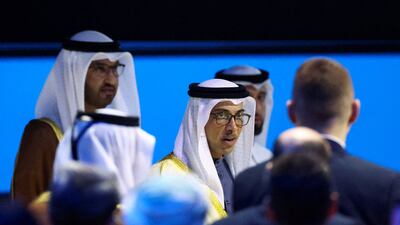
Sheikh Mansour bin Zayed, UAE Vice President, Deputy Prime Minister and Chairman of the Presidential Court, attends the opening ceremony of the Adipec conference. All photos: Reuters -
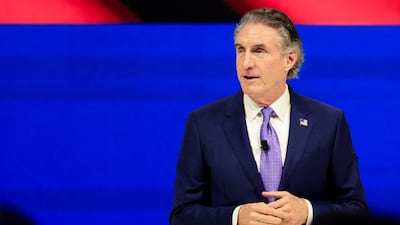
US Secretary of the Interior Doug Burgum addresses delegates at the major energy sector event. -

Suhail Al Mazrouei, UAE Minister of Energy and Infrastructure, and Qatari Energy Minister Saad Al Kaabi at the opening ceremony. -
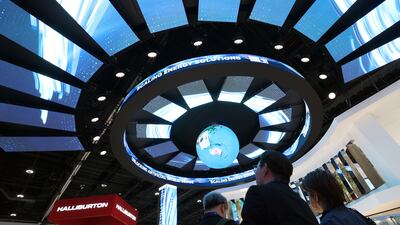
More than 205,000 people are set to attend the Adipec conference in Abu Dhabi this year. Chris Whiteoak / The National -
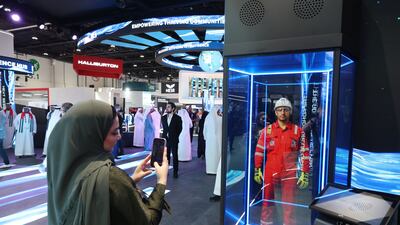
More than 50 energy companies from around the world to be represented at the event. Chris Whiteoak / The National -
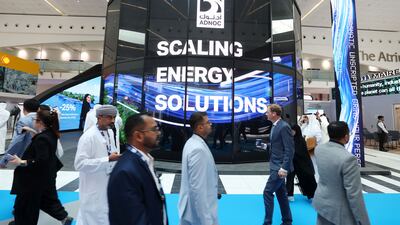
More than 1,800 speakers are scheduled to take part in the conference. Chris Whiteoak / The National


Last year, the Journal of Petroleum Technology has reported an industry estimate that unmanaged mental-health challenges cost the oil and gas sector around $200 billion annually in lost productivity and turnover. According to Deloitte, predictive-maintenance programs are associated with 25 per cent higher productivity, 70 per cent fewer breakdowns and 25 per cent lower maintenance costs. Bringing that predictive logic to people working in the energy sector will yield even greater returns, financial and human. This is because physical and mental safety are not a cost. They are an investment.
A Siemens report published in 2023 indicates that, in the oil and gas sector, a single hour of downtime can cost up to $500,000 – a value that fluctuates with prices. In contrast, neuro-adaptive safety systems, continuous upskilling, and personalised onboarding cost only a fraction, and deliver compounding returns in safety, well-being and operational continuity.
At MBZUAI, we see the human factor as the multiplier: the element that turns every watt of computation, every line of code and every dirham of investment into exponential returns.
Many energy sector chief executives agree: safety is the industry’s true currency. AI systems, when designed for people, are the best investment to keep improving both performance and protection.
Safiya’s story is not unique. It’s a glimpse of a future of energy, a future that is already taking shape in many other sectors. This is because the most advanced AI systems are not those that think like us, but those that think with us.

