


News that former Philippine president Rodrigo Duterte was held in custody at Manila International Airport on Tuesday, and was then “forcibly taken” on to a plane headed to the Netherlands – as his daughter, Vice President Sara Duterte, put it – was certainly dramatic. But of itself, being arrested or sentenced to jail is something that plenty of past and present leaders, both in the Philippines and in South-East and East Asia, have experienced.
Two other former Philippine presidents have been arrested. Joseph Estrada was found guilty of plunder in 2007, although he was swiftly pardoned by his former vice president, Gloria Macapagal-Arroyo – who was herself arrested twice, in 2011 and 2012, on charges of electoral sabotage and misuse of state funds. (The first charge was dropped, and she was found not guilty of the second.)
President Yoon Suk-yeol of South Korea is currently suspended from his job after his brief imposition of martial law in December, and faces severe criminal charges. Five other former presidents have been subject to criminal investigations since the establishment of the Sixth Republic in 1988, four of whom were sentenced to jail while one died by suicide.
Malaysian Prime Minister Anwar Ibrahim spent eight years in jail after being dismissed as deputy prime minister in 1998 (he was granted a full royal pardon in 2018). One of his predecessors, Najib Tun Razak, is in prison; another, Muhyiddin Yassin, is due to stand trial later this year; and a third, Ismail Sabri, is currently being investigated by the country’s anti-corruption commission.
Thailand’s former prime minister Thaksin Shinawatra was sentenced to two years in jail while in self-imposed exile. Myanmar’s former de facto leader Aung San Suu Kyi is currently under house arrest, as she also was for most of the 1990s and 2000s. And East Timor’s Prime Minister, Xanana Gusmao, was imprisoned from 1993 to 1999 when the country was part of Indonesia.
-
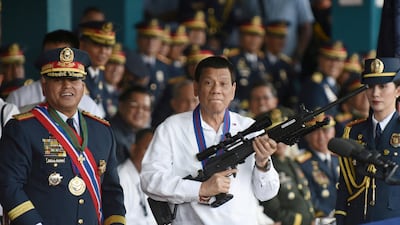
Philippine President Rodrigo Duterte holds a Galil sniper rifle next to outgoing National Police Chief Ronald Bato Dela Rosa during a handover ceremony in Camp Crame, Quezon City, Manila. Reuters -
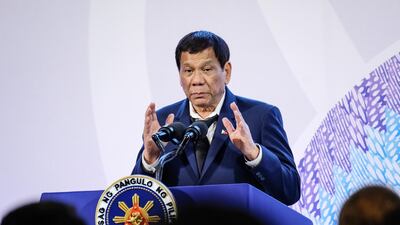
Rodrigo Duterte speaks during a news conference at the Asean Summit in Manila, the Philippines. Duterte lashed out at Justin Trudeau after the Canadian prime minister raised concerns about human rights abuses under the country’s drug war. Bloomberg -
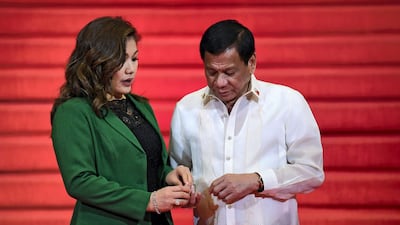
Rodrigo Duterte chats with partner Honeylet Avancena while waiting for leaders to arrive to attend the opening ceremony of the ASEAN summit in Manila on April 29, 2017. AFP -

Rodrigo Duterte saluting a soldier wounded by an explosion, during a visit to a military camp in Jolo, Sulu province, southern Philippines. Twin bombings hit a Sunday mass at Jolo Cathedral in the Mindanao region of the southern Philippines on January 27. EPA -

Malaysia's Prime Minister Mahathir Mohamad, Myanmar State Counsellor Aung San Suu Kyi and Philippine President Rodrigo Duterte pose for a group photo on the sidelines of the 33rd ASEAN summit in Singapore, 2018. AFP -

Rodrigo Duterte salutes at Lieutenant General Rolando Joselito D. Bautista and Major General Macairog Sabeniano Alberto, during a change of command ceremonies of the Philippine Army at a military camp in Taguig, south of Manila, Philippines. EPA -
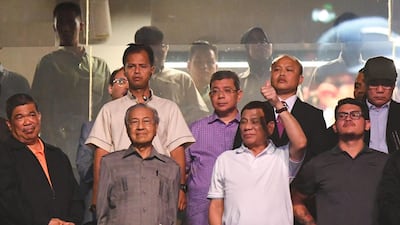
Rodrigo Duterte gestures next to Malaysian Prime Minister Mahathir Mohamad after Philippines' Manny Pacquiao beat Argentina's Lucas Matthysse during their world welterweight boxing championship bout at Axiata Arena in Kuala Lumpur. AFP -

King Abdullah II of Jordan talks with Rodrigo Duterte as they review the guard of honor at the Royal Palace in Amman, Jordan, September 6, 2018. EPA -
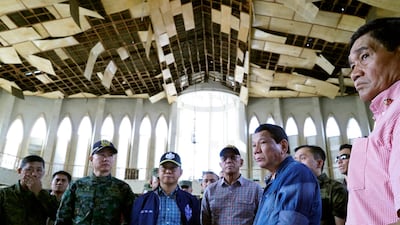
Rodrigo Duterte inspects a Catholic church damaged by explosion in Jolo, Sulu province, southern Philippines, 28 January 2019. EPA -
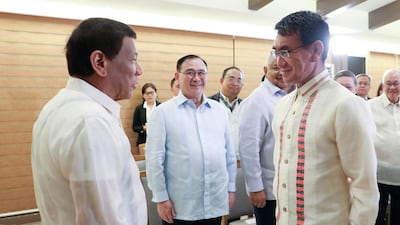
Rodrigo Duterte with Japanese Foreign Minister Taro Kono during a meeting in Davao city, Philippines. EPA


The above is not an exhaustive list; but being whisked halfway around the world on a warrant from the International Criminal Court in The Hague, which wants to try Mr Duterte for crimes against humanity, is on another level.
The families of the up to 30,000 people who died during his administration’s “war on drugs” may be pleased. But this move will also be controversial – and not just with those who argue that the ICC has no rightful jurisdiction in the Philippines since Mr Duterte withdrew the country from the court in 2019. (The judges say they do have that right, as they are investigating alleged crimes from when the Philippines was a member.)
The big challenge to the ICC is that the implementation of its arrest warrants is so troublingly uneven that it appears to be neither credible nor impartial to some. What is the likelihood that Russian President Vladimir Putin, Israeli Prime Minister Benjamin Netanyahu, or Myanmar’s military leader, Min Aung Hlaing, will see the inside of a courtroom in The Hague? Warrants have been issued for the first two leaders, and one has recently been requested by ICC chief prosecutor Karim Khan for the third.
Myanmar’s leader will probably steer clear of travelling to ICC signatory countries, and he has no fear of a snatch squad attempting to spirit him away, since nobody has ever seriously suggested solving the country’s problems by outside intervention, no matter what brutalities its military may inflict on the population.
Mr Putin was given the red-carpet treatment when he visited Mongolia last September, despite the country being an ICC member. And Mr Netanyahu acts as though his arrest warrant doesn’t even exist. No wonder, when Germany’s probable next chancellor, Friedrich Merz, has said that the country’s membership of the ICC would not stand in the way of Mr Netanyahu visiting. “I have promised myself that we will find a way to ensure that he can visit Germany and leave again without being arrested,” Mr Merz said last month.
“It is not for states to unilaterally determine the soundness of the court’s legal decisions,” the ICC responded. But that’s exactly what many do.

The ICC may – perhaps – have surmounted a previous criticism. “What are we to make of the fact that in its eleven-year history, the International Criminal Court has prosecuted only Africans?” asked Human Rights Watch’s then executive director, Kenneth Roth, in 2014. Leaders from the Global North are no longer exempt from ICC warrants. However, it seems that if you are powerful enough, or you are considered an indispensable ally, there are plenty of countries that will ignore the ICC’s rulings.
One reason they will give, if they wish to explain themselves, is their belief that some ICC charges are politically motivated. This is exactly what Mr Duterte’s supporters are saying, while the man himself has accused his opponents of allying “with white foreigners”. Claims of political motivation in legal cases have a lot of currency in South-East Asia; and that’s quite understandable, because if you look at the list I outlined above, politics – and not justice – was surely involved in many of the instances.
All of this points to the importance of the rule of law, but equally to what exactly is lost when faith in it is eroded. It pains me to ask what trust and hope can still be placed in the ICC. But perhaps that was always the question, right from its inception in 2002, when the US not only failed to ratify it, but actually passed a law nicknamed “The Hague Invasion Act”, which would allow a sitting US president to send the military into The Hague to stop American forces being prosecuted or held by the ICC.
It’s never had anything like universal jurisdiction. Only 125 countries are “State Parties to the Rome Statute” of the court. So the ICC is not another example of the so-called international rules-based order crumbling under the shocks of these tumultuous times. It was never fully built in the first place.
For those reasons and more, I would ask whether flying Mr Duterte to The Hague to be tried is a wise move. If he claims political victimisation and being sent off to a faraway land to receive “white man’s justice”, there’ll be plenty who believe him.

