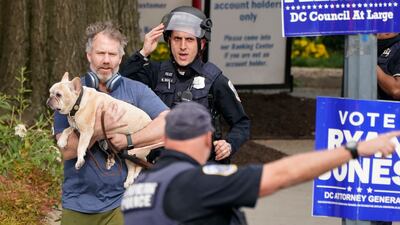
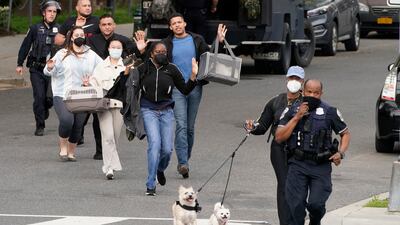
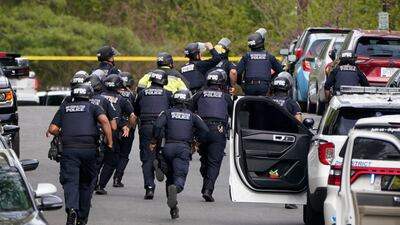
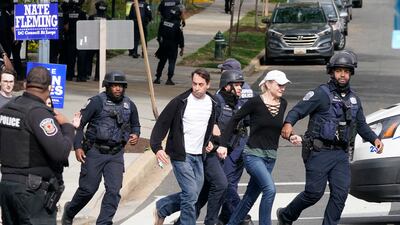
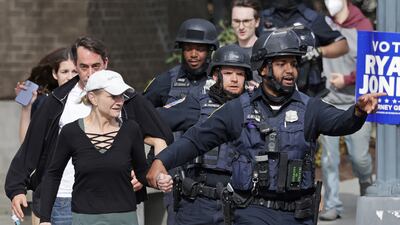
People are reunited with family members at a library after being removed from the scene of last week's shooting in Washington. AP


When America’s everyday violence comes crashing home


  • English
  • Arabic

April 25, 2022

Proximity and frequency are key factors in deciding which stories are considered newsworthy.

In Afghanistan, where I worked for a year as an editor, the countless blasts targeting civilians would sometimes get short shrift if they were in a remote location, even if lives had been lost.

Similarly, in a country where scores of Taliban fighters and Afghan troops were dying daily, the threshold for a war story was high.

If something happens every day, it is not new – so, by definition, not news. It is easy to grow dispassionate about horror when it is commonplace and far away.

Violence closer to home changes the calculus.

The thud of a rocket landing nearby or a blaring alarm from Nato headquarters warning of incoming “indirect fire” would always generate coverage, even if no one was hurt.

Working now in the US, my third stint here as a journalist, I find myself facing similar considerations in covering the news.

The scale of violence permeating this country at almost every level is so overwhelming, pervasive and numbing that it can be difficult to know what to cover. Just as in Afghanistan, US editors must filter the bloodshed.

This grim triage was brought home to me last week when my Washington neighbourhood was attacked.

On the scale of mass shootings in America — one in which four or more people are killed or injured, not including the gunman — this barely registered.

A child and three adults were wounded. No one died. It could have been so much worse.

If it had happened elsewhere in the US, it would not have been a national news story and I doubt I would have covered it.

My youngest child was in a playground just a short walk from the school the gunman targeted. A hail of bullets strayed for more than a kilometre, breaking glass at businesses I know.

The panicked parents and passers-by pictured fleeing the scene were my neighbours.

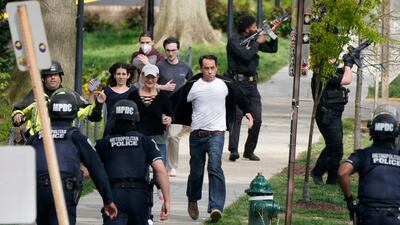
  • DC Metropolitan Police evacuate people near the scene of a shooting on Friday, April 22, in an upscale neighbourhood in north-west Washington. AP
    DC Metropolitan Police evacuate people near the scene of a shooting on Friday, April 22, in an upscale neighbourhood in north-west Washington. AP
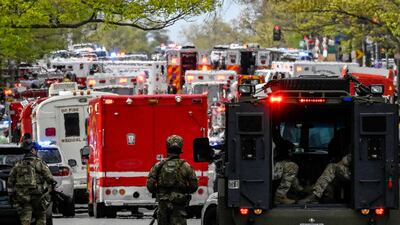
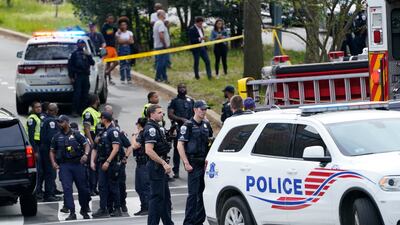
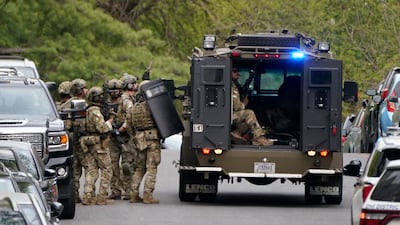
  • Dozens of law enforcement officers responded to the scene of a shooting near Connecticut Avenue and Van Ness Street. AP
    Dozens of law enforcement officers responded to the scene of a shooting near Connecticut Avenue and Van Ness Street. AP
  • Police said at least three people were injured. AP
    Police said at least three people were injured. AP
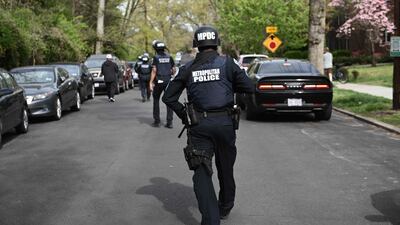
  • Police officer respond to a reported shooting near the 2900 block of Van Ness Street in north-west Washington. AFP
    Police officer respond to a reported shooting near the 2900 block of Van Ness Street in north-west Washington. AFP
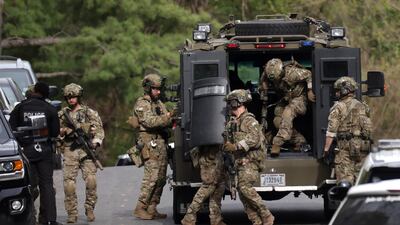
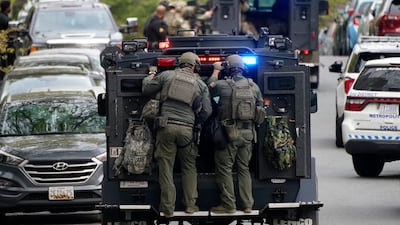
  • Armoured vehicles were brought to the scene of the shooting. Getty Images / AFP
    Armoured vehicles were brought to the scene of the shooting. Getty Images / AFP
  • Police say at least three people were injured. AP
    Police say at least three people were injured. AP
  • Police respond near the scene of the shooting. AP
    Police respond near the scene of the shooting. AP
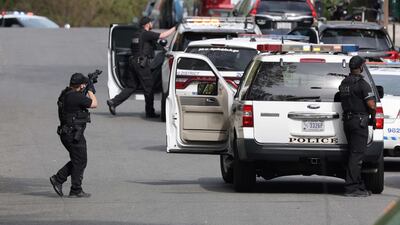
  • Police point their weapons at a building near the scene of the shooting. AFP
    Police point their weapons at a building near the scene of the shooting. AFP
  • Police respond near the scene of the shooting. AP
    Police respond near the scene of the shooting. AP
  • Police respond near the scene of the shooting. AP
    Police respond near the scene of the shooting. AP
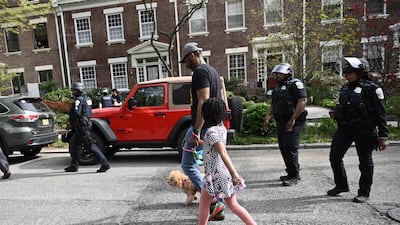
  • A man walks with a girl and dog past police officers following the shooting. AFP
    A man walks with a girl and dog past police officers following the shooting. AFP
  • Police evacuate people near the scene. AP
    Police evacuate people near the scene. AP
  • Police officers respond to news of a shooting. AFP
    Police officers respond to news of a shooting. AFP
  • Police evacuate people near the scene. AP
    Police evacuate people near the scene. AP
  • Police officers escort people away from the scene, some without shoes. AFP
    Police officers escort people away from the scene, some without shoes. AFP

The gunman had set up what police called a “sniper’s nest” in an apartment overlooking a private school. It was filled with ammunition, at least three assault rifles and a sniper’s tripod.

He fired more than 100 rounds in sustained bursts of semi-automatic gunfire that shattered windows at the private school.

The man was from nearby Virginia, where it is legal to buy assault rifles and high-capacity magazines.

He killed himself as police entered his apartment. His motive is still unknown.

When I first worked in the US nearly 20 years ago, a mass shooting would dominate the news for days on end.

I was in Colorado at the time, a few years after the 1999 massacre in which two Grade 12 pupils murdered a teacher and 12 fellow pupils in Columbine, outside Denver.

In the years since, every imaginable institution in the country has been hit with a mass shooting.

Hospitals, high schools, elementary schools, universities, music festivals, night clubs, places of worship, businesses, supermarkets — all have been targeted.

So far in 2022, the US has reported more than 140 mass shootings. About 20,000 people are killed here in gun homicides each year. Another 25,000 or so use guns to commit suicide.

These are war-zone levels. The year I was in Afghanistan, which has a population of about 40 million, roughly 3,400 civilians were killed.

A police officer leads two women and a child from Sandy Hook Elementary School in Connecticut, the scene of the 2012 mass shooting that killed 20 children and six adults. AP

My older child has already been taught the uniquely American lexicon of everyday violence. She’s had “active shooter” drills at school. She knows how to “shelter in place”.

School “lockdowns” in the US were routine long before the pandemic made us all familiar with the word.

I visited a military base in Kabul with a US official some years back. Soldiers there told him they were more worried about their kids’ safety at home than they were for their own lives in Afghanistan.

It seems nothing changes here when it comes to gun violence. For every incremental push for reform, gun activists push harder the other way.

Some parts of the country have almost no gun laws anymore, except age restrictions.

Several states including Georgia now let anyone over 21 carry a firearm — no background check or permit required, in most cases.

In the old days, when mass shootings still made national news, Republican politicians would get pilloried for sending “thoughts and prayers” after each slaying while refusing to consider gun reforms.

Nowadays even these platitudes have largely disappeared from the national conversation.

As spring turns to summer here in the US, we can expect more violence.

The country is already a powder keg after two years of pandemic isolation, record-high inflation and an internet where grievances are easily aired and amplified.

Add to this an endless supply of guns and ammunition, and it’s obvious we will be having to cover — or not — many more mass shootings in the months ahead.


Mercer, the investment consulting arm of US services company Marsh & McLennan, expects its wealth division to at least double its assets under management (AUM) in the Middle East as wealth in the region continues to grow despite economic headwinds, a company official said.

Mercer Wealth, which globally has $160 billion in AUM, plans to boost its AUM in the region to $2-$3bn in the next 2-3 years from the present $1bn, said Yasir AbuShaban, a Dubai-based principal with Mercer Wealth.

Within the next two to three years, we are looking at reaching $2 to $3 billion as a conservative estimate and we do see an opportunity to do so,” said Mr AbuShaban.

Mercer does not directly make investments, but allocates clients’ money they have discretion to, to professional asset managers. They also provide advice to clients.

“We have buying power. We can negotiate on their (client’s) behalf with asset managers to provide them lower fees than they otherwise would have to get on their own,” he added.

Mercer Wealth’s clients include sovereign wealth funds, family offices, and insurance companies among others.

From its office in Dubai, Mercer also looks after Africa, India and Turkey, where they also see opportunity for growth.

Wealth creation in Middle East and Africa (MEA) grew 8.5 per cent to $8.1 trillion last year from $7.5tn in 2015, higher than last year’s global average of 6 per cent and the second-highest growth in a region after Asia-Pacific which grew 9.9 per cent, according to consultancy Boston Consulting Group (BCG). In the region, where wealth grew just 1.9 per cent in 2015 compared with 2014, a pickup in oil prices has helped in wealth generation.

BCG is forecasting MEA wealth will rise to $12tn by 2021, growing at an annual average of 8 per cent.

Drivers of wealth generation in the region will be split evenly between new wealth creation and growth of performance of existing assets, according to BCG.

Another general trend in the region is clients’ looking for a comprehensive approach to investing, according to Mr AbuShaban.

“Institutional investors or some of the families are seeing a slowdown in the available capital they have to invest and in that sense they are looking at optimizing the way they manage their portfolios and making sure they are not investing haphazardly and different parts of their investment are working together,” said Mr AbuShaban.

Some clients also have a higher appetite for risk, given the low interest-rate environment that does not provide enough yield for some institutional investors. These clients are keen to invest in illiquid assets, such as private equity and infrastructure.

“What we have seen is a desire for higher returns in what has been a low-return environment specifically in various fixed income or bonds,” he said.

“In this environment, we have seen a de facto increase in the risk that clients are taking in things like illiquid investments, private equity investments, infrastructure and private debt, those kind of investments were higher illiquidity results in incrementally higher returns.”

The Abu Dhabi Investment Authority, one of the largest sovereign wealth funds, said in its 2016 report that has gradually increased its exposure in direct private equity and private credit transactions, mainly in Asian markets and especially in China and India. The authority’s private equity department focused on structured equities owing to “their defensive characteristics.”

MATCH INFO

Bayern Munich 2 Borussia Monchengladbach 1
Bayern:
 Zirkzee (26'), Goretzka (86')
Gladbach: Pavard (37' og)

Man of the Match: Breel Embolo (Borussia Monchengladbach)

How the bonus system works

The two riders are among several riders in the UAE to receive the top payment of £10,000 under the Thank You Fund of £16 million (Dh80m), which was announced in conjunction with Deliveroo's £8 billion (Dh40bn) stock market listing earlier this year.

The £10,000 (Dh50,000) payment is made to those riders who have completed the highest number of orders in each market.

There are also riders who will receive payments of £1,000 (Dh5,000) and £500 (Dh2,500).

All riders who have worked with Deliveroo for at least one year and completed 2,000 orders will receive £200 (Dh1,000), the company said when it announced the scheme.

What is blockchain?

Blockchain is a form of distributed ledger technology, a digital system in which data is recorded across multiple places at the same time. Unlike traditional databases, DLTs have no central administrator or centralised data storage. They are transparent because the data is visible and, because they are automatically replicated and impossible to be tampered with, they are secure.

The main difference between blockchain and other forms of DLT is the way data is stored as ‘blocks’ – new transactions are added to the existing ‘chain’ of past transactions, hence the name ‘blockchain’. It is impossible to delete or modify information on the chain due to the replication of blocks across various locations.

Blockchain is mostly associated with cryptocurrency Bitcoin. Due to the inability to tamper with transactions, advocates say this makes the currency more secure and safer than traditional systems. It is maintained by a network of people referred to as ‘miners’, who receive rewards for solving complex mathematical equations that enable transactions to go through.

However, one of the major problems that has come to light has been the presence of illicit material buried in the Bitcoin blockchain, linking it to the dark web.

Other blockchain platforms can offer things like smart contracts, which are automatically implemented when specific conditions from all interested parties are reached, cutting the time involved and the risk of mistakes. Another use could be storing medical records, as patients can be confident their information cannot be changed. The technology can also be used in supply chains, voting and has the potential to used for storing property records.

The specs

Engine: 4.0-litre V8 twin-turbocharged and three electric motors

Power: Combined output 920hp

Torque: 730Nm at 4,000-7,000rpm

Transmission: 8-speed dual-clutch automatic

Fuel consumption: 11.2L/100km

On sale: Now, deliveries expected later in 2025

Price: expected to start at Dh1,432,000

Match info

Who: India v Afghanistan
What: One-off Test match, Bengaluru
When: June 14 to 18
TV: OSN Sports Cricket HD, 8am starts
Online: OSN Play (subscribers only)

RESULTS
%3Cp%3E%0D%3Cstrong%3E6pm%3A%3C%2Fstrong%3E%20Marfa%20Deira%20%E2%80%93%20Conditions%20(PA)%20Dh80%2C000%20(Dirt)%201%2C200m%0D%3Cbr%3E%3Cstrong%3EWinner%3A%3C%2Fstrong%3E%20Wadheha%2C%20Bernardo%20Pinheiro%20(jockey)%2C%20Majed%20Al%20Jahouri%20(trainer)%0D%3Cbr%3E%3Cstrong%3E6.35pm%3A%20%3C%2Fstrong%3EDubai%20Creek%20%E2%80%93%20Maiden%20(TB)%20Dh82%2C500%20(D)%201%2C400m%0D%3Cbr%3E%3Cstrong%3EWinner%3A%20%3C%2Fstrong%3EBarq%20Al%20Emarat%2C%20Bernardo%20Pinheiro%2C%20Ismail%20Mohammed%0D%3Cbr%3E%3Cstrong%3E7.10pm%3A%20%3C%2Fstrong%3EMina%20Hamriya%20%E2%80%93%20Handicap%20(TB)%20Dh95%2C000%20(D)%201%2C600m%0D%3Cbr%3E%3Cstrong%3EWinner%3A%3C%2Fstrong%3E%20Tahdeed%2C%20Dane%20O%E2%80%99Neill%2C%20Michael%20Costa%0D%3Cbr%3E%3Cstrong%3E7.45pm%3A%3C%2Fstrong%3E%20Mina%20Rashid%20%E2%80%93%20Maiden%20(TB)%20Dh82%2C500%20(D)%201%2C900m%0D%3Cbr%3E%3Cstrong%3EWinner%3A%20%3C%2Fstrong%3ESeyaasi%2C%20Xavier%20Ziani%2C%20Salem%20bin%20Ghadayer%0D%3Cbr%3E%3Cstrong%3E8.20pm%3A%20%3C%2Fstrong%3EAl%20Garhoud%20Sprint%20DP%20World%20%E2%80%93%20Listed%20(TB)%20Dh132%2C500%20(D)%201%2C200m%0D%3Cbr%3E%3Cstrong%3EWinner%3A%3C%2Fstrong%3E%20Mouheeb%2C%20Ray%20Dawson%2C%20Michael%20Costa%0D%3Cbr%3E%3Cstrong%3E8.55pm%3A%3C%2Fstrong%3E%20Mirdiff%20Stakes%20Jebel%20Ali%20Port%20%E2%80%93%20Conditions%20(TB)%20Dh120%2C000%20(D)%201%2C400m%0D%3Cbr%3E%3Cstrong%3EWinner%3A%3C%2Fstrong%3E%20Seyouff%2C%20Antonio%20Fresu%2C%20Michael%20Costa%0D%3Cbr%3E%3Cstrong%3E9.30pm%3A%3C%2Fstrong%3E%20Jebel%20Ali%20Free%20Zone%20%E2%80%93%20Handicap%20(TB)%20Dh95%2C000%20(D)%202%2C000m%0D%3Cbr%3E%3Cstrong%3EWinner%3A%20%3C%2Fstrong%3EAjuste%20Fiscal%2C%20Jose%20da%20Silva%2C%20Julio%20Olascoaga%3C%2Fp%3E%0A
Iftar programme at the Sheikh Mohammed Centre for Cultural Understanding

Established in 1998, the Sheikh Mohammed Centre for Cultural Understanding was created with a vision to teach residents about the traditions and customs of the UAE. Its motto is ‘open doors, open minds’. All year-round, visitors can sign up for a traditional Emirati breakfast, lunch or dinner meal, as well as a range of walking tours, including ones to sites such as the Jumeirah Mosque or Al Fahidi Historical Neighbourhood.

Every year during Ramadan, an iftar programme is rolled out. This allows guests to break their fast with the centre’s presenters, visit a nearby mosque and observe their guides while they pray. These events last for about two hours and are open to the public, or can be booked for a private event.

Until the end of Ramadan, the iftar events take place from 7pm until 9pm, from Saturday to Thursday. Advanced booking is required.

For more details, email openminds@cultures.ae or visit www.cultures.ae


Timeline

2012-2015

The company offers payments/bribes to win key contracts in the Middle East

May 2017

The UK SFO officially opens investigation into Petrofac’s use of agents, corruption, and potential bribery to secure contracts

September 2021

Petrofac pleads guilty to seven counts of failing to prevent bribery under the UK Bribery Act

October 2021

Court fines Petrofac £77 million for bribery. Former executive receives a two-year suspended sentence 

December 2024

Petrofac enters into comprehensive restructuring to strengthen the financial position of the group

May 2025

The High Court of England and Wales approves the company’s restructuring plan

July 2025

The Court of Appeal issues a judgment challenging parts of the restructuring plan

August 2025

Petrofac issues a business update to execute the restructuring and confirms it will appeal the Court of Appeal decision

October 2025

Petrofac loses a major TenneT offshore wind contract worth €13 billion. Holding company files for administration in the UK. Petrofac delisted from the London Stock Exchange

November 2025

180 Petrofac employees laid off in the UAE

%3Cp%3EMATA%0D%3Cbr%3EArtist%3A%20M.I.A%0D%3Cbr%3ELabel%3A%20Island%0D%3Cbr%3ERating%3A%203.5%2F5%3C%2Fp%3E%0A
DMZ facts
  • The DMZ was created as a buffer after the 1950-53 Korean War.
  • It runs 248 kilometers across the Korean Peninsula and is 4km wide.
  • The zone is jointly overseen by the US-led United Nations Command and North Korea.
  • It is littered with an estimated 2 million mines, tank traps, razor wire fences and guard posts.
  • Donald Trump and Kim Jong-Un met at a building in Panmunjom, where an armistice was signed to stop the Korean War.
  • Panmunjom is 52km north of the Korean capital Seoul and 147km south of Pyongyang, North Korea’s capital.
  • Former US president Bill Clinton visited Panmunjom in 1993, while Ronald Reagan visited the DMZ in 1983, George W. Bush in 2002 and Barack Obama visited a nearby military camp in 2012. 
  • Mr Trump planned to visit in November 2017, but heavy fog that prevented his helicopter from landing.
Updated: April 26, 2022, 12:38 PM