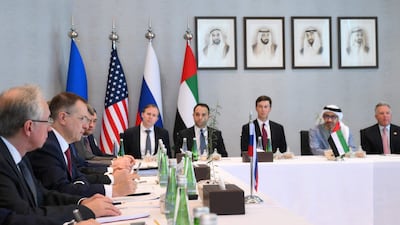

High-stakes talks between the US, Russia and Ukraine – the first since February – began in Abu Dhabi on Tuesday, with European engagement.
Security guarantees are expected to be central to the two-day discussions, alongside de-escalation, humanitarian measures and prospects for a wider settlement.
US envoys Steve Witkoff and Jared Kushner, who is also President Donald Trump's son-in-law, are set to lead the American delegation.

Officials said they would meet representatives from Ukraine, the EU, Nato, Germany, France, Britain and Italy before the talks.
“We expect to cover security guarantees, and then also, with regard to long-term security architecture between Russia and Europe, how to reduce future conflicts,” a US official told journalists on Monday.

“I do believe that now we're in a position where there is a shot at trying to make, you know, serious progress to end the war.”
Despite the official's optimism, the prospect of a breakthrough remains uncertain. Moscow and Kyiv continue to attack each other's energy sites, while Russia is demanding major territorial concessions from Ukraine.
Kyiv, meanwhile, insists on strong guarantees against future Russian aggression and has ruled out surrendering its territory.
“Our proposal is to bring the Europeans into the discussion after this trilateral and to try and run on parallel tracks so that they can both help solve the other,” the US official said.
Mr Kushner said he hoped the discussions would identify areas of common ground. “This is an extremely complex and complicated conflict. We understand that difficult decisions lie ahead,” he wrote in a post on X on Monday.
At the weekend, EU foreign policy chief Kaja Kallas said she saw little sign of Russian willingness to negotiate an end to the war.
The talks come after Mr Trump's Republican Party suffered a bruising defeat in the US midterm elections.
Mr Trump took office nearly two years ago, promising to bring a swift end to the war in Ukraine. In an interview with 60 Minutes, broadcast on Sunday, he said he believed an agreement was close.
“I believe we're very close to making a deal,” he said. “I think we're going have it done, and I think it's going to happen and they're going end up with a little bit different shaped Ukraine.”

Daniel Fried, a former US assistant secretary of state for Europe during the George W Bush administration, said the White House was continuing to offer Russia concessions at Ukraine's expense and possibly at Europe's, without evidence that Moscow was interested in negotiations beyond its own terms.
“Jared Kushner seems to be now putting even more offers on the table, using language favoured by the Kremlin,” Mr Fried said.
“So, having failed to move negotiations by putting pressure on Ukraine and offering economic concessions to Russia, the Americans are now offering even more to Russia – and I see no evidence that any of this is going to work,” he said.
Mr Trump, Mr Fried added, was persisting despite having a weaker hand, with little evidence that his approach would serve American interests.
Matthew Boyse, a senior fellow at the Hudson Institute's Centre on Europe and Eurasia, said Russian President Vladimir Putin believed he had the advantage in negotiations and little incentive to compromise.
He said Moscow regarded Mr Trump as politically weakened after the midterm elections and increasingly eager to secure a diplomatic victory by ending the war.
“Following the midterms, Moscow sees a much weaker President Trump who is now even more keen to be seen as a winner, such as by delivering an end to the war,” Mr Boyse said. “Putin thinks he has the cards.”
Mr Boyse said previous rounds of negotiations had produced humanitarian outcomes, including prisoner exchanges and the return of Ukrainian children taken to Russia, but had failed to make progress on the fundamental disagreements preventing an end to the conflict.
“If the history of these meetings since 2022 is a guide, you can be forgiven for being sceptical,” he said.
Mr Boyse also questioned whether Mr Trump was prepared to use economic pressure against Moscow, saying the US leader had weakened his own influence by pursuing energy deals and moves to restore Russian oil and gas trade after signing legislation authorising more sanctions.

