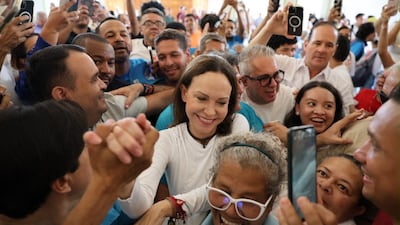
Opposition leader Maria Corina Machado has returned to Venezuela after nearly a year outside the country.
"I'm here with you," the Nobel Peace Prize winner wrote on social media early on Sunday.
Her media team shared images of her in central-western Lara state, in the Plaza del Pueblo de Santa Rosa, where she appeared at a church.
The issue of her return has strained her relationship with US President Donald Trump's administration, which she has sought to cultivate as an ally since before the toppling of long-time leader Nicolas Maduro in January. After her Nobel win, Ms Machado gave the prize to Mr Trump, who had said several times he thought he deserved it.
He has repeatedly expressed support for interim President Delcy Rodriguez, Mr Maduro's former vice president, and hailed deals on oil production and other business ventures by US companies in the South American country. Mr Trump said in September that it was too soon to consider democratic elections in Venezuela.
Speaking at the White House on Sunday, Mr Trump said he did not know anything about Ms Machado's return to Venezuela and suggested that the US would continue to back Ms Rodriguez.
"She's a very nice woman," he said, referring to Ms Machado. "But we're doing really well in Venezuela.”
This is not the first time she has tried to return to Venezuela after she escaped the country in December 2025 to receive her Nobel prize. She had gone into hiding after her detention during a protest against recent elections.
Ms Rodriguez was named interim leader of Venezuela after Mr Maduro was captured by US forces in early January and taken to New York to face drug and weapons-related charges. She said there will be future elections but no date has been set.
Ms Rodriguez's government has allowed politicians, activists and journalists who spent years in exile to return, including some of Ms Machado’s closest allies. Allowing Ms Machado to organise and campaign would be a most consequential move, while detaining her or restricting her activities could put pressure on Washington to respond.
But the US has has given priority to political and economic stability over an immediate democratic transition. A major energy agreement in early September has given the US access to as much as 65 billion barrels of Venezuela’s crude reserves.
Ms Machado's desire to return had caused friction in Washington, with US officials asking her to delay her trip, Reuters reported in June.
Secretary of State Marco Rubio said her return was the “direct result of the US-supported reconciliation talks".
“The United States expects the freedoms of all sectors of Venezuelan politics to continue to be respected,” he said in a post on X. “Likewise, we expect all political actors to support these talks, which represent the best chance Venezuela has had in 30 years to peacefully achieve not just a free and fair election, but an enduring democracy.”
Still, Ms Machado may have missed her chance at being part of the transition. US-backed talks between Ms Rodriguez’s government and a faction of the opposition ended their latest round this week with agreements to begin reviewing laws governing political disqualifications, parties and public demonstrations, among other measures.

