
A quarter of a century after the deadliest attack on US soil, Americans gathered on Friday to commemorate the nearly 3,000 lives lost on September 11, 2001.
The Al Qaeda attack was perhaps the defining event of this century so far, and has shaped countless lives across the globe, particularly in the Middle East during a string of US-led wars that arguably led to the current conflict with Iran.
Former presidents George W Bush, Bill Clinton, Barack Obama and Joe Biden joined New York Mayor Zohran Mamdani and Vice President JD Vance at the National September 11 Memorial in Manhattan.
The ceremony began at 8:46am with a moment of silence, marking the time American Airlines Flight 11 hit the World Trade Centre’s North Tower. Family members then began reading the names of all 2,977 people who were killed, as well as the six people killed in the 1993 World Trade Centre bombing.
Thousands more have died in the years since 9/11 for reasons related to the attack, many from inhaling toxic dust from the collapsed buildings and debris in New York.
Alexander Romero, who was two years old when his father Elvin Romero was killed in the Twin Towers, paid tribute to him.
“Don't leave anything left unsaid, and try to make the absolute most of the limited time that we all have here,” he said. “I love you. I wish I got to know you. Please keep looking out for all of us and keep us safe. We miss and we love you”.
The attacks have shaped generations of Americans who lived through the event or grew up in its aftermath, influencing US foreign policy, domestic politics and public attitudes towards security.
President Donald Trump commemorated the occasion at the Defence Department.
“We will never, ever forget. That's why we fight today,” he said in a speech outside the Pentagon, in the location where American Airlines Flight 77 struck the military headquarters.
Defence Secretary Pete Hegseth described the post-9/11 wars as "imperfect" but said they were "retribution". He also used his speech to defend the US war in Iran, which arguably is morphing into the sort of open-ended conflict the Trump administration had vowed not to start.
“We are ensuring that Iran will never have a nuclear weapon,” he said. “The economic pressure tightens every day. We control the strait. We will finish this fight.”
Mr Trump also mentioned Iran, condemning it for its actions across the region. “We salute the service members working right now to ensure the world’s number one sponsor of terror, the Islamic Republic of Iran, will never ever have a nuclear weapon," he said.
Some analysts have said the US-led 2003 invasion of Iraq strengthened Iran and set the US on a course for today's confrontation.
Mourners also held a ceremony in Shanksville, Pennsylvania, at the crash site where passengers brought down a fourth hijacked plane that was headed for Washington.
-
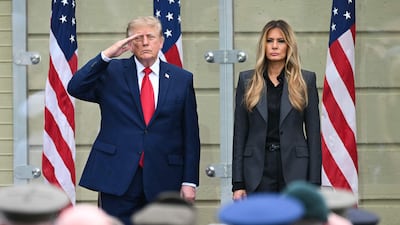
Donald and Melania Trump listen to the national anthem during the commemoration at the Pentagon in Washington DC. AFP -
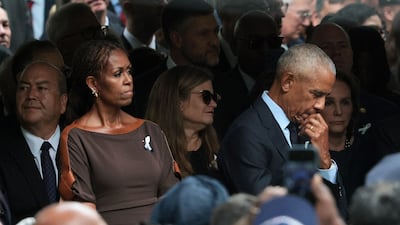
Michelle and Barack Obama during the ceremony at the National 9/11 Memorial & Museum. Getty Images via AFP -
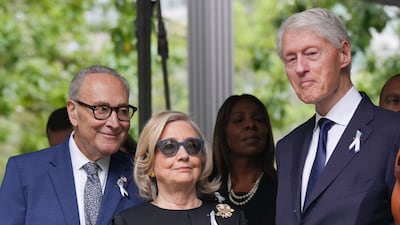
US Senate Minority Leader Chuck Schumer with Hillary and Bill Clinton. AFP -
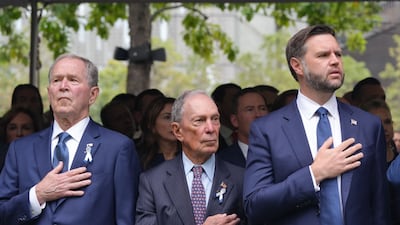
Former president George W Bush, former New York City mayor Michael Bloomberg and Vice President JD Vance. AFP -
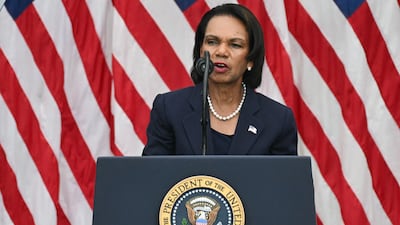
Former US secretary of state Condoleezza Rice speaks during the commemoration at the Pentagon. AFP -
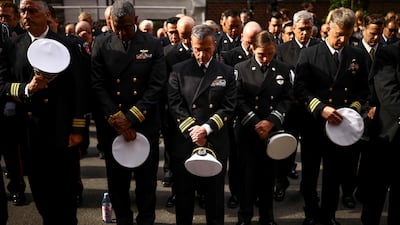
Firefighters pay tribute outside the Engine 54/Ladder 4/Battalion 9 firehouse in New York. AFP -
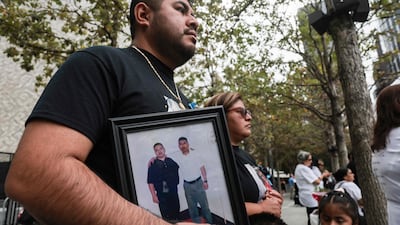
Juan Lopez, who lost his father Leobardo in the attacks. Getty Images via AFP -
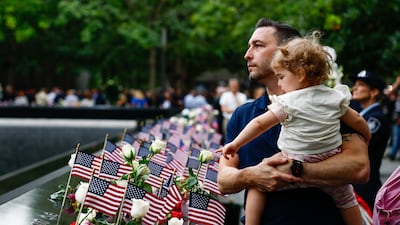
Matt Dunleavy holds his daughter Ellie during the ceremony at the 9/11 Memorial. EPA -
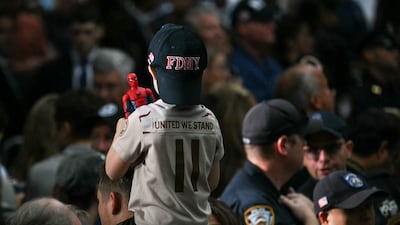
People at the commemoration event at the 9/11 Memorial. AFP -
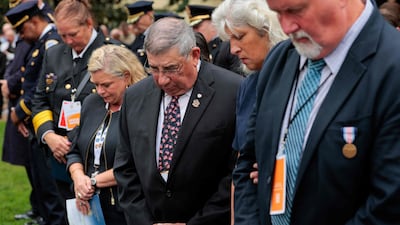
The ceremony at the Pentagon. Getty Images via AFP -
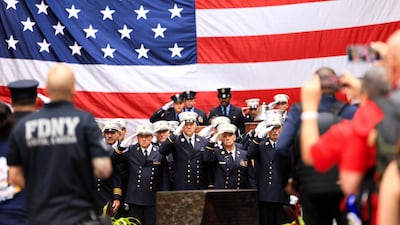
Firefighters outside Engine 54/Ladder 4/Battalion 9 firehouse. AFP


'War on terror'
The attacks initiated America's “war on terror”, which led to the creation of the Department of Homeland Security and the US invasions of Afghanistan and Iraq, both of which lasted for many years.
The resulting public backlash helped fuel Mr Trump's rise a decade ago, when he vowed not to start new foreign entanglements – a promise being tested by the current Iran war.
According to Brown University's Watson School of International and Public Affairs, which has spent years tracking the costs of the post-9/11 wars, the US has spent or is obliged to spend about $8 trillion on military intervention and associated costs. That figure does not include interest payments on borrowing to fund the wars.
Brown says it has also calculated that at least 940,000 people have died due to direct war violence, including civilians, armed forces on all sides, contractors, journalists and humanitarian workers.
At home, Americans expressed deep solidarity and patriotism, as well as sorrow, in the immediate wake of the attacks. At the same time, however, Muslim Americans and immigrants from Muslim-majority countries faced a rise in prejudice and hate crimes.

Public polls have found 9/11 continues to shape Americans' perceptions of Muslims to this day. Mr Mamdani, New York's first Muslim mayor, faced calls from some Republicans to skip Friday's ceremony, which he rejected.

