
When Osama bin Laden ordered Al Qaeda attacks against America for September 11, 2001, he knew he could not directly defeat the US military. Instead, he opted to lure the US into a string of costly wars, in a strategy he later described as “bleeding America to the point of bankruptcy”.
A quarter of a century after 9/11, the US is not bankrupt. But its response to the worst terrorist attack in the country’s history factors heavily in the national debt, which last month exceeded $40 trillion.
And although the US has largely defeated Al Qaeda, Washington remains trapped in a cycle of conflict and is anchored to the Middle East, even as successive presidents have sought to shift attention to countering China.

America's latest, open-ended confrontation in the region, this time with Iran, comes with a historical twist dating back to 9/11.
Arguably, it was George W Bush's invasion of Iraq after those attacks that emboldened Tehran and created the conditions for today's conflict with the US. Iran and the US had been adversaries since the 1979 revolution, but it was the 2003 invasion that fundamentally changed US-Iran dynamics.
“We weren't really in the region enough to become a target. Now, not only did we, by entering the region, become a target – we created more," said Tony Pfaff, a former US defence attache in Iraq and a non-resident senior fellow at the Atlantic Council.
The Shiite groups Saddam Hussein had suppressed for years were suddenly able to re-emerge after his removal. Tehran exploited the vacuum by supporting Shiite militias, which killed and maimed hundreds of US troops through direct combat or roadside bombs, fuelling hawkish views against Iran in Washington.
That came to a head with President Donald Trump launching the current war on February 28, alongside Israel. Mr Trump has repeatedly mentioned the work of Shiite militias when explaining why war against Iran is necessary.
-
Hijacked United Airlines Flight 175 from Boston crashes into the South Tower of the World Trade Centre at 9.03 am in New York City on September 11, 2001. AFP -
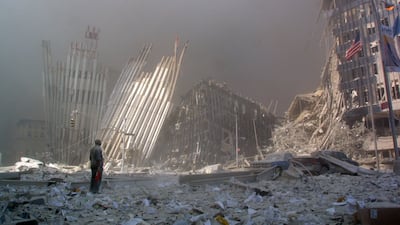
A man calling out asking if anyone alive trapped amid the rubble needs help after the collapse of the first tower on 9/11. AFP -
Marcy Borders, known as the 9/11 Dust Lady, seeks refuge in an office building after the twin towers collapsed. AFP -
Former US president George W Bush with firefighter Bob Beckwith and other rescue workers on September 14, 2001, at the site of the destroyed World Trade Centre. AFP -
Businessman Edward Fine, who survived the attack after walking down 87 floors of the WTC North Tower, is covered in ash as he walks through the debris. AFP -
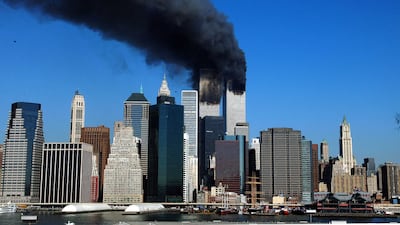
Smoke billows from the twin towers of the World Trade Centre after the hijacked planes crashed into them. AFP -
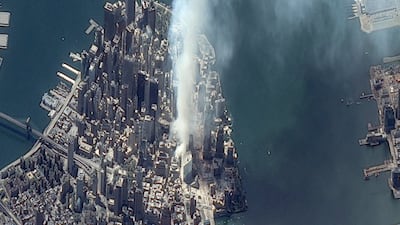
The collapse of the twin towers led to toxic dust, asbestos and glass fibres in the air, while underground fires smouldered at Ground Zero until December 2001. Reuters -
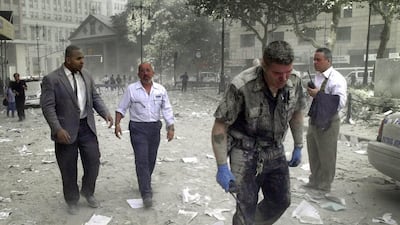
Debris covers streets including Park Row, which is nearly half a kilometre away from Ground Zero, after the towers collapsed. AFP -
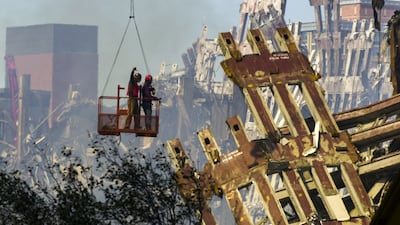
Workmen begin dismantling the destroyed remains of the World Trade Centre on September 17, 2001. EPA


Mr Pfaff described everything that has happened in the region since the invasion of Iraq as "basically a tit-for-tat cycle”, with every new attempt to leave inadvertently causing a reason to return, such as the US withdrawal from Iraq in 2011, fuelling the conditions for the rise of ISIS, which emerged from Al Qaeda's Iraqi branch. Another twist: Bin Laden's terror group was not active in the country until after the US-led invasion.
9/11's continuing costs
On September 11, 2001, 19 hijackers used passenger jets to kill 2,977 people in New York, at the Pentagon and in Pennsylvania.
The US responded by invading Afghanistan and toppling the Taliban government, which had been harbouring Al Qaeda. The Bush administration then quickly shifted its attention to Iraq, a country that had played no role in 9/11, claiming Saddam was stockpiling weapons of mass destruction.
The costs of those early interventions are still accumulating today.
According to Brown University's Watson School of International and Public Affairs, which has spent years tracking the costs of the post-9/11 wars, the US has spent or is obliged to spend about $8 trillion on military intervention and associated costs. That figure does not include interest payments on borrowing to fund the wars.
Brown says it has also tallied that at least 940,000 people have died due to direct war violence, including civilians, armed forces on all sides, contractors, journalists and humanitarian workers.
Beyond this are the harder-to-quantify costs to America. A quarter of a century of Middle East military engagements has drained resources and affected readiness in other possible theatres of conflict.
Retired rear admiral Mark Montgomery, a former senior Pentagon official, says the US is not as prepared for any challenges from China and Russia as it should be.
“We now really face a simultaneity problem,” Mr Montgomery said. “We need to be ready for multiple theatres simultaneously.”
He gave as an example the recent posting of the USS Abraham Lincoln carrier strike group to the Middle East to fight Iran, saying the war is using naval capacity that had been intended for Indo-Pacific deterrence.
The Lincoln was supposed to be sent to the Indo-Pacific from January until June this year, but ended up on an extended mission in the Middle East. The strike group has been relieved by the USS George Washington, which was also supposed to go to Asia.
Mr Montgomery, who is now a senior fellow at Washington's FDD think tank, estimated the resulting gap could ultimately mean there would be no aircraft carrier in the Indo-Pacific for about 18 months, after factoring in subsequent rotations and maintenance.
“So that means you both fail to deter China, and almost as importantly … failed to assure your Asian partners, Japan, Taiwan, and Korea, in the Philippines, in Singapore, in Australia," he said. “These deployments to the Middle East are so straining and so taxing."

For Iraqis, however, the consequences of a seemingly endless cycle of conflict is not measured by levels of readiness.
Marsin Alshamary, an Iraq expert at Boston College who lived in the country from 2020 to 2023, said she had watched Iraq make tentative progress before the latest regional conflict again exposed how difficult it was for the country to escape the region's wider wars.
“We had that brief moment in Iraq where people were kind of catching their breath and hoping for a better future,” she said. “And then you just feel the weight of the inevitability of the regional war getting to you.”
Ms Alshamary said US and Israeli policies that favour regional states incapable of challenging Israel have helped to perpetuate the security vacuums in which armed groups flourish.
Unless the US overhauls its policy for the region, it is entirely possible that it will remain locked into the Middle East as it marks 50 years since 9/11, she said.
"If it doesn't change ... 25 years pass by in the blink of an eye," Ms Alshamary said. "In a way, I wouldn't be surprised to see us in a similar position."

