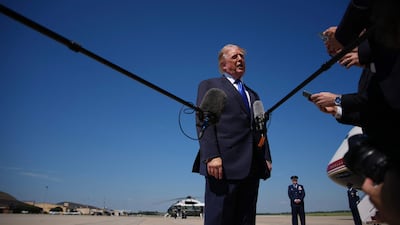

President Donald Trump said the war with Iran would end “immediately” after the US midterm elections, as Iranian attacks reportedly damaged several US military aircraft at a base in Jordan.
Mr Trump, who was travelling to Dallas, Texas, to attend a Republican midterm convention, also said energy prices would begin falling after the election.
“I think the war is going to end immediately after the election” on November 3, he told reporters.
He suggested that Tehran was trying to prolong the conflict as a way of keeping fuel prices high in the run-up to the election.
"They'd like to have it that way," Mr Trump said. "But right after the election, oil prices are going to be tumbling downward.”
The comments mark a shift from his earlier statements about the expected duration of the conflict. When he launched the war alongside Israel on February 28, he said he expected it to last only a few weeks. The conflict has now continued for more than six months.
Several US military aircraft were damaged in Iranian strikes on the Muwaffaq Salti air base in Jordan, CBS reported. About eight F-15 fighter jets sustained light damage but were returned to service, while an A-10 Thunderbolt was struck and lost a wing. No US deaths were reported.
The attack followed American strikes on five Iranian oil tankers on Tuesday, which Washington said came in response to Iran's attempted attacks on US warships. Iran's Islamic Revolutionary Guard Corps said it had struck eight tankers and two warships, as well as US assets at the Jordanian base. US forces defending Jordan fired more than 30 Patriot interceptors during the attack, CBS reported.
Iran's ability to put a chokehold on the Strait of Hormuz, through which a fifth of global supply of fuel once flowed, has emerged as the major sticking point in the conflict.
Vessel traffic through the strategic waterway fell on Wednesday, with seven transits recorded, down from 12 the previous day and below the 10-day average of 14, according to initial Kpler data. Four vessels exited the strait and three entered. The figures may not capture ships sailing with their transponders switched off.
When asked why the war would end after the election, Mr Trump said Iran’s leaders were “desperate” to influence the results.
He also said the US was no longer seeking a negotiated end to the war, although he left open the possibility that talks could take place.
“Originally, I wanted to make a deal. We're so far down the line, they have very little country left right now, so we're not looking for it,” he said. “Yes, a negotiation could possibly happen but it's not something we're looking at.”
Explosions were reported early on Thursday in the coastal areas of Sirik and Minab in Iran's Hormozgan province, near the Strait of Hormuz, according to the Tasnim news agency. Sounds of blasts were also heard on nearby Qeshm Island. Authorities said the sounds heard on Qeshm came from the direction of the sea. No casualties or damage were immediately reported.
Oil prices have risen sharply during the conflict. Brent crude rose above $100 a barrel on Wednesday for the first time in six weeks, as fighting and disruptions around the Strait of Hormuz raised concerns over global supplies.
Higher energy and living costs are a key economic concern for Americans before the midterm elections, in which control of Congress is at stake.
Mr Trump campaigned on promises of lower costs and has repeatedly blamed inflation on his predecessor, Joe Biden.
His handling of the economy and the war in Iran have dented his approval ratings, which are about 33 per cent, polls show.
Mr Trump said petrol prices will eventually fall below $2 a gallon (52 cents a litre). The national average is currently above $4.
The conflict is also widening across the region. Pakistan delivered a Saudi warning to Iran to rein in Yemen's Houthi rebels after they stepped up attacks on the kingdom, Reuters reported, citing Saudi, Pakistani and Iranian sources.
The Iran-backed Houthis struck an airbase and oil infrastructure in Saudi Arabia on Tuesday, wounding at least 73 people. Saudi Arabia responded with 54 air strikes across Yemen, according to the Houthis. A senior regional diplomat said Pakistan delivered the warning to Tehran on Tuesday. An Iranian official confirmed receiving the message but said: “Iran does not control the Houthis.”
Two Iranian sources said Tehran had instructed the Houthis last week to attack Saudi Arabia and promised additional funding and weapons. Pakistan has a defence pact with Saudi Arabia and Turkey, with Defence Minister Khawaja Asif warning an attack on one would be treated as an attack on all three. Islamabad said it would pursue a diplomatic solution for now.
The Houthis launched further attacks on southern Saudi Arabia on Wednesday, with the Saudi-led coalition saying the militia fired ballistic missiles and drones at Khamis Mushait, Abha and Jazan. Maj Gen Turki Al Malki, spokesman for the coalition supporting Yemen's internationally recognised government, said the attacks would be dealt with in accordance with the principle of self-defence under international law.