

The ceasefire between Israel and Iran marks a dramatic culmination of events that have urgently reshaped the geopolitics of the Middle East, leaving many wondering what US President Donald Trump's next moves might be in the region.
His first order of business will be to shore up the fragile truce, which came after the US joined Israel in bombing Iran by striking three nuclear sites at the weekend. Israel also wiped out many of Iran's air defences and hit its senior commanders and officers.
Mr Trump on Wednesday said the US and Iran would hold talks next week, raising hopes for a durable peace between Israel and Iran, two rivals that have spent decades waging a rhetorical war that frequently saw Iran strike at Israeli or western interests through an array of proxy groups.
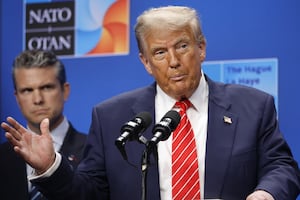
“We may sign an agreement, I don’t know,” Mr Trump said at a Nato summit in The Hague. “The way I look at it, they fought, the war is done."
Iran, however, insists it will retain its nuclear programme and appears set to halt co-operation with the UN's International Atomic Energy Agency.
Alex Vatanka, a senior fellow at the Middle East Institute, highlighted the unpredictability of Iran's actions and how these might shape the Trump administration's Middle East policies.
He said Mr Trump has made a strategic bet that military force will shock the Iranians and force them into making the concessions he wants.
"He might be right, he might be wrong. Last time he took a strategic bet like this, in 2018 when he pulled out of the [2015 nuclear deal], his gamble didn't work out, and Iran enriched more and more. In fact, it started acting [more aggressively] in the region," Mr Vatanka told The National.
Before this month's war between Israel and Iran, the Trump administration had been working on a ceasefire deal between Israel and Hamas in Gaza.
The Israel-Iran ceasefire will now help that deal come to fruition and secure the release of hostages in Gaza, Mr Trump said on Wednesday, amid reports that talks had picked up pace in Egypt.
"It helped a little and showed a lot of power … we were very close to making a deal in Gaza … I think this helped, yes," he said.
Iran's nuclear capabilities and its "malign activities", including the funding of proxy groups, have dominated foreign policy conversations and think tank research in Washington for decades.
The apparent end of Iran's nuclear programme and the erosion of groups such as Hezbollah and Hamas leaves an opening for the US to focus more on what it wants from the Middle East, namely investment and trade deals and an expansion of the Abraham Accords, as shown by the US President's trip to Saudi Arabia, Qatar and the UAE last month.
"If Trump can do that, then you can see a region emerging where the focus is on economic development integration, where non-state actors backed by Iran are sidelined," Mr Vatanka said.
He said Arab states could gain more leeway to try to persuade the transactional Mr Trump to begin to support a two-state solution for the Israeli-Palestinian conflict.
Some Iran watchers have warned that Tehran is unlikely to move quietly into peaceful coexistence with Israel and is going to accelerate its nuclear programme to develop a bomb.
"But racing to the bomb is not so simple," noted David Makovsky, director of the Koret Project on Arab-Israel Relations at the Washington Institute for Near East Policy. "It presupposes that they have the resources and that the world is so distracted that they will let them do that. And I don't see that at this time."

Mr Makovsky told The National that some estimates put the total cost of Iran's nuclear programme and sanctions against the regime at about $500 billion. "Not a good investment for the Iranian taxpayer," he said.
Experts predict some sort of shift within Iran's ruling power structure, although not necessarily regime change. After the US strikes, Mr Trump on Sunday asked "why wouldn't there be a regime change" in Iran, but on Tuesday he said he opposed such an outcome as it would invite chaos.
Enia Krivine, who runs the Foundation for Defence of Democracies' Israel Programme, said Israel and Mr Trump are going to focus on normalisation, in which Arab and other Muslim-majority countries will begin to establish ties with Israel.
She also predicted that Mr Trump would use the US air strikes in Iran to push Israeli Prime Minister Benjamin Netanyahu to end the war in Gaza.
"There's going to be a lot of pressure on Israel to come to some sort of conclusion in Gaza that everyone can live with," Ms Krivine told The National. "There's probably going to be some trade-off for Trump's operation over Iran. He's a very transactional president, for better or worse."


