

In his first address to a joint session of Congress this month, US President Donald Trump delivered a paradox wrapped in a proclamation: he announced the end of government censorship and proclaimed the restoration of free speech – a declaration that soon revealed its inherent contradictions.
“I’ve stopped all government censorship and brought back free speech in America,” Mr Trump declared with certitude. “It’s back.”
Earlier in the day, however, he had sharpened his arrows and taken aim at educational institutions that permitted what he called “illegal protests”, with a particular focus on those related to Israel, Palestine and the war in Gaza.
The official reason cited for this targeting was the universities' “continued inaction in the face of persistent harassment of Jewish students".
'Fear starts to penetrate'
The first educational institution to feel the impact of this new policy was Columbia University, which suffered a swift and severe $400 million cut in federal funding.
And the first person to come into the administration's crosshairs was Mahmoud Khalil, who was detained by federal immigration authorities last weekend.
As the lead negotiator between protesting students and the university administration, the former Columbia student and Palestinian refugee – now a US resident – was one of the most visible activists in last year’s campus protest movement.
Mr Khalil and his wife, an American citizen, were returning from an evening out when agents forced their way into the lobby of the university owned apartment building in Manhattan.
One told Mr Khalil's lawyer by phone that they were carrying out a State Department order to revoke his student visa. Informed that Mr Khalil was a permanent US resident with a green card, the agent said they were revoking that, too.
The White House posted a picture of Mr Khalil with the caption “Shalom, Mahmoud” on its X account celebrating his arrest.
Supporters of Mr Trump’s policy argue it is a necessary step to protect Jewish students from anti-Semitism, which is often masked by political critiques of Israel.
Critics argue that the administration's actions threaten the very foundation of academic freedom, using federal funding as a lever to impose a narrow political agenda.
A source familiar with the situation and the inner workings of Columbia, who spoke to The National on condition of anonymity, criticised the lack of transparency and questioned the motives behind the case against Mr Khalil.
“What has this student done, exactly? What is he accused of? Isn't this a question that we should ask ourselves?” the source said.
The source argued that Mr Khalil’s role in protests has been grossly misinterpreted.
“If anything, the university should say, ‘you have done what every student should have done’. He worked as a mediator between the administration of Columbia and the students, and that's exactly what you want to do."
-
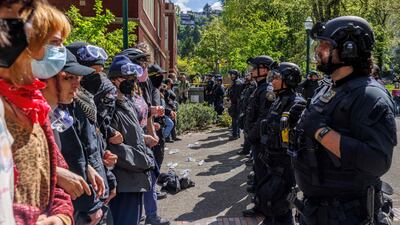
Students and activists protesting against the Gaza war face police after demonstrators were evicted from the library at Portland State University in Oregon. AFP -

A car is damaged after it was driven towards protesters at Portland State University. AFP -
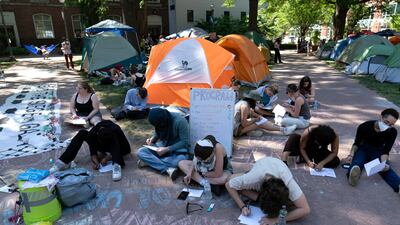
Students write letters in support of Palestinians in Gaza at an encampment at George Washington University, in Washington. AP -
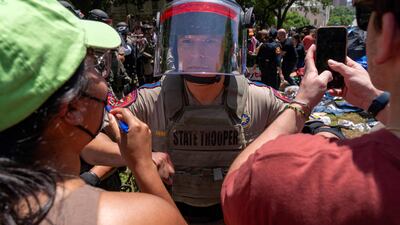
Pro-Palestinian protesters confront a state trooper at the University of Texas in Austin. AFP -
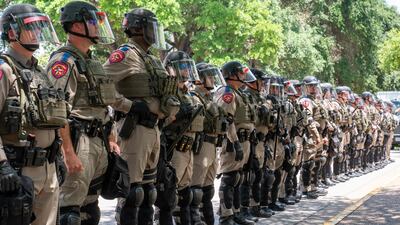
Texas State troopers stand guard at the University of Texas. AFP -
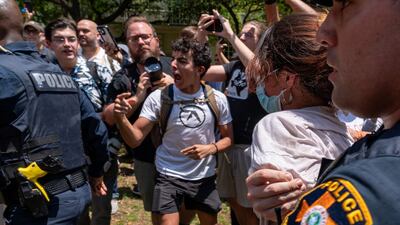
A protester confronts University of Texas police. AFP -

A demonstrator protests outside the encampment established in support of Palestinians in Gaza at Columbia University, in New York City. AFP -
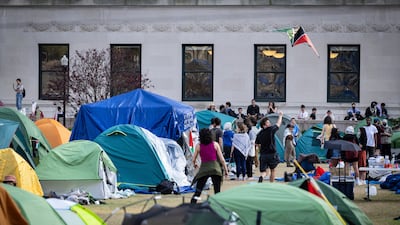
A student protester flies a kite inside the protest encampment at Columbia University. AP -
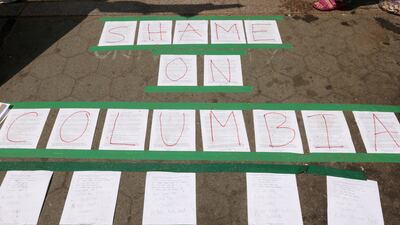
Students at Columbia University write a message as the conflict between Israel and Hamas continues. Reuters -
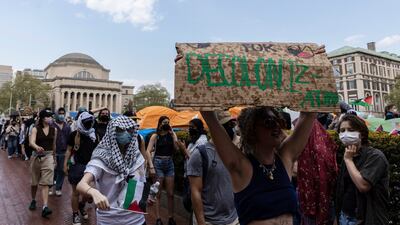
Student protesters march round their encampment at Columbia University. AP -
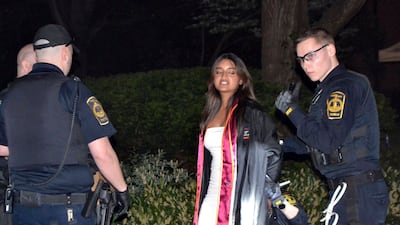
A student is arrested at a protest encampment on the Virginia Tech campus in Blacksburg. AP -
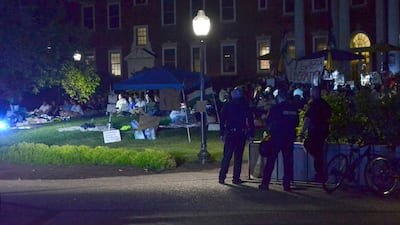
Police move to bring down an encampment after several days of protests by pro-Palestinian activists on the Virginia Tech campus. AP -

Vish Gill, a prominent figure at pro-Palestine protests, is arrested at Virginia Tech campus. AP -
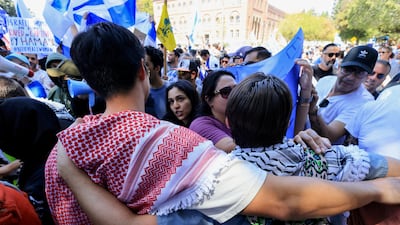
Pro-Israel counter-protesters gather at a pro-Palestine demonstration at the University of California, Los Angeles. Reuters -
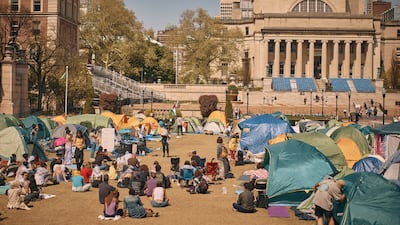
Pro-Palestine demonstrators gather on the campus of Columbia University. AP


The case has sent a chilling message to other international students.
“Mahmoud is used as an example,” the source explained. “What happens to the foreign students who are there [at Columbia and Barnard College] who have a student visa? Fear starts to penetrate. The fear of being punished, the fear of retaliation, and some of them cannot even go back to their countries.”
Columbia as 'ground zero'
Nadia Abu El Haj, an anthropology professor at Barnard College and Columbia University, described Columbia as “ground zero” for the battle over free speech.
She views the government's portrayal of widespread anti-Semitism on campuses as a calculated distortion.
“There's a narrative that has been allowed to fester, claiming that Jewish students are inherently unsafe on campus – this is not only untrue, its dangerously misleading,” she said. “This started a year and a half ago. We shouldn't have gotten here”.
In a campus-wide email sent on Monday and seen by The National, Katrina Armstrong, the university’s interim president, told students and faculty that Columbia “is taking the government’s action very seriously”.
“I want to assure the entire Columbia community that we are committed to working with the federal government to address their legitimate concerns. To that end, Columbia can, and will, continue to take serious action towards combating anti-Semitism on our campus," the email said.

The university has established an Office of Institutional Equity, whose stated goal is to "combat anti-Semitism and all forms of harassment and discrimination on campus".
On Thursday, Columbia announced that it has expelled or suspended some students who took over a campus building during pro-Palestinian protests last spring and had temporarily revoked the diplomas of others who have since graduated.
“An Ivy League university like Columbia, where the price of education per year is one of the highest, the dean has the responsibility to make sure that every student who pays such a price is safe on the campus. The line there is extremely fine between the two,” the source said.
A Barnard student, who spoke on condition of anonymity, told The National: “Being a member of this community and seeing everything happen first-hand has been a surreal and conflicting experience. I am appalled and burning with anger following the violent responses from administration and have evidently been feeling this feeling for a while.
"And despite my decreasing hope for change within the institution, I do feel comforted by the persistent actions of the student body. This is where my hope comes from.”
Another student told The National the environment is incredibly “toxic”.
'Be careful, but don't give up'
Alumni from Columbia's School of International and Public Affairs voiced their profound dismay over the detention of Mr Khalil and said in a statement that a day before being taken into custody by immigration authorities, Mr Khalil had sought the protection of university leadership – including that of interim president Ms Armstrong.
The alumni further criticised the university for its prolonged inaction over wrongful disciplinary charges against Mr Khalil, which were ultimately "proven baseless, leaving him exposed and vulnerable to abuse from the Trump administration”.
An official from Columbia University conveyed to The National that the institution firmly supports the protocols established by its Office of Institutional Equity.
“Columbia’s policies are consistent with guidance from the Office of Civil Rights which makes clear that all members have speech protections, until that speech crosses the line into discriminatory harassment,” the official said. “In responding to reports concerning speech or conduct regarding a country’s policies or practices, the office will consider whether such speech or conduct is an exercise of academic freedom and inquiry.”
The official pointed out that the office's policies were made public in the autumn to ensure students were informed.
"Imagine coming home after dinner and having multiple ICE agents and armoured cars come to your house, abduct you in the middle of night, shift you from New York to New Jersey, and then after your lawyers file a legal claim, move you out of the city [New York], out of this jurisdiction 1,000 miles away, where you don't have access to counsel or family," Baher Azmy, one of Mr Khalil's lawyers, said.
Mr Azmy also shared his advice for students hesitant about protesting due to potential repercussions.
“I think one should be cautious," he said. "One should know their rights, but one should not totally cow to fear unless we give in to this.”
As Mr Khalil's legal team gears up for a contentious fight, the academic community and its allies stand at a crossroads, confronting a challenge that could redefine the landscape of free speech and civil liberties on campuses across the nation.
The resolution of Mr Khalil's case may well dictate the future not only of individual students like him but also the very essence of academic freedom in an increasingly polarised America.

