


Live updates: Follow the latest on Israel-Gaza
President-elect Donald Trump is preparing to return to the White House, and Israeli settlers who have been hit with US sanctions are hoping their fortunes will turn under his leadership.
Mr Trump, who has described himself as Israel's “best friend”, has tapped former Arkansas governor Mike Huckabee, an evangelical preacher, and Marco Rubio, a foreign policy hawk, to be America's next ambassador to Israel and secretary of state.
“We are hopeful,” said Rachel Touitou, spokeswoman for the group Tsav 9, which had sanctions imposed by the administration of President Joe Biden in June for stopping humanitarian aid entering Gaza.
As the Israel-Gaza war continues to rage and attacks on Palestinians in the West Bank intensify, the Biden administration has tried to deter settler aggression by placing economic sanctions on a handful of Israelis.
In an executive order issued in February, Mr Biden said the “high levels of extremist settler violence, forced displacement of people and villages and property destruction” had reached “intolerable levels” that threaten the peace and stability of the West Bank, Gaza, Israel and the broader region.
Washington has now issued sanctions against 17 people and 14 entities over an array of violent acts and other problematic behaviour against Palestinians in the West Bank.
In the 14 months since the Gaza war began, violence in the West Bank has soared. The UN Office for the Co-ordination of Humanitarian Affairs says about 1,700 Palestinian Bedouin have been forced from their homes by Israeli settlers.
The Biden administration tried to stop such actions by issuing sanctions against people and the outposts they operate if they were identified as being especially violent or aggressive towards Palestinians. Among those sanctioned were Neriya Ben Pazi, Yinon Levy and Moshe Sharvit, who have been accused of attacking and harassing Palestinians.

This year, The National visited two of Mr Ben Pazi's farms, at least one of which has been placed under sanctions by the US. At the first site, we found a family of 10 living in a clapboard house, with farm equipment scattered across the hilltop.
A few kilometres away, down a rough track, we found Mr Ben Pazi working at a separate farm, where a new concrete home was being erected. He was building a pen when The National arrived.
He declined to comment but an American friend who was working alongside him spoke briefly to us, declining to identify himself.
“Neriya doesn't speak,” he said. “I have extensive experience with you guys [the media] – you guys are the champions of twisting and manipulating and lying. We have no desire whatsoever to speak to you guys. I have a lot more that I can say as an American citizen but I won't, besides the fact that I'm super ashamed by the conduct of my government.”
It is unclear how effective the sanctions have been in disrupting the behaviour of the settlers, but Reut Ben Haim, cofounder of Tsav9, said she felt the impact of the sanctions immediately.
“Right away, my credit cards were cancelled,” she told The National shortly after being sanctioned in June.
The mother of eight, whose husband is a US citizen, said the sanctions have complicated her life and made it more difficult for her to operate her business.
Ms Ben Haim said that for every transaction she makes, she has to go to the bank and prove its purpose, and she has to make sure that whoever she is paying is not a US citizen.
But she and other sanctioned Israelis may not have to deal with the pecuniary measures much longer: Mr Trump can wipe them away with the stroke of a pen.
“The sanctions that we have put in place are decisions by the executive branch, under authority given to us, in the State Department's case, and I believe it's true in the Treasury Department's case as well, by an executive order signed by the President,” State Department spokesman Matthew Miller told The National.
“Executive actions, unlike statutes, can be reversed by future executives, and executive orders issued by one president can be withdrawn by future presidents.”
While the incoming administration has yet to publicly address the sanctions against settlers, Mr Trump's choices to oversee the region suggest they may not be in place for much longer.
-
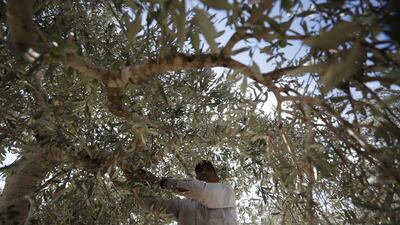
A Palestinian man picks olives during harvest season near Nablus, in the Israeli-occupied West Bank. Reuters -
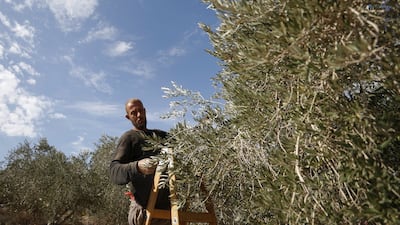
Olive trees are considered both a revered cultural emblem and an economic necessity for Palestinians. Reuters -
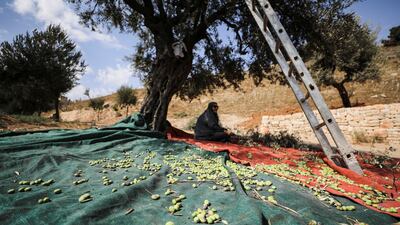
A Palestinian woman sits under an olive tree as others pick its olives in Jerusalem. Reuters -

Palestinian farmer Ibrahim Amar, 64, stands by the Seam Zone in Qaffin, in the occupied West Bank. Seam zones are sections of Palestinian land that have been designated by Israel as closed military areas. Tanya Habjouqa / Noor for The National -
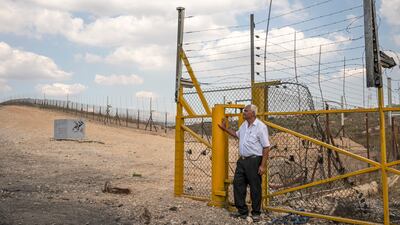
Palestinian farmer Mohammed Khasib, 65, by the Seam Zone in Qaffin. Tanya Habjouqa / Noor for The National -
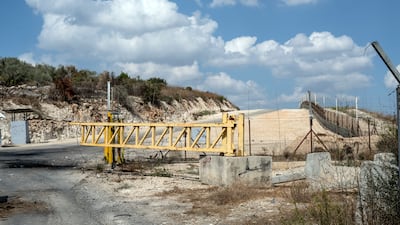
Israel has erected walls and gates to separate Palestinian farmers from their land. Tanya Habjouqa / Noor for The National -
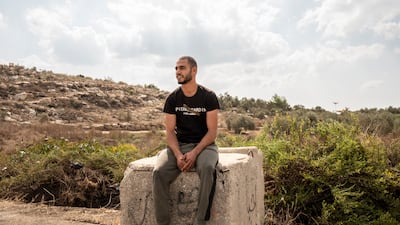
A Palestinian man outside a seam zone. Access to these Palestinian areas is controlled by an Israeli permit system. Tanya Habjouqa / Noor for The National -
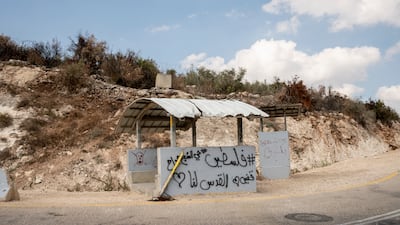
Palestinian graffiti on a stand used by Israeli soldiers in the seam zone in Qaffin. It reads in Arabic: 'Palestine, Sheikh Jarrah, Jerusalem is ours'. Tanya Habjouqa / Noor for The National -
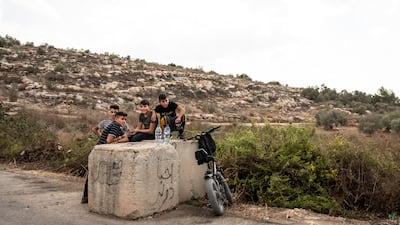
Young men and children hang around the seam zone to see if they will be allowed to help their family members, who have permits to access their farms in Qaffin, harvest their olives. Tanya Habjouqa / Noor for The National -
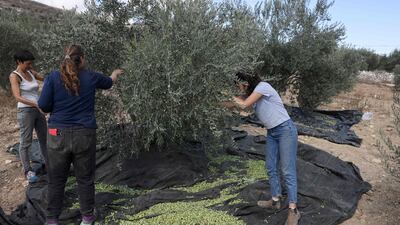
Activists from the Rabbis for Human Rights organisation help Palestinian farmers to harvest their olive trees near Nablus. AFP -

Palestinians walk alongside Israel's separation barrier after receiving special permission to harvest their olive trees, near Bait A'wa village, on the outskirts of the West Bank city of Hebron. AFP -
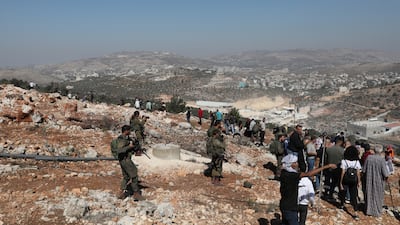
Israeli soldiers stand guard as volunteers and demonstrators help Palestinian farmers to pick their olives next to the Israeli outpost of Evitar, near Nablus. The volunteers picked the olives in solidarity with Palestinians, whose land was confiscated by Israeli settlers. EPA -
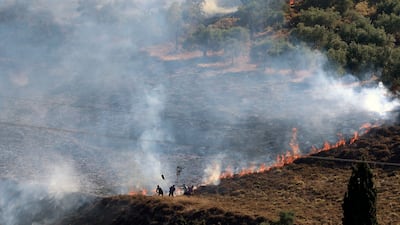
Palestinians extinguish a fire in a field around the village of Burin, south of Nablus, on June 29, 2021. AFP -
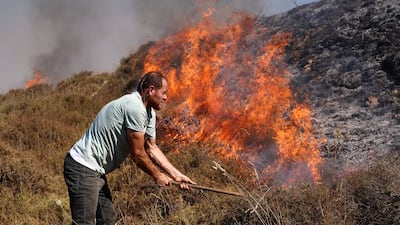
The field was set ablaze by Israelis from the settlement of Yitzhar, according to witnesses from the village council. AFP


In August, Mr Rubio, then a senator, wrote a letter to US Secretary of State Antony Blinken, ridiculing the Biden administration for imposing sanctions on Hashomer Yosh, an organisation that provides conscripts to illegal outposts in the West Bank, and Yitzhak Levi Filant, for being involved in “acts of violence” against Palestinians.
“Israel has a functioning judicial system that is fully capable of prosecuting crimes committed within its borders,” Mr Rubio wrote. “Instead of allowing Israel to carry out their duty to investigate and prosecute any alleged crimes, this administration continues to insert itself, in what many could only surmise as appeasing the progressives in the party.”
In the letter, he refers to the West Bank as Judea and Samaria, a biblical reference used by settlers to describe the area.
Mr Huckabee, Mr Trump's choice for ambassador to Israel, has also frequently referred to the area, which is home to an estimated three million Palestinians, by its biblical name. He has also claimed there is “no such thing as a Palestinian”.
The two leaders, who will probably help to steer American policy in the region, point to a return to the approach that Mr Trump took in his first term. He prides himself on being the “most pro-Israel” president in US history and upended decades of established policy in the region during his first term – and may well do the same in his second.
In 2017, Mr Trump broke with long-standing US policy and recognised Jerusalem as the capital of Israel. In 2019, then-secretary of state Mike Pompeo altered Washington's view of settlements – considered illegal under international law – by declaring them not “inconsistent” with international law.
Israeli settlers sanctioned by the Biden administration are banking on Mr Trump again showing that he is their country's best friend.

