

A key employee who labelled a doomed experimental submersible unsafe before its fatal voyage testified on Tuesday that he frequently clashed with OceanGate’s co-founder, felt the company was committed only to making money and said he had “no confidence” in the way the vessel was built.
David Lochridge, OceanGate’s former operations director, was one of the most highly anticipated witnesses to appear before a US commission trying to determine what caused the Titan to implode en route to the wreckage of the Titanic last year, killing all five on board.
His testimony echoed that of other former employees on Monday, one of whom described OceanGate head Stockton Rush as volatile and difficult to work with.
“The whole idea behind the company was to make money,” Mr Lochridge said. “There was very little in the way of science.”
Mr Lochridge referenced a 2018 report in which he raised safety issues about OceanGate operations. He said with all of the safety issues he saw, “there was no way I was signing off on this”.
Asked whether he had confidence in the way the Titan was being built, he said: “No confidence whatsoever.”
Mr Rush was among the five people who died in the implosion in July 2023. OceanGate owned the Titan and brought it on several dives to the Titanic going back to 2021.
Mr Lochridge's testimony began a day after other witnesses painted a picture of a troubled company that was impatient to get its unconventionally designed craft into the water. The accident set off a worldwide debate about the future of private undersea exploration.
The veteran engineer and submersible pilot who joined the company in the mid-2010s said he quickly came to feel he was being used to lend the company scientific credibility. He said he felt the company was selling him as part of the project “for people to come up and pay money” and that did not sit well with him.
“I was, I felt, a show pony,” he said. “I was made by the company to stand up there and do talks. It was difficult. I had to go up and do presentations. All of it.”
He eventually was fired after raising the safety concerns, he said.
-
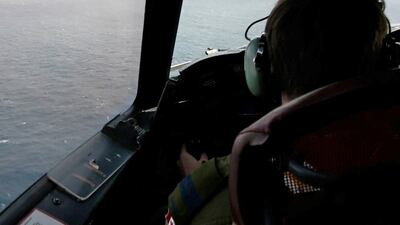
The pilot of a Royal Canadian Air Force maritime surveillance aircraft flies over the Atlantic during the search for the missing OceanGate submersible. Reuters -
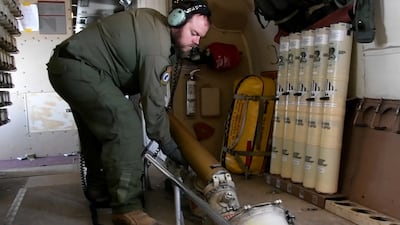
A Royal Canadian Air Force serviceman drops sonar buoys from a surveillance aircraft. Reuters -
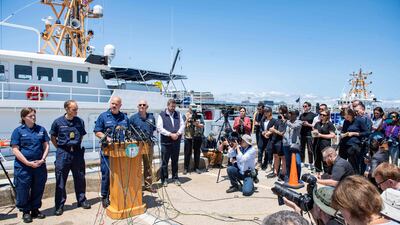
Capt Jamie Frederick of the US coastguard speaks to reporters about the search for the submersible, during a press conference in Boston, Massachusetts. AFP -
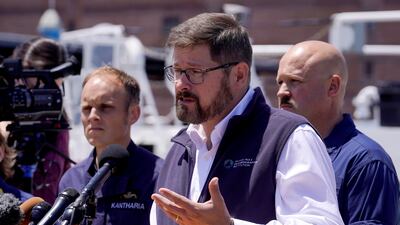
Carl Hartsfield, director and senior programme manager Oceanographic Systems Laboratory, faces reporters as Royal Navy Lt Cdr Rich Kantharia, left, and Capt Frederick look on during the news conference. AP -
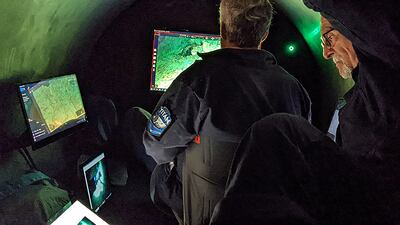
Inside the submersible vessel Titan on a previous dive. The vessel is used to visit the wreckage site of the Titanic. PA -
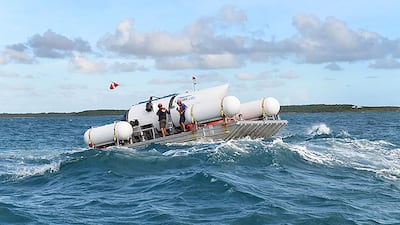
Titan went missing on a dive to the Titanic wreck site this week. PA -
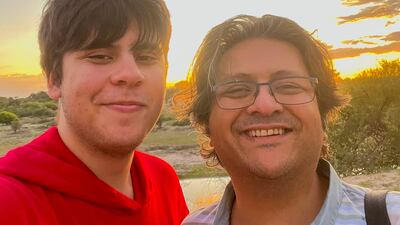
Businessman Shahzada Dawood, the vice-chairman of Karachi conglomerate Engro, and his son Suleman are on board the missing sub. AFP -
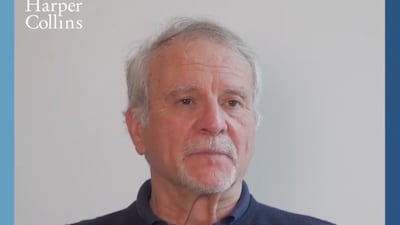
Paul-Henri Nargeolet, French explorer and director of a company that owns the rights to the Titanic wreck, is on board the submarine. Reuters -
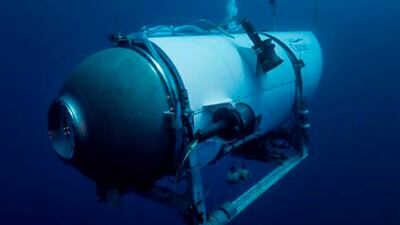
The Titan submersible was taking five people to view the wreck of the Titanic when it went missing. AP -
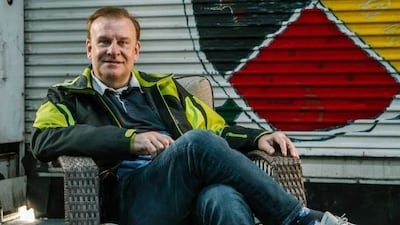
UAE-based British space explorer Hamish Harding posted this image of himself in Canada a day before the expedition. Photo: Instagram -
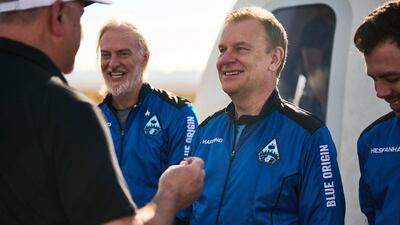
Mr Harding, a businessman, receives his Blue Origin astronaut pin after a successful flight to space in June 2022. AP -
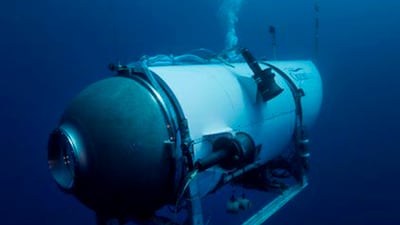
The submersible usually carries a pilot, three paying guests and a 'content expert'. It has enough oxygen for up to 96 hours. AP -

The Titanic sank on April 15, 1912, during its maiden voyage from Southampton to New York, killing more than 1,500 of the 2,200 passengers on board. Getty -
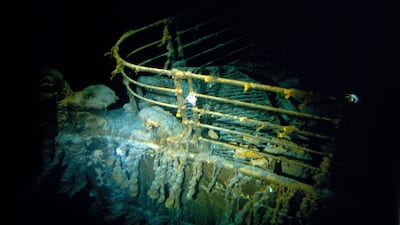
The wreck, which was located in 1985, sits 3,800 metres at the bottom of the Atlantic, about 600km off Newfoundland. AFP


“I didn’t want to lose my job. I wanted to do the Titanic. But to dive it safely. It was on my bucket list, too,” Mr Lochridge said.
OceanGate, based in Washington state, suspended its operations after the implosion.
The company's former engineering director, Tony Nissen, kicked off Monday's testimony, telling investigators he felt pressured to get the vessel ready to dive and refused to pilot it for a journey several years before Titan's last trip.
“I’m not getting in it,” Mr Nissen said he had told the late Mr Rush.
When asked if there was pressure to get Titan into the water, Mr Nissen responded: “100 per cent”.
But asked if he felt that the pressure compromised safety decisions and testing, he replied: “No. And that’s a difficult question to answer, because given infinite time and infinite budget, you could do infinite testing.”
During the submersible's final dive on June 18, 2023, the crew lost contact after an exchange of texts about the Titan's depth and weight as it descended.
When the submersible was reported overdue, rescuers rushed ships, planes and other equipment to an area about 700km south of St John’s, Newfoundland. Wreckage of the Titan was subsequently found on the ocean floor about 300 metres off the bow of the Titanic, coastguard officials said.


