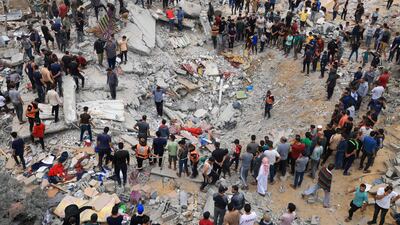
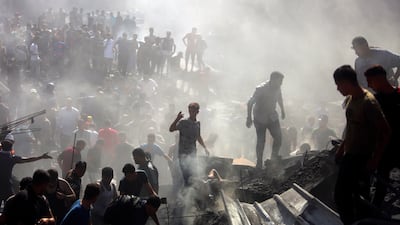
US Secretary of State Antony Blinken called the Gaza conflict 'extraordinarily complex'. AP

Blinken defends weapons pause as Israel lacks 'credible plan' to protect Rafah civilians


  • English
  • Arabic

US Secretary of State Antony Blinken on Sunday defended a decision to pause a weapons delivery to Israel over concerns they could be used in the Gazan city of Rafah, saying Israel lacked a “credible plan” to protect civilians there.

“We have real concerns about the way they [certain weapons] are used,” Mr Blinken told ABC News's This Week, adding that Israel needs to “have a clear, credible plan to protect civilians, which we haven't seen”.

“At present, the only thing that we've delayed and are holding back are these high-payload bombs, because we're in an continuing conversation with Israel, given the impact that those weapons can have when they're used in populated areas,” Mr Blinken told CBS's Face the Nation.

“When it comes to the use of weapons, concerns about incidents where, given the totality of the damage that's been done to children, women, men, it was reasonable to assess that in certain instances, Israel acted in ways that are not consistent with international humanitarian law.”

He also called the conflict “extraordinarily complex”, and said that it was difficult to determine “exactly what happened and to draw any conclusions” as to breaches of international law.

Mr Blinken declined to define a “red line” on Israel aid but said the US is in active conversations “about the provision of heavy or high-payload weapons”.

In a highly anticipated report sent to Congress on Friday, the State Department said that while Israel may have violated international law, the “provision of defence articles” can still continue.

The Secretary of State reiterated that US would not support a full-scale invasion of Rafah “in the absence of a credible plan to protect civilians”.

The Pentagon confirmed last week that it had paused a shipment of weapons to Israel amid an intensifying assault on Rafah. And President Joe Biden said he would halt other weapons transfers to Israel if it were to invade the southern Gaza city.

Netanyahu praises 'very important step' after seizing Rafah border crossing in Gaza – video

After weeks of threats, Israel issued evacuation orders to civilians in parts of Rafah last week and Israeli forces took over the Gazan side of the border crossing with Egypt.

Israel has insisted it must enter Rafah to achieve its goal of eliminating Hamas and freeing scores hostages taken into Gaza on October 7.

Despite the weapons hold, the US has maintained that Israel continues to need support in its continuing war against Hamas.

Mr Blinken said that in areas that Israel had previously cleared of Hamas elements, the militant group is regrouping, telling NBC's Meet the Press that the shared goal of the US and Israel is ensuring it cannot govern Gaza in the future.

“Israel's on the trajectory, potentially, to inherit an insurgency with many armed Hamas left, or if it leaves a vacuum filled by chaos filled by anarchy and probably refilled by Hamas,” he said.

“We've been talking to them about a much better way of getting an enduring result, enduring security in Gaza itself, and much more broadly in the region. Those conversations continue.”

He added that the US has been working with Israel as well as Arab countries and other partners on such a plan.

As to a potential ceasefire, he said that the quickest way to end the conflict would be “for Hamas to give up the hostages”.

“The fastest way to get hostages home is through an agreement and we're determined every single day to pursue that and to try to get it to happen.”

Talks on a ceasefire and a release of hostages ended in Cairo on Thursday without agreement after Israel said a proposal by Qatari and Egyptian mediators included unacceptable elements.

Hamas said on Friday that efforts to come to a deal were back to square one, with the White House saying it was trying to keep the sides engaged “if only virtually”.

Two hundred days of Israel Gaza war – in pictures

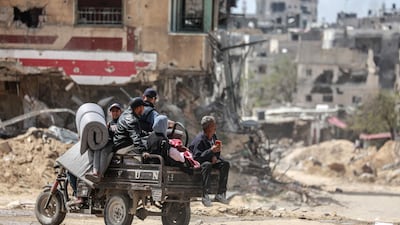
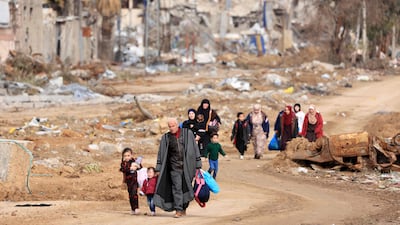
  • Palestinians move with their belongings on a road lined with destroyed buildings, in Khan Younis, in the south of the Gaza Strip, on April 22. AFP
    Palestinians move with their belongings on a road lined with destroyed buildings, in Khan Younis, in the south of the Gaza Strip, on April 22. AFP
  • An infant saved from the womb of her mother Sabreen Al Sheikh, who was killed in an Israeli strike along with her husband Shokri and her daughter Malak, lies in an incubator at Al Emirati hospital in Rafah, on April 21. Reuters
    An infant saved from the womb of her mother Sabreen Al Sheikh, who was killed in an Israeli strike along with her husband Shokri and her daughter Malak, lies in an incubator at Al Emirati hospital in Rafah, on April 21. Reuters
  • A man rides a bicycle, on April 2, past a damaged vehicle where employees from the World Central Kitchen non-profit, including foreigners, were killed in an Israeli air strike. Reuters
    A man rides a bicycle, on April 2, past a damaged vehicle where employees from the World Central Kitchen non-profit, including foreigners, were killed in an Israeli air strike. Reuters
  • A woman at the damaged Al Shifa Hospital, on April 1, after Israeli forces withdrew from the medical complex following a two-week siege. Reuters
    A woman at the damaged Al Shifa Hospital, on April 1, after Israeli forces withdrew from the medical complex following a two-week siege. Reuters
  • The view from a Jordanian flight dropping vital aid by parachute into Gaza, in March. Matthew Kynaston / The National
    The view from a Jordanian flight dropping vital aid by parachute into Gaza, in March. Matthew Kynaston / The National
  • Nozha Awad flees Al Shifa hospital with her triplet children, after an Israeli raid siege began at the medical complex, in March. Reuters
    Nozha Awad flees Al Shifa hospital with her triplet children, after an Israeli raid siege began at the medical complex, in March. Reuters
  • Palestinians gather to receive aid outside a UNRWA warehouse, in March. Reuters
    Palestinians gather to receive aid outside a UNRWA warehouse, in March. Reuters
  • A family end their fast amid the rubble of their destroyed home, during Ramadan in Rafah, in March. Reuters
    A family end their fast amid the rubble of their destroyed home, during Ramadan in Rafah, in March. Reuters
  • Wafaa Tabasi with her twin malnourished daughters, at Al Awda health centre in Rafah, in March. Reuters
    Wafaa Tabasi with her twin malnourished daughters, at Al Awda health centre in Rafah, in March. Reuters
  • Palestinians carry bags of flour taken from an aid lorry near an Israeli checkpoint in Gaza City, in February. Reuters
    Palestinians carry bags of flour taken from an aid lorry near an Israeli checkpoint in Gaza City, in February. Reuters
  • Fernando Simon Marman and Louis Hare, two Israeli hostages who, according to the Israeli military, were freed in a special forces operation in Rafah, reunite with loved ones at Sheba Medical Centre, in Ramat Gan, Israel, in February. Reuters
    Fernando Simon Marman and Louis Hare, two Israeli hostages who, according to the Israeli military, were freed in a special forces operation in Rafah, reunite with loved ones at Sheba Medical Centre, in Ramat Gan, Israel, in February. Reuters
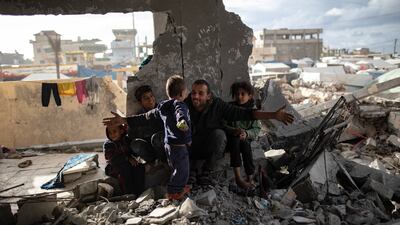
  • Palestinian Muhammad Al Durra with his children in the ruins of a house in Rafah where they sheltered on January 11, 2024. EPA
    Palestinian Muhammad Al Durra with his children in the ruins of a house in Rafah where they sheltered on January 11, 2024. EPA
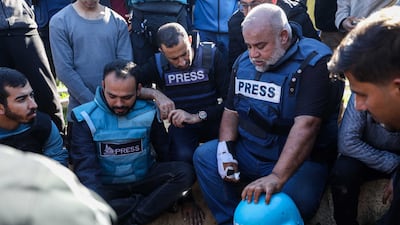
  • Family and friends at the funerals of journalists Hamza Al Dahdouh and Mustafa Thuraya on January 7, 2024 in Rafah, Gaza. Getty Images
    Family and friends at the funerals of journalists Hamza Al Dahdouh and Mustafa Thuraya on January 7, 2024 in Rafah, Gaza. Getty Images
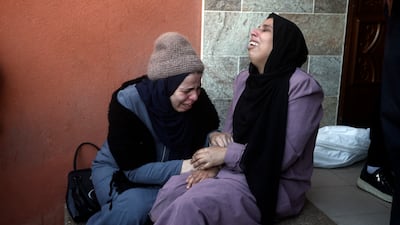
  • Palestinians mourn relatives killed by Israeli bombardment of the Gaza Strip outside a mortuary in Khan Younis January 4, 2024. AP Photo
    Palestinians mourn relatives killed by Israeli bombardment of the Gaza Strip outside a mortuary in Khan Younis January 4, 2024. AP Photo
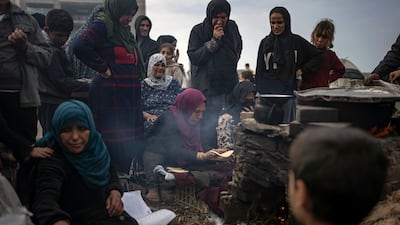
  • Displaced Palestinians queue to bake bread at a camp in the Muwasi area of Rafah, Gaza Strip, on December 23, 2023. AP Photo
    Displaced Palestinians queue to bake bread at a camp in the Muwasi area of Rafah, Gaza Strip, on December 23, 2023. AP Photo
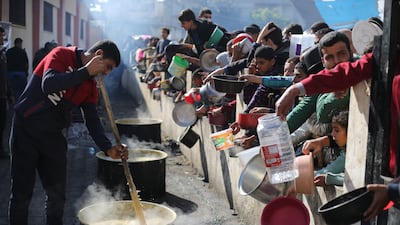
  • Palestinians queue for food in Rafah, the Gaza Strip, on December 20, 2023. AP Photo
    Palestinians queue for food in Rafah, the Gaza Strip, on December 20, 2023. AP Photo
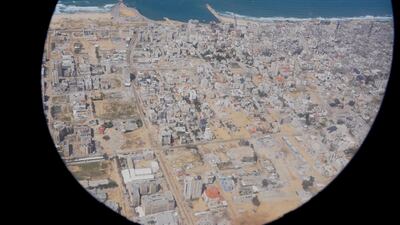
  • The ruins of Rafah on December 14, 2023. AFP
    The ruins of Rafah on December 14, 2023. AFP
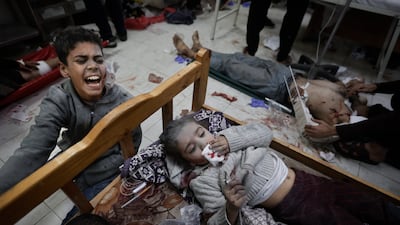
  • Palestinians wounded in the Israeli bombardment of the Gaza Strip arrive at a hospital in Khan Younis on December 8, 2023. AP Photo
    Palestinians wounded in the Israeli bombardment of the Gaza Strip arrive at a hospital in Khan Younis on December 8, 2023. AP Photo
  • Palestinians flee Israeli bombing along the Salaheddine Road in the Zeitoun district of Gaza city on November 28, 2023. AFP
    Palestinians flee Israeli bombing along the Salaheddine Road in the Zeitoun district of Gaza city on November 28, 2023. AFP
  • A Red Cross vehicle takes Israeli hostages from the Gaza Strip into Egypt in Rafah on November 25, 2023. AP
    A Red Cross vehicle takes Israeli hostages from the Gaza Strip into Egypt in Rafah on November 25, 2023. AP
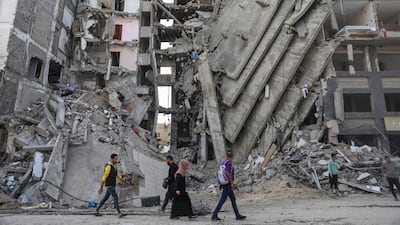
  • The ruins of buildings in Gaza city on November 24, 2023, as a temporary truce between Israel and Hamas took effect. AP Photo
    The ruins of buildings in Gaza city on November 24, 2023, as a temporary truce between Israel and Hamas took effect. AP Photo
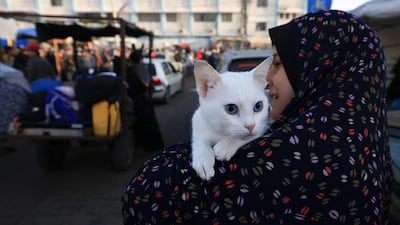
  • A woman and her cat return home to eastern Khan Younis in the southern Gaza Strip during the first hours of a four-day truce between Israel and Hamas forces on November 24, 2023. AFP
    A woman and her cat return home to eastern Khan Younis in the southern Gaza Strip during the first hours of a four-day truce between Israel and Hamas forces on November 24, 2023. AFP
  • Mourning the dead of Israeli bombardment outside the mortuary at Nasser Hospital in Khan Younis on November 14, 2023. AFP
    Mourning the dead of Israeli bombardment outside the mortuary at Nasser Hospital in Khan Younis on November 14, 2023. AFP
  • Civilians and rescuers look for survivors in the rubble of a building after Israeli bombing of Khan Younis in the southern Gaza Strip on November 12, 2023. AFP
    Civilians and rescuers look for survivors in the rubble of a building after Israeli bombing of Khan Younis in the southern Gaza Strip on November 12, 2023. AFP
  • November 7, 2023, a month to the day after Hamas attacked Israel, a victim of an Israeli bombardment in Rafah is moved from the rubble. AFP
    November 7, 2023, a month to the day after Hamas attacked Israel, a victim of an Israeli bombardment in Rafah is moved from the rubble. AFP
  • Searching the rubble after Israeli air strikes on the town of Khan Younis, southern Gaza Strip, on October 26, 2023. AP Photo
    Searching the rubble after Israeli air strikes on the town of Khan Younis, southern Gaza Strip, on October 26, 2023. AP Photo
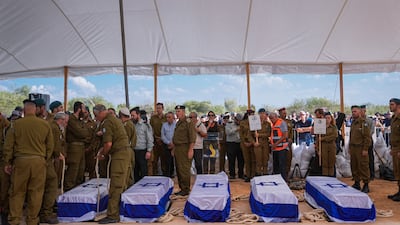
  • Mourning the Kotz family at their funeral in Gan Yavne, Israel, on October 17, 2023. AP Photo
    Mourning the Kotz family at their funeral in Gan Yavne, Israel, on October 17, 2023. AP Photo
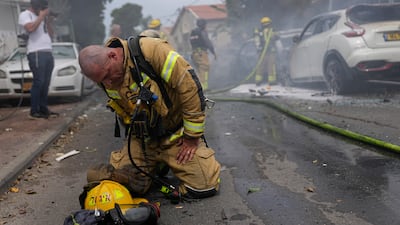
  • An Israeli firefighter composes himself after he and his colleagues extinguished cars set on fire by a rocket fired from the Gaza Strip in Ashkelon, Israel, on October 9, 2023. AP Photo
    An Israeli firefighter composes himself after he and his colleagues extinguished cars set on fire by a rocket fired from the Gaza Strip in Ashkelon, Israel, on October 9, 2023. AP Photo
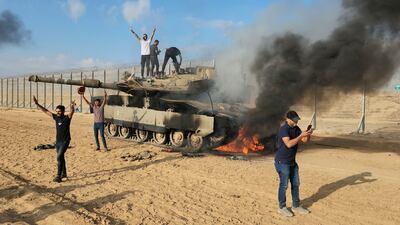
  • Palestinians with the wreckage of an Israeli tank at the Gaza Strip fence east of the city of Khan Younis on October 7, 2023, the day Hamas forces swept unopposed into Israel. AP Photo
    Palestinians with the wreckage of an Israeli tank at the Gaza Strip fence east of the city of Khan Younis on October 7, 2023, the day Hamas forces swept unopposed into Israel. AP Photo
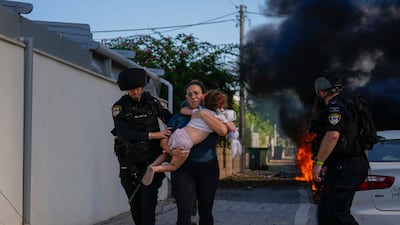
  • Israeli police officers evacuate a woman and a child from a site hit by a rocket fired from the Gaza Strip, in Ashkelon, southern Israel, on October 7, 2023. AP Photo
    Israeli police officers evacuate a woman and a child from a site hit by a rocket fired from the Gaza Strip, in Ashkelon, southern Israel, on October 7, 2023. AP Photo

Mercer, the investment consulting arm of US services company Marsh & McLennan, expects its wealth division to at least double its assets under management (AUM) in the Middle East as wealth in the region continues to grow despite economic headwinds, a company official said.

Mercer Wealth, which globally has $160 billion in AUM, plans to boost its AUM in the region to $2-$3bn in the next 2-3 years from the present $1bn, said Yasir AbuShaban, a Dubai-based principal with Mercer Wealth.

Within the next two to three years, we are looking at reaching $2 to $3 billion as a conservative estimate and we do see an opportunity to do so,” said Mr AbuShaban.

Mercer does not directly make investments, but allocates clients’ money they have discretion to, to professional asset managers. They also provide advice to clients.

“We have buying power. We can negotiate on their (client’s) behalf with asset managers to provide them lower fees than they otherwise would have to get on their own,” he added.

Mercer Wealth’s clients include sovereign wealth funds, family offices, and insurance companies among others.

From its office in Dubai, Mercer also looks after Africa, India and Turkey, where they also see opportunity for growth.

Wealth creation in Middle East and Africa (MEA) grew 8.5 per cent to $8.1 trillion last year from $7.5tn in 2015, higher than last year’s global average of 6 per cent and the second-highest growth in a region after Asia-Pacific which grew 9.9 per cent, according to consultancy Boston Consulting Group (BCG). In the region, where wealth grew just 1.9 per cent in 2015 compared with 2014, a pickup in oil prices has helped in wealth generation.

BCG is forecasting MEA wealth will rise to $12tn by 2021, growing at an annual average of 8 per cent.

Drivers of wealth generation in the region will be split evenly between new wealth creation and growth of performance of existing assets, according to BCG.

Another general trend in the region is clients’ looking for a comprehensive approach to investing, according to Mr AbuShaban.

“Institutional investors or some of the families are seeing a slowdown in the available capital they have to invest and in that sense they are looking at optimizing the way they manage their portfolios and making sure they are not investing haphazardly and different parts of their investment are working together,” said Mr AbuShaban.

Some clients also have a higher appetite for risk, given the low interest-rate environment that does not provide enough yield for some institutional investors. These clients are keen to invest in illiquid assets, such as private equity and infrastructure.

“What we have seen is a desire for higher returns in what has been a low-return environment specifically in various fixed income or bonds,” he said.

“In this environment, we have seen a de facto increase in the risk that clients are taking in things like illiquid investments, private equity investments, infrastructure and private debt, those kind of investments were higher illiquidity results in incrementally higher returns.”

The Abu Dhabi Investment Authority, one of the largest sovereign wealth funds, said in its 2016 report that has gradually increased its exposure in direct private equity and private credit transactions, mainly in Asian markets and especially in China and India. The authority’s private equity department focused on structured equities owing to “their defensive characteristics.”

The bio

Date of Birth: April 25, 1993
Place of Birth: Dubai, UAE
Marital Status: Single
School: Al Sufouh in Jumeirah, Dubai
University: Emirates Airline National Cadet Programme and Hamdan University
Job Title: Pilot, First Officer
Number of hours flying in a Boeing 777: 1,200
Number of flights: Approximately 300
Hobbies: Exercising
Nicest destination: Milan, New Zealand, Seattle for shopping
Least nice destination: Kabul, but someone has to do it. It’s not scary but at least you can tick the box that you’ve been
Favourite place to visit: Dubai, there’s no place like home

The burning issue

The internal combustion engine is facing a watershed moment – major manufacturer Volvo is to stop producing petroleum-powered vehicles by 2021 and countries in Europe, including the UK, have vowed to ban their sale before 2040. The National takes a look at the story of one of the most successful technologies of the last 100 years and how it has impacted life in the UAE. 

Read part four: an affection for classic cars lives on

Read part three: the age of the electric vehicle begins

Read part one: how cars came to the UAE


TRAINING FOR TOKYO

A typical week's training for Sebastian, who is competing at the ITU Abu Dhabi World Triathlon on March 8-9:

  • Four swim sessions (14km)
  • Three bike sessions (200km)
  • Four run sessions (45km)
  • Two strength and conditioning session (two hours)
  • One session therapy session at DISC Dubai
  • Two-three hours of stretching and self-maintenance of the body

ITU Abu Dhabi World Triathlon

For more information go to www.abudhabi.triathlon.org.

LAST 16

SEEDS

Liverpool, Manchester City, Barcelona, Paris St-Germain, Bayern Munich, RB Leipzig, Valencia, Juventus

PLUS

Real Madrid, Tottenham, Atalanta, Atletico Madrid, Napoli, Borussia Dortmund, Lyon, Chelsea

Dr Afridi's warning signs of digital addiction

Spending an excessive amount of time on the phone.

Neglecting personal, social, or academic responsibilities.

Losing interest in other activities or hobbies that were once enjoyed.

Having withdrawal symptoms like feeling anxious, restless, or upset when the technology is not available.

Experiencing sleep disturbances or changes in sleep patterns.

What are the guidelines?

Under 18 months: Avoid screen time altogether, except for video chatting with family.

Aged 18-24 months: If screens are introduced, it should be high-quality content watched with a caregiver to help the child understand what they are seeing.

Aged 2-5 years: Limit to one-hour per day of high-quality programming, with co-viewing whenever possible.

Aged 6-12 years: Set consistent limits on screen time to ensure it does not interfere with sleep, physical activity, or social interactions.

Teenagers: Encourage a balanced approach – screens should not replace sleep, exercise, or face-to-face socialisation.

Source: American Paediatric Association
The specs: Rolls-Royce Cullinan

Price, base: Dh1 million (estimate)

Engine: 6.75-litre twin-turbo V12

Transmission: Eight-speed automatic

Power: 563hp @ 5,000rpm

Torque: 850Nm @ 1,600rpm

Fuel economy, combined: 15L / 100km

Avatar: Fire and Ash

Director: James Cameron

Starring: Sam Worthington, Sigourney Weaver, Zoe Saldana

Rating: 4.5/5

The specs

Engine: Four electric motors, one at each wheel

Power: 579hp

Torque: 859Nm

Transmission: Single-speed automatic

Price: From Dh825,900

On sale: Now

The burning issue

The internal combustion engine is facing a watershed moment – major manufacturer Volvo is to stop producing petroleum-powered vehicles by 2021 and countries in Europe, including the UK, have vowed to ban their sale before 2040. The National takes a look at the story of one of the most successful technologies of the last 100 years and how it has impacted life in the UAE.

Read part three: the age of the electric vehicle begins

Read part two: how climate change drove the race for an alternative 

Read part one: how cars came to the UAE

COMPANY%20PROFILE%20
%3Cp%3EName%3A%20DarDoc%3Cbr%3EBased%3A%20Abu%20Dhabi%3Cbr%3EFounders%3A%20Samer%20Masri%2C%20Keswin%20Suresh%3Cbr%3ESector%3A%20HealthTech%3Cbr%3ETotal%20funding%3A%20%24800%2C000%3Cbr%3EInvestors%3A%20Flat6Labs%2C%20angel%20investors%20%2B%20Incubated%20by%20Hub71%2C%20Abu%20Dhabi's%20Department%20of%20Health%3Cbr%3ENumber%20of%20employees%3A%2010%3C%2Fp%3E%0A
In-demand jobs and monthly salaries
  • Technology expert in robotics and automation: Dh20,000 to Dh40,000 
  • Energy engineer: Dh25,000 to Dh30,000 
  • Production engineer: Dh30,000 to Dh40,000 
  • Data-driven supply chain management professional: Dh30,000 to Dh50,000 
  • HR leader: Dh40,000 to Dh60,000 
  • Engineering leader: Dh30,000 to Dh55,000 
  • Project manager: Dh55,000 to Dh65,000 
  • Senior reservoir engineer: Dh40,000 to Dh55,000 
  • Senior drilling engineer: Dh38,000 to Dh46,000 
  • Senior process engineer: Dh28,000 to Dh38,000 
  • Senior maintenance engineer: Dh22,000 to Dh34,000 
  • Field engineer: Dh6,500 to Dh7,500
  • Field supervisor: Dh9,000 to Dh12,000
  • Field operator: Dh5,000 to Dh7,000
Key figures in the life of the fort

Sheikh Dhiyab bin Isa (ruled 1761-1793) Built Qasr Al Hosn as a watchtower to guard over the only freshwater well on Abu Dhabi island.

Sheikh Shakhbut bin Dhiyab (ruled 1793-1816) Expanded the tower into a small fort and transferred his ruling place of residence from Liwa Oasis to the fort on the island.

Sheikh Tahnoon bin Shakhbut (ruled 1818-1833) Expanded Qasr Al Hosn further as Abu Dhabi grew from a small village of palm huts to a town of more than 5,000 inhabitants.

Sheikh Khalifa bin Shakhbut (ruled 1833-1845) Repaired and fortified the fort.

Sheikh Saeed bin Tahnoon (ruled 1845-1855) Turned Qasr Al Hosn into a strong two-storied structure.

Sheikh Zayed bin Khalifa (ruled 1855-1909) Expanded Qasr Al Hosn further to reflect the emirate's increasing prominence.

Sheikh Shakhbut bin Sultan (ruled 1928-1966) Renovated and enlarged Qasr Al Hosn, adding a decorative arch and two new villas.

Sheikh Zayed bin Sultan (ruled 1966-2004) Moved the royal residence to Al Manhal palace and kept his diwan at Qasr Al Hosn.

Sources: Jayanti Maitra, www.adach.ae

UAE v Ireland

1st ODI, UAE win by 6 wickets

2nd ODI, January 12

3rd ODI, January 14

4th ODI, January 16

The years Ramadan fell in May

1987

1954

1921

1888

Updated: May 12, 2024, 5:04 PM