


Live updates: Follow the latest on Israel-Gaza
It is end-of-year exams week for most university students in the US.
But for Yasmine, a Palestinian American second-year student, her only priority is maintaining the Gaza solidarity camp at George Washington University in the US capital.
“There's nothing more important right now, nothing,” Yasmine tells The National.
“There's an urgency to what's happening – everything else has to be pushed to the back burner.”
The student, 18, says her family is from the West Bank town of Jenin, and she feels it is her duty to do all she can to make her voice heard.
Yasmine, who attends Gallaudet University, is part of the Students for Justice in Palestine coalition in the Washington, Maryland and Virginia region.
Students from eight universities joined forces a week ago at George Washington University in solidarity with Gaza.
Like students at dozens of academic institutions across the US, they are demanding their universities divest from companies and colleges with ties to Israel.
They are also calling for the administration of President Joe Biden to secure a ceasefire in the war that has killed more than 34,500 people in Gaza, according to local health authorities, since the October 7 Hamas-led attacks.
Those attacks resulted in the deaths of 1,200 people in southern Israeli communities.
“We see right through what Biden says, it's an American [military] campaign as much as an Israeli one. We are not easily fooled,” Yasmine says.
She has been camped in one of more than a dozen tents pitched in the heart of the university's campus.
At the entrance, a statue of George Washington, the first US president, has been wrapped with a large Palestinian flag and a keffiyeh.
In the middle of the camp, metal barriers lay on top of each other with a Palestinian flag in the middle.
The student movement at George Washington has been supported by the community, with residents of the city donating money.
Several tents with food, water and snacks were laid out across the encampment.
The scene was starkly different than in New York City, where nearly 300 students and supporters were arrested on Tuesday night at Columbia University and City College.
Police officers in riot gear raided the two campuses at the request of university administrators.
“There is no angle from which to justify this,” Omar, a Palestinian-American former student of George Washington University, said of the arrests in New York.
“Arresting innocent kids standing up for humanity is just wrong on every level.”
Omar said he decided to join the camp after seeing images of children in Gaza carrying signs thanking the student protesters in the US.
First he cried, then he filled up his car with food and supplies and drove to the camp.
“It's the best thing we can do at this moment,” Omar said.
He grew up in Northern Virginia, and he has family in the West Bank city of Hebron. At least a dozen of his relatives have been killed in Gaza, he said.
Will Youmans, an associate professor at the George Washington's university's school of media and public affairs, says seeing Arab-American students taking part in the protests is a departure from the past.
The last generation was hesitant to take part in political protests, fearing their activism would be met with a heavy-handed police response and be viewed with suspicion and claims of extremism.
But over the past two decades, the Palestinian cause has been gathering the support of a broad range of students from all backgrounds.
“Arab-American students are feeling very empowered by the fact that it's not just Arab Americans, Palestinians at their side – it's a true solidarity,” Mr Youmans told The National.
Still, he says he is one of a few Arab-American professors at George Washington University.
He said an email the university president sent out days after October 7 mentioned only Israeli casualties, despite a growing toll of Palestinians.
“It struck me as extremely alienating, as an Arab American I felt that I wasn't represented at all,” he said.
“It always feels like an uphill battle as an Arab American.”
Police dismantle Los Angeles student encampment – in pictures
-
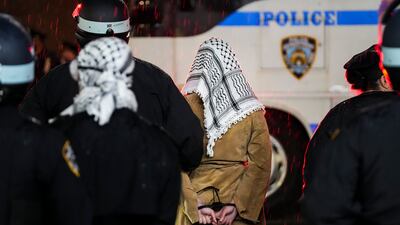
New York City police officers arrest a protester at Columbia University after student activists had barricaded themselves in the building. EPA -
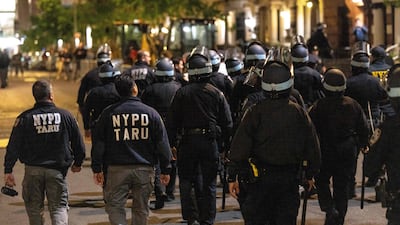
Students are opposing the university's investments in Israel and showing support for Palestinians, inspiring similar action at universities across the US and beyond. Getty Images -
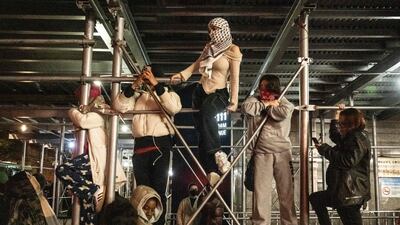
Protesters took over Hamilton Hall, renaming it Hind's Hall in honour of Hind Rajab, a 6-year-old Palestinian girl killed by the Israeli military in January. Getty Images -

The student encampment prepares for a police raid at Columbia University. AP -
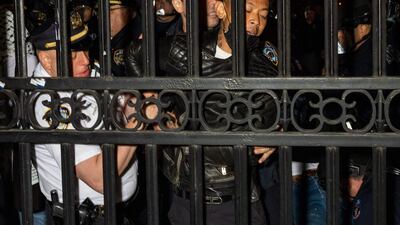
Police arrested nearly 100 people as they cleared the university of demonstrators who were issued a notice to disband their encampment. Getty Images -
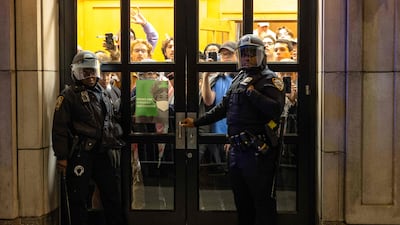
The protesters had said they planned on remaining in Hamilton Hall until the university met their demands. Getty Images -
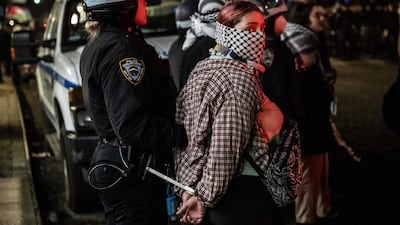
University president Minouche Shafik has requested the police maintain a presence on campus until May 17 at the earliest. Getty Images -
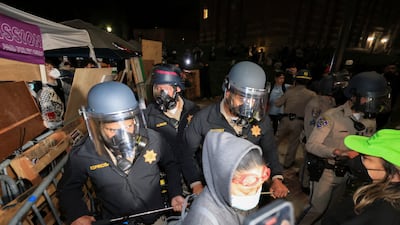
Police clear a student encampment, set up in support of Palestinians in Gaza, on campus at the University of California, Los Angeles. Reuters -

Counter-protesters clash with demonstrators at the University of California. Reuters -
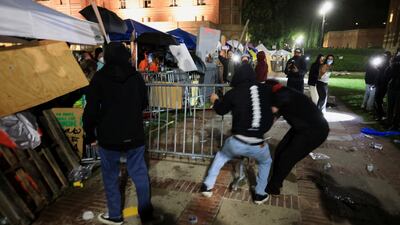
Students in the US are determined not to let up with their protests. Reuters



