Secretary of Defence Lloyd Austin said more must be done to ensure civilian safety. AP

Israel must do ‘a lot more’ before Rafah invasion, Pentagon chief says


Thomas Watkins
  • English
  • Arabic

Live updates: Follow the latest on Israel-Gaza

Israel must do much more to ensure civilian safety before pressing ahead with any invasion of Rafah, US Defence Secretary Lloyd Austin said on Tuesday, as the Pentagon indicated that such an offensive was still a way off.

Mr Austin's comments come after Prime Minister Benjamin Netanyahu said Israel would enter the southern Gaza city to destroy Hamas, with or without a ceasefire and hostage release deal.

More than one million Palestinians displaced by the war have sought refuge in Rafah since October 7 and the latest pressure from the US could force Israel to delay its invasion plans.

Mr Austin told the House Armed Services Committee that Israel had put some civilian safeguards in place, but stressed that these were inadequate.

Israel “must do what’s necessary to take care of these civilians that are not non-combatants and move them out of the battlespace, and take care of them wherever you move them to. And you have to allow sufficient time to do that appropriately,” Mr Austin said.

“I have seen them put some things in place, but you and I know that there’s a lot more that needs to be done before we can say that they’ve accounted for the civilians and taken care of them.”

Mr Austin said he had told Israeli counterparts that they must plan operations “sequentially”.

Protecting civilians “must be the first thing that must be done before they consider any other any other military operations”, he said.

Israel has approved military plans for its offensive and has positioned troops and tanks in the southern part of the country in apparent preparation for an invasion.

The timing, however, is unclear. A US defence official told The National that any invasion of Rafah did not appear to be on the immediate horizon.

“We are in constant contact with the Israelis on their plan for Rafah. We are not seeing anything imminent – they still have a very highly concentrated civilian population in Rafah,” the official said.

Israel has reaffirmed that it makes its own tactical decisions, but in reality, it can't afford to fall too far afoul of the US, its top military backer.

A satellite image shows an overview of a tent camp settlement near Rafah. Maxar Technologies / Reuters

State Department spokesman Vedant Patel said that any kind of Israeli action in Rafah would face stiff US resistance if civilians are not protected.

“It continues to be the case that we have not seen a credible plan that would address the areas of concerns,” Mr Patel said.

“Any kind of operation that does not address some of these key concerns will certainly be opposed by us.”

UN Secretary General Antonio Guterres on Tuesday urged Israel not to invade Rafah, saying it would “be an unbearable escalation, killing thousands more civilians and forcing hundreds of thousands to flee”.

Separately, Mr Austin acknowledged that US forces working on the humanitarian aid pier that will be attached to the Gaza shore could be shot at.

He said they have the right to protect themselves and shoot back, if needed. He also noted that Israeli forces on land would be conducting security for the area.

Israel targets Rafah with air strikes – in pictures

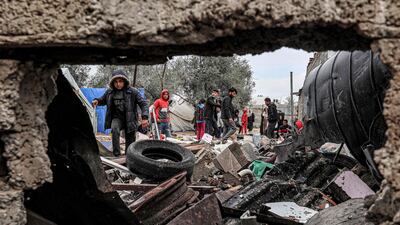
  • People inspect destroyed vehicles following deadly overnight Israeli bombardments of Rafah in the southern Gaza Strip. AFP
    People inspect destroyed vehicles following deadly overnight Israeli bombardments of Rafah in the southern Gaza Strip. AFP
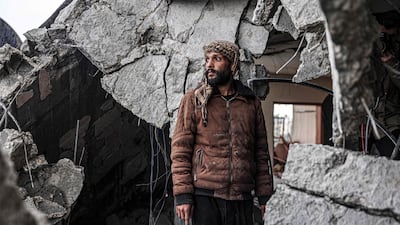
  • A man stands in the rubble of a building hit by overnight Israeli air strikes in Rafah, where more than a million Palestinians have sought shelter. AFP
    A man stands in the rubble of a building hit by overnight Israeli air strikes in Rafah, where more than a million Palestinians have sought shelter. AFP
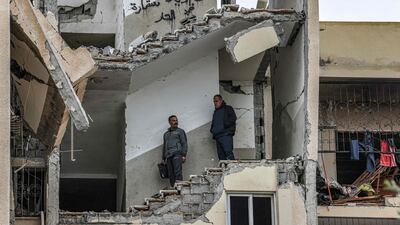
  • A building destroyed by overnight Israeli strikes on Rafah. AFP
    A building destroyed by overnight Israeli strikes on Rafah. AFP
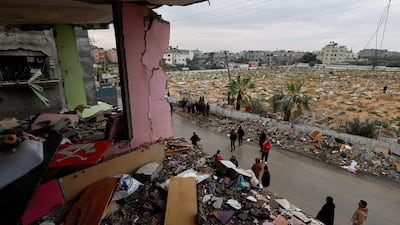
  • The heavy bombardment caused widespread panic in Rafah because many people were asleep. Some feared Israel had begun its anticipated ground offensive on the city. Reuters
    The heavy bombardment caused widespread panic in Rafah because many people were asleep. Some feared Israel had begun its anticipated ground offensive on the city. Reuters
  • A building destroyed by overnight Israeli strikes on Rafah. AP
    A building destroyed by overnight Israeli strikes on Rafah. AP
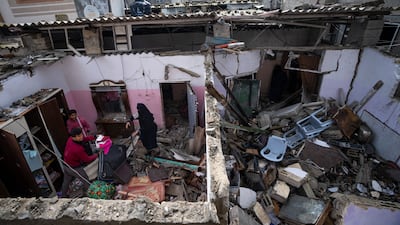
  • Displaced Palestinians inspect the remains of their shelters at the Rafah refugee camp following overnight Israeli strikes. AFP
    Displaced Palestinians inspect the remains of their shelters at the Rafah refugee camp following overnight Israeli strikes. AFP
  • Shelters erected outside a damaged apartment building in the Rafah refugee camp, where food, water and medicine are becoming increasingly scarce. AFP
    Shelters erected outside a damaged apartment building in the Rafah refugee camp, where food, water and medicine are becoming increasingly scarce. AFP
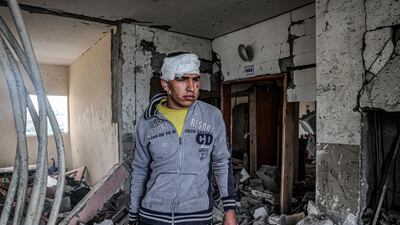
  • An injured boy inside a building damaged by overnight Israeli strikes on Rafah. AFP
    An injured boy inside a building damaged by overnight Israeli strikes on Rafah. AFP
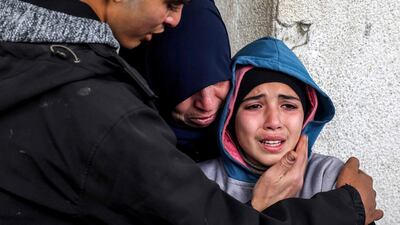
  • A woman and a man embrace a crying girl at Al Najjar Hospital in Rafah as they mourn relatives killed during the overnight bombardment. AFP
    A woman and a man embrace a crying girl at Al Najjar Hospital in Rafah as they mourn relatives killed during the overnight bombardment. AFP
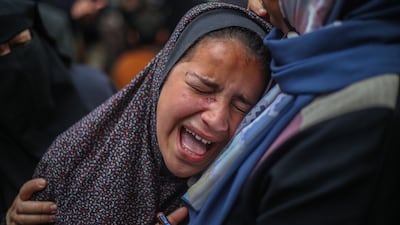
  • A mourner cries as the dead bodies of victims are received in Rafah, where hospitals say their morgues are full. Getty Images
    A mourner cries as the dead bodies of victims are received in Rafah, where hospitals say their morgues are full. Getty Images

Mercer, the investment consulting arm of US services company Marsh & McLennan, expects its wealth division to at least double its assets under management (AUM) in the Middle East as wealth in the region continues to grow despite economic headwinds, a company official said.

Mercer Wealth, which globally has $160 billion in AUM, plans to boost its AUM in the region to $2-$3bn in the next 2-3 years from the present $1bn, said Yasir AbuShaban, a Dubai-based principal with Mercer Wealth.

Within the next two to three years, we are looking at reaching $2 to $3 billion as a conservative estimate and we do see an opportunity to do so,” said Mr AbuShaban.

Mercer does not directly make investments, but allocates clients’ money they have discretion to, to professional asset managers. They also provide advice to clients.

“We have buying power. We can negotiate on their (client’s) behalf with asset managers to provide them lower fees than they otherwise would have to get on their own,” he added.

Mercer Wealth’s clients include sovereign wealth funds, family offices, and insurance companies among others.

From its office in Dubai, Mercer also looks after Africa, India and Turkey, where they also see opportunity for growth.

Wealth creation in Middle East and Africa (MEA) grew 8.5 per cent to $8.1 trillion last year from $7.5tn in 2015, higher than last year’s global average of 6 per cent and the second-highest growth in a region after Asia-Pacific which grew 9.9 per cent, according to consultancy Boston Consulting Group (BCG). In the region, where wealth grew just 1.9 per cent in 2015 compared with 2014, a pickup in oil prices has helped in wealth generation.

BCG is forecasting MEA wealth will rise to $12tn by 2021, growing at an annual average of 8 per cent.

Drivers of wealth generation in the region will be split evenly between new wealth creation and growth of performance of existing assets, according to BCG.

Another general trend in the region is clients’ looking for a comprehensive approach to investing, according to Mr AbuShaban.

“Institutional investors or some of the families are seeing a slowdown in the available capital they have to invest and in that sense they are looking at optimizing the way they manage their portfolios and making sure they are not investing haphazardly and different parts of their investment are working together,” said Mr AbuShaban.

Some clients also have a higher appetite for risk, given the low interest-rate environment that does not provide enough yield for some institutional investors. These clients are keen to invest in illiquid assets, such as private equity and infrastructure.

“What we have seen is a desire for higher returns in what has been a low-return environment specifically in various fixed income or bonds,” he said.

“In this environment, we have seen a de facto increase in the risk that clients are taking in things like illiquid investments, private equity investments, infrastructure and private debt, those kind of investments were higher illiquidity results in incrementally higher returns.”

The Abu Dhabi Investment Authority, one of the largest sovereign wealth funds, said in its 2016 report that has gradually increased its exposure in direct private equity and private credit transactions, mainly in Asian markets and especially in China and India. The authority’s private equity department focused on structured equities owing to “their defensive characteristics.”

Nancy 9 (Hassa Beek)

Nancy Ajram

(In2Musica)

How Islam's view of posthumous transplant surgery changed

Transplants from the deceased have been carried out in hospitals across the globe for decades, but in some countries in the Middle East, including the UAE, the practise was banned until relatively recently.

Opinion has been divided as to whether organ donations from a deceased person is permissible in Islam.

The body is viewed as sacred, during and after death, thus prohibiting cremation and tattoos.

One school of thought viewed the removal of organs after death as equally impermissible.

That view has largely changed, and among scholars and indeed many in society, to be seen as permissible to save another life.

First Person
Richard Flanagan
Chatto & Windus 

The candidates

Dr Ayham Ammora, scientist and business executive

Ali Azeem, business leader

Tony Booth, professor of education

Lord Browne, former BP chief executive

Dr Mohamed El-Erian, economist

Professor Wyn Evans, astrophysicist

Dr Mark Mann, scientist

Gina MIller, anti-Brexit campaigner

Lord Smith, former Cabinet minister

Sandi Toksvig, broadcaster


RESULT

Huddersfield Town 1 Manchester City 2
Huddersfield: Otamendi (45' 1 og), van La Parra (red card 90' 6)
Man City: Agüero (47' pen), Sterling (84')

Man of the match: Christopher Schindler (Huddersfield Town)

Infiniti QX80 specs

Engine: twin-turbocharged 3.5-liter V6

Power: 450hp

Torque: 700Nm

Price: From Dh450,000, Autograph model from Dh510,000

Available: Now

RESULTS

Time; race; prize; distance

4pm: Maiden; (D) Dh150,000; 1,200m
Winner: General Line, Xavier Ziani (jockey), Omar Daraj (trainer)

4.35pm: Maiden (T); Dh150,000; 1,600m
Winner: Travis County, Adrie de Vries, Ismail Mohammed

5.10pm: Handicap (D); Dh175,000; 1,200m
Winner: Scrutineer, Tadhg O’Shea, Ali Rashid Al Raihe

5.45pm: Maiden (D); Dh150,000; 1,600m
Winner: Yulong Warrior, Richard Mullen, Satish Seemar

6.20pm: Maiden (D); Dh150,000; 1,600m
Winner: Ejaaby, Jim Crowley, Doug Watson

6.55pm: Handicap (D); Dh160,000; 1,600m
Winner: Storyboard, Richard Mullen, Satish Seemar

7.30pm: Handicap (D); Dh150,000; 2,200m
Winner: Grand Dauphin, Gerald Mosse, Ahmed Al Shemaili

8.05pm: Handicap (T); Dh190,000; 1,800m
Winner: Good Trip, Tadhg O’Shea, Ali Rashid Al Raihe

Dubai Bling season three

Cast: Loujain Adada, Zeina Khoury, Farhana Bodi, Ebraheem Al Samadi, Mona Kattan, and couples Safa & Fahad Siddiqui and DJ Bliss & Danya Mohammed 

Rating: 1/5

The years Ramadan fell in May

1987

1954

1921

1888

Updated: May 01, 2024, 7:41 AM