


The massive foreign aid bill that President Joe Biden signed into law on Wednesday will help to replenish the Ukrainian military's depleted stocks of weapons and ammunition at a crucial time.
Included in the $61 billion package are big-ticket items such as fighting vehicles, long-range missiles and air defence interceptors.
Experts say they will help Ukraine to avoid defeat against Russia, which invaded in February 2022 and has made territorial gains as US Republicans dithered for six months over providing more funding.
“I'm making sure the shipments start right away,” Mr Biden said.
“In the next few hours – literally in the next few hours – we are going to begin sending in equipment to Ukraine, for air-defence munitions, for artillery for rocket systems, and armoured vehicles.”
A US defence official said the first shipments would be sent by the end of the day, and Ukrainian forces could start to receive aid “within days”.
When and where weapons are distributed will be decided by Kyiv. The $61 billion will be disbursed over a period of months, with an initial $1 billion tranche released on Wednesday.
Ukrainian President Volodymyr Zelenskyy said Kyiv had been working closely with US officials to work out details of that package to ensure it contained “exactly the weapons that our soldiers need”.
“During recent days we were actively working with our American friends, at all levels, to fill in this package with those weapons our warriors need,” Mr Zelenskyy said in his regular address to the nation.
“We will do everything to compensate that half a year, which was spent in debates and doubts.”
Ukrainian and US officials acknowledged for the first time that the latest US assistance includes the longer-range version of a tactical ballistic missile system known as ATACMS, which Ukraine has long desired in a push to strike deeper into occupied territory.
White House National Security Adviser Jake Sullivan confirmed to reporters that a "significant number" of the missiles had already been sent to Ukraine under a previous authorisation, and "we will send more."
The missiles were used for the first time in the early hours of April 17, when they were launched against a Russian airfield in Crimea that was about 165km from the Ukrainian front lines.
The longer-range missiles are crucial. Not only can they be used to strike deep inside occupied territory, they can force Russian helicopter bases, logistics centres and fighting forces back from the front lines, reducing Moscow's ability to launch offensives.
“Anything that creates long-range fire is important,” said Dr Jan Kallberg, a senior fellow at the Centre for European Policy Analysis and a fellow at the Army Cyber Institute at West Point.
Ukraine has for months been rationing its artillery ammunition against Moscow's relentless bombardment along front lines in southern and eastern Ukraine, where Russian forces have been making steady gains as they use drones from Iran and missiles and munitions from North Korean.
The defence official told The National that some artillery rounds and missiles are expected to arrive quickly, with larger items such as armoured vehicles taking longer.
But Ukrainian opposition politician Vadym Ivchenko, a member of the Ukrainian Parliament’s national security, defence and intelligence committee, said logistical challenges and bureaucracy could delay shipments to Ukraine by two to three months, and it could be even longer before they reach the front line.
Aside from battlefield impacts, the latest US aid is likely to have a profound effect on Ukrainian troop morale, Dr Kallberg told The National.
“Feeling abandoned is one of the worst things for a soldier's perspective,” he said.
“Feeling like you're stuck and abandoned in a dire spot breaks down morale pretty quick, and this is a direct boost.”
Initial military aid flows to Ukraine included a lot of older equipment from the 1990s, Dr Kallberg noted.
But the weapons in the latest aid package include top-of-the-range gear that the Ukrainians already know how to use, such as the Bradley fighting vehicles that have shown to be effective in taking out Russian tanks.
Russian President Vladimir Putin’s military is now focused on Kharkiv, Ukraine’s second-largest city, with a bombing campaign that Ukrainian and western officials see as an attempt to force the evacuation of civilians.
Weapons wanted by Ukraine – in pictures
-
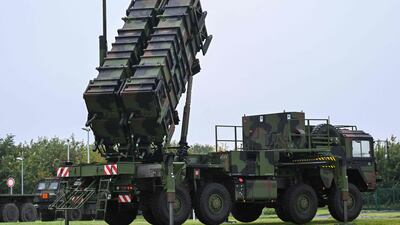
Air defence: Ukraine’s air defence largely depends on the Patriot system. AFP -
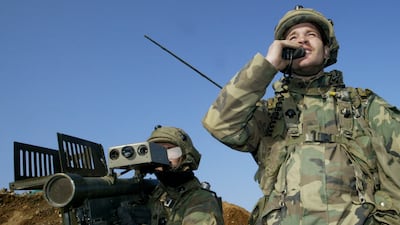
Air: Stinger short-range surface-to-air missile. Reuters -
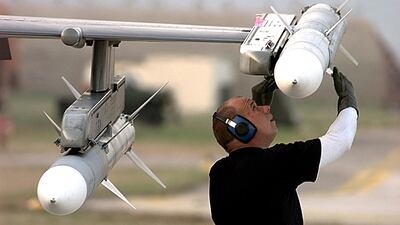
Air: Aim-120 air-to-air missiles. More than 14,000 of the missiles, that have a range exceeding 120km, have been produced with their accuracy so good that they have been nicknamed “Slammer”. Getty Images -
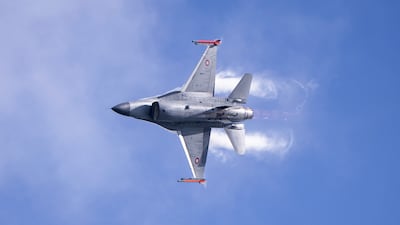
Air: F-16s will provide greater surveillance and the ability to attack high-value targets behind Russian lines in occupied Ukraine. EPA -
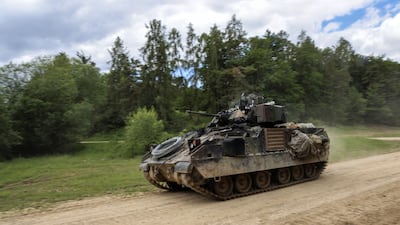
Armour: Bradley IFV. The Ukrainians have found the Bradley infantry fighting vehicle, with its 25mm cannon, very useful in protecting troops and providing decent firepower. Bloomberg -
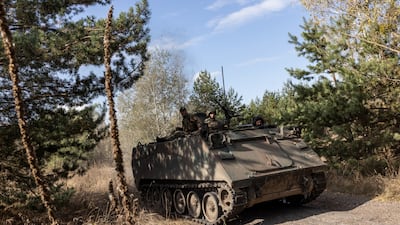
Armour: M113. The 1960s-designed versatile M113 armoured personnel carrier has proven effective in protecting troops against minefields. Getty Images -
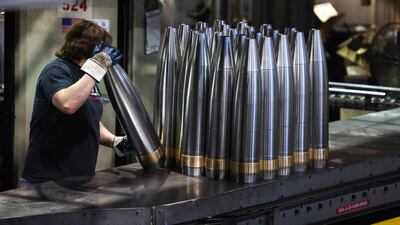
Artillery: 155mm artillery rounds. A massive delivery of 155mm rounds could prove crucial in preventing further Russian advances, particularly in its expected summer offensive. AFP -
Artillery: ATACMs long-range precision missiles. The ATACMS have a range of 300km with the ability to land within a few metres of a target. Getty Images -
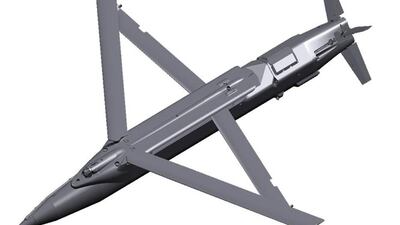
Artillery: Ground-Launched Small Diameter Bomb (GLSDB). It can be fired from the HIMARS system. Photo: Wikimedia Commons -

Artillery: M777 guns and replacement barrels. The Ukrainians need many M777 howitzer barrels to replace those worn down by extensive use. Getty Images



