


One year into the Sudanese civil war with the fighting showing no signs of abating, Iran appears to be attempting to exert its influence in the conflict.
The fighting erupted on April 15, 2023, pitting the Sudanese armed forces, led by Gen Abdel Fattah Al Burhan, against the paramilitary Rapid Support Forces, commanded by Gen Mohamed Dagalo.
A recent report from Reuters suggested the Sudanese military may be using Iranian-made drones to gain ground around the capital Khartoum, where much of the conflict over the past year has been focused.
The report cites sources in Khartoum who say Sudanese military drones have been tracking RSF movements and hitting them with precision strikes in Omdurman, across the Nile from Khartoum.
Omdurman is home to several major military bases, including the headquarters of the army's engineering corps.
In the early months of the conflict, the RSF managed to capture large parts of the city. While the conflict there eventually ground into a stalemate, fighting has intensified in the past month.
"The SAF have started to regain some territory: they breached the siege around the centre of Omburdman in mid-February and won a significant battle in early March by reclaiming the headquarters of the national radio and television in Omburdman, historically a focal point for Sudanese coups," Pierre Pahlavi, a professor at the Canadian Forces College who focuses on Iran, told The National.
Mr Pahlavi said that despite recent gains, it was unlikely that Iran's support would "tip the balance" of the conflict.
A Dutch peace organisation which has been monitoring the use of drones in the conflict believes there is evidence that Iran has supplied the Sudanese military with new drones.
War in Sudan one year on – in pictures
-

Rapid Support Forces commander Gen Mohamed Dagalo, then deputy head of Sudan's sovereign council, gives a media briefing in Khartoum in February last year. Reuters -
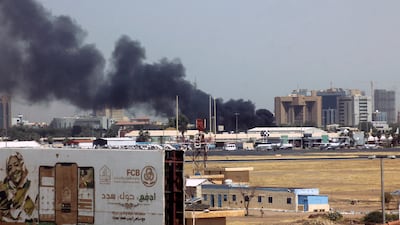
Smoke rises after blasts in Khartoum amid clashes between the Sudanese Army and the Rapid Support Forces paramilitary on April 15 last year. AFP -
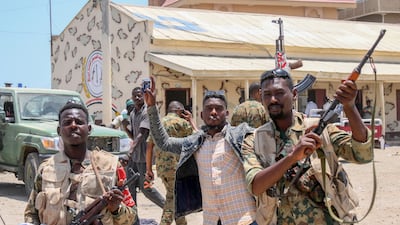
Sudanese Army soldiers at the Rapid Support Forces base in Port Sudan on April 16 last year. AFP -

Black smoke covers the sky over Khartoum as clashes continued on April 19. AFP -
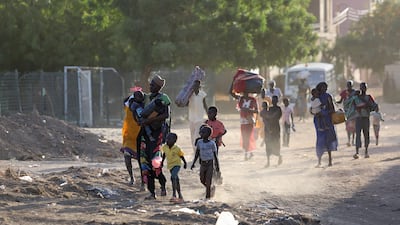
Displaced Khartoum residents flee the city after a 24-hour truce collapsed on April 19. AFP -
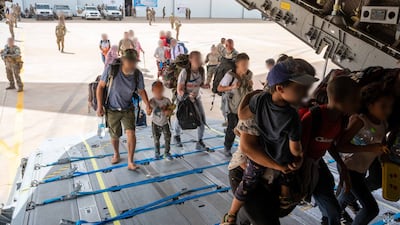
Foreign citizens board a plane at a French military air base in Khartoum to leave Sudan on April 23. AFP -
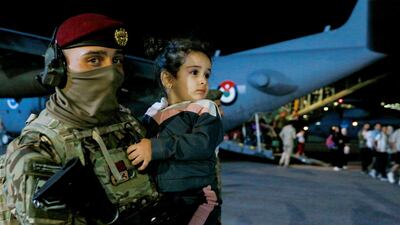
A soldier carries a child as people evacuated from Sudan disembark from a plain at a military airport in Amman on April 24. AFP -

Evacuees from Sudan sit in a military plane as they wait to be processed by Kenyan troops in Nairobi on April 24. Reuters -

Sudanese refugees gather to receive humanitarian aid in Koufroun, Chad, on April 30. AFP -
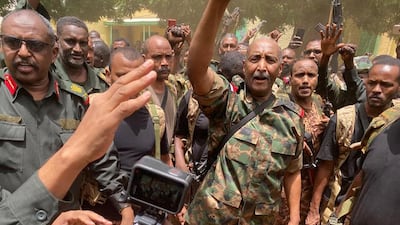
Sudanese Army chief Gen Abdel Fattah Al Burhan visits troop positions in Khartoum on May 30. AFP -
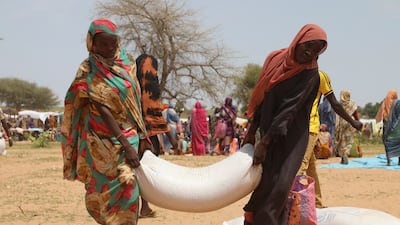
Sudanese refugees at the Zabout camp in Goz Beida, Chad, on July 1. AP -

Smoke rises from a fire at a lumber warehouse in southern Khartoum on June 7. AFP -
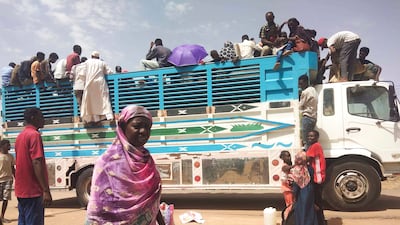
People prepare to leave Khartoum during a ceasefire on June 19. AP -

People sit on top of a lorry carrying furniture on the road between Khartoum and Wad Madani, Al Gezirah state, on July 18. AFP -
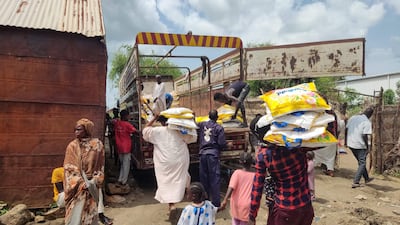
Men load goods from Ethiopia on to a lorry in the border town of Gallabat on August 2. AFP -
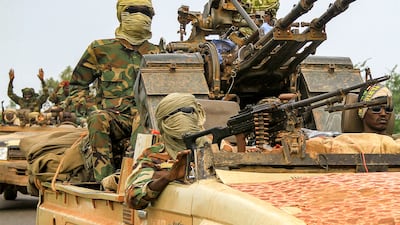
Sudanese Army troops ride in a military convoy accompanying the governor of Darfur State in the eastern city of Gedaref on August 30. AFP -
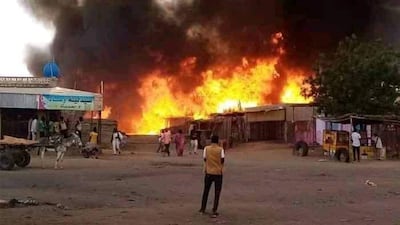
A fire rages at a livestock market after RSF bombardment in Al Fasher, the capital of North Darfur state, on September 1. AFP -

People cook on a campfire at a school that has been turned into a shelter for displaced Sudanese in the northern border town of Wadi Halfa, near Egypt, on September 11. AFP -
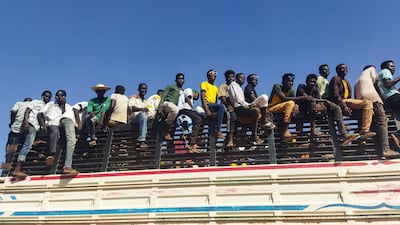
Displaced Sudanese ride on top of a lorry in Wad Madani on December 16. AFP -
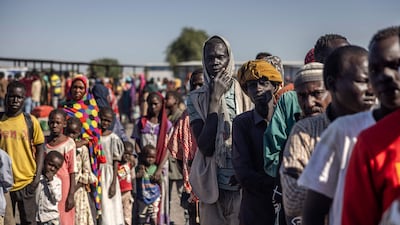
Sudanese refugees queue to board a lorry to go to a transit centre after crossing the border into South Sudan on February 14. AFP -
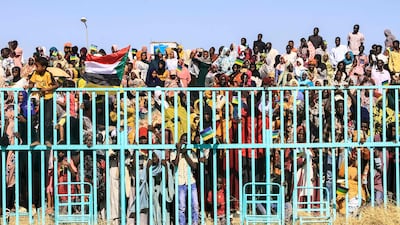
People watch as fighters from the army-aligned Sudan Liberation Movement attend a graduation ceremony in the south-eastern Gedaref state on March 28. AFP -

Fighters from the SLM attend a graduation ceremony in Gedaref state on March 28. AFP


“They have a long-standing relation with Sudan and have provided drones in the past starting off in 2008, 2009,” Wim Zwijnenburg, project leader at Pax, told The National.
“But we had indications after a couple of Iranian drones were shot down early January, that they were provided new drones, which indicates that Iran has restarted their export to Sudan.”
Mr Zwijnenburg said that there is evidence that the Sudanese military is using a relatively new Iranian drone called the Zargil-3, an updated version of a previous drone, which can drop heavy mortar rounds and could potentially be armed with guided missiles.
He added that, with the help of online sleuths, his organisation had tracked an Iranian flight believed to be carrying weapons to Sudan – though without the plane’s manifest, there is no way to say exactly what was on the flight.
“We found the presence of the Boeing 747 at Port Sudan Airport, so these are known Iranian airlines being involved in arms because they are owned by the Iranian government, known to be transporting arms, including also to Syria, which was an indication that Iran has been shipping weapons to Port Sudan,” he said.
That Iran is wading into the conflict in Sudan is not surprising.
“Iran's involvement in Sudan is part of its broader strategy for expanding its presence in the Red Sea, building off of its success in supporting and building up the Houthis,” said Gregory Brew, an Iran analyst at the Eurasia Group.
Sudan's army chief says war crimes are being committed in country – video
“Iran also sees Sudan's embattled government as a potential ally, one that it can cultivate through arms deals and drone sales.”
Tehran has also been accused of providing military equipment including drones to Russia for its war in Ukraine. It also supplies drones to Yemen's Houthis, who have carried out a series of attacks on commercial shipping in the Red Sea.
"Iran also seeks to gain a significant avenue of influence, particularly in eastern Sudan and Port Sudan, which it has informally designated as its capital," Mr Pahlavi said.
"This strategic position, with around 700 kilometres of maritime shorelines, provides Iran with a substantial asset to disrupt maritime passage in the Red Sea region."
The US has spoken with allies in the region and asked them to urge Iran not to become further involved in the conflict.
"We've encouraged them to encourage other countries, like Iran, not to engage," said Linda Thomas-Greenfield, US ambassador to the UN.
Both the Sudanese military and the RSF have been accused of committing atrocities in the year-long war.
A February UN report, based on interviews with 303 victims and witnesses, said the army and the RSF had “used explosive weapons with wide-area effects, such as missiles fired from fighter jets, unmanned aerial vehicles, anti-aircraft weapons and artillery shells in densely populated areas”.
The UN estimates that between 10,000 and 15,000 people have been killed in the war, which has pitted the
About eight million people have been displaced since fighting began.
Early attempts to broker peace, led by the US and Saudi Arabia, fell through.
Last month, Washington's special envoy for Sudan Tom Perriello said the US hoped to resume talks in April.
America has said that peace talks with the warring parties in Saudi Arabia would need to be inclusive, including the UAE, Egypt, regional East African bloc IGAD and the African Union.


