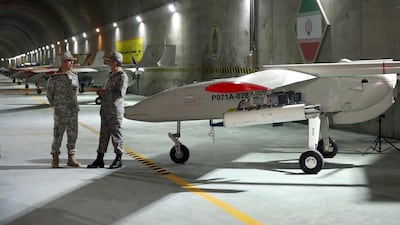
Iranian Army Chief of Staff Mohammad Hossein Bagheri, left, and Commander Gen Abdolrahim Mousavi visiting an underground tunnel and drone base in Iran’s Zagros mountains. AP

Iran's growing arsenal of drones and missiles: Can they strike Israel?


Robert Tollast
  • English
  • Arabic

Live updates: Follow the latest on Israel-Gaza

Iran has warned Israel it will pay a price for attacking its embassy compound in Damascus on April 1, an air strike that killed two Iranian generals, among seven officers of Islamic Revolutionary Guard Corps (IRGC) and nine others, including some Syrians.

This leaves the question of which weapons Iran has at hand to strike Israeli targets.

In the past, Iran has delivered long-range drones and missiles to allies to attack Israel, accepting losses among those allies in retaliatory air strikes.

Iranian supreme leader Ayatollah Ali Khamenei, left, praying at the coffins of members of the IRGC who were killed in Syria, ahead of their funeral in Tehran. EPA

Mark Pyruz, an expert on Iran's security services, says observers should not expect the Iranians to accept what he calls “reflexive control” after the attack, whereby Iran restrains its retaliatory instincts for fear of provoking something worse.

This was the case after the US assassination of Maj Gen Qassem Suleimani in Iraq in 2020, when Iran halted direct attempts at retaliation after firing one heavy barrage of missiles at American forces.

Today, Iran could be willing to take more losses and more risk, if history is a guide.

“The Iranian-Israeli contest stretches back to the First Lebanon War [1982], with attrition and replacements a feature of raised levels of conflict,” Mr Pyruz says. "A response isn't expected to divert global public focus away from Israel's disadvantageous Gaza policy but rather a continuation of targeting observed during this present crisis."

This form of proxy warfare is already playing out on the Israel-Lebanon border in daily clashes between Iran-backed Hezbollah and Israel.

Hezbollah is thought to possess a number of guided ballistic missiles that have not yet been used, which could strike Israeli airports and power plants – but the group has hinted it will not play a central role in an Iranian strike.

Israel's Iron Dome missile defence system intercepting rockets fired from south Lebanon amid increasing cross-border tensions with Hezbollah. AFP

It is suspected that Hezbollah has not yet used Khaibar-1 missiles, with a 100km range, or Fateh 110 missiles, with a 160km range, because such a move could rapidly expand the war.

This leaves two other proxy fronts in Iraq, where analysts say Iran has sent allied militias shorter-range ballistic missiles, including the Al Aqsa missile thought to have capability of travelling less than 100km.

The militias have, however, fired drones towards Eilat, thought to be Shahed 110s, commonly used by Iran-backed groups against US forces.

If that continues, Israel could retaliate inside Iraq – Israeli jets may have bombed the militias in a series of mysterious air strikes and explosions in 2019.

On the Syrian front, where these groups operate frequently alongside Hezbollah, Israel has launched hundreds of air strikes, accepting responsibility for some over a period of more than 10 years, but commenting seldom on individual attacks.

Israel's F-35 Lightning II fighter jet takes part in an aerial display in the Negev desert, near the southern city of Beer Sheva. AFP

This is one reason why attacks from Syria have been relatively rare.

Unless supplied with longer-range missiles, there is little more Iran-backed groups in Iraq can do except hope that one of their drones hits a high-value target, such as the Eilat naval base.

This leaves two possibilities: an increased supply of weapons to Houthi militias currently blockading the Red Sea, sending more advanced missiles such as the Toufan ballistic missile and Quds-3 cruise missile, both of which can hit Israel and have come close on two occasions.

This option is not ideal, due to Israel’s now reinforced air defence network.

“The Houthis have been firing at Eilat and southern Israel since October, with very little to show for their efforts and expenditure,” says Aron Lund, of the Century International think tank. "These attacks seem to have no strategic material impact on the conflict whatsoever.

“One might justifiably ask why they’re willing to throw away all these expensive and hard-to-come-by weapons without hitting anything that matters or seriously complicating Israeli operations.”

This limited capability leaves some form of direct Iranian attack on Israeli interests – such as a terrorist attack on embassies, hinted at in IRGC-linked media – or against Israel itself.

Iran has used Shahed 136 drones to attack vessels owned by Israeli companies, before the current Gaza war, hitting the Pacific Zircon, owned by Israeli billionaire Idan Ofer, in 2022, and striking the Mercer Street, also linked to an Israeli company, killing two sailors, in 2021.

Direct confrontation?

Tehran’s most extreme option is attacking Israel directly.

Israel is well within range of missiles such as the Khormashahr 4, with a 2,000km range, or even the shorter-range Shahab. The accuracy of these weapons at such long distances is unknown, unlike the 500km-range Fateh 313, which is accurate to tens of metres.

Without accuracy, Iran might be satisfied with hitting a city or sparsely populated area, depending on whether it is prepared for a limited war or major Israeli retaliation, if many Israelis are killed.

Iran’s Shahed-149 “Gaza” drone, with a claimed range of 2,500km, might contribute to such an attack but it presents a relatively big target for air defences.

"Israel has intercepted drones from Syria in the past and intercepted Hezbollah drones. Most of the Iranian proxies use similar models for drones. They don't have the capabilities to avoid modern air defences, but that doesn't mean they can't find complex routes that keep them away from air defences for part of their flight path," says Seth Frantzman, author of Drone Wars: Pioneers, Killing Machines, Artificial Intelligence, and the Battle for the Future.

Israel, meanwhile, has long-planned to use its F-35I stealth fighter to strike Iran in the event of war, or to hit Iranian nuclear facilities. Such an attack could be augmented by non-stealth aircraft such as the heavily armed and fast F-15.

But these operations might be limited, given Israel’s lack of in-flight refuelling for massive air operations at long range, and US-purchased KC-46A Pegasus refuelling tankers are not expected to be delivered until 2025.

In any case, even a limited clash between Iran and Israel would represent another tipping point towards a worsening regional war.


In numbers: PKK’s money network in Europe

Germany: PKK collectors typically bring in $18 million in cash a year – amount has trebled since 2010

Revolutionary tax: Investigators say about $2 million a year raised from ‘tax collection’ around Marseille

Extortion: Gunman convicted in 2023 of demanding $10,000 from Kurdish businessman in Stockholm

Drug trade: PKK income claimed by Turkish anti-drugs force in 2024 to be as high as $500 million a year

Denmark: PKK one of two terrorist groups along with Iranian separatists ASMLA to raise “two-digit million amounts”

Contributions: Hundreds of euros expected from typical Kurdish families and thousands from business owners

TV channel: Kurdish Roj TV accounts frozen and went bankrupt after Denmark fined it more than $1 million over PKK links in 2013 

PROFILE OF SWVL

Started: April 2017

Founders: Mostafa Kandil, Ahmed Sabbah and Mahmoud Nouh

Based: Cairo, Egypt

Sector: transport

Size: 450 employees

Investment: approximately $80 million

Investors include: Dubai’s Beco Capital, US’s Endeavor Catalyst, China’s MSA, Egypt’s Sawari Ventures, Sweden’s Vostok New Ventures, Property Finder CEO Michael Lahyani

German intelligence warnings
  • 2002: "Hezbollah supporters feared becoming a target of security services because of the effects of [9/11] ... discussions on Hezbollah policy moved from mosques into smaller circles in private homes." Supporters in Germany: 800
  • 2013: "Financial and logistical support from Germany for Hezbollah in Lebanon supports the armed struggle against Israel ... Hezbollah supporters in Germany hold back from actions that would gain publicity." Supporters in Germany: 950
  • 2023: "It must be reckoned with that Hezbollah will continue to plan terrorist actions outside the Middle East against Israel or Israeli interests." Supporters in Germany: 1,250 

Source: Federal Office for the Protection of the Constitution

GAC GS8 Specs

Engine: 2.0-litre 4cyl turbo

Power: 248hp at 5,200rpm

Torque: 400Nm at 1,750-4,000rpm

Transmission: 8-speed auto

Fuel consumption: 9.1L/100km

On sale: Now

Price: From Dh149,900

Dubai works towards better air quality by 2021

Dubai is on a mission to record good air quality for 90 per cent of the year – up from 86 per cent annually today – by 2021.

The municipality plans to have seven mobile air-monitoring stations by 2020 to capture more accurate data in hourly and daily trends of pollution.

These will be on the Palm Jumeirah, Al Qusais, Muhaisnah, Rashidiyah, Al Wasl, Al Quoz and Dubai Investment Park.

“It will allow real-time responding for emergency cases,” said Khaldoon Al Daraji, first environment safety officer at the municipality.

“We’re in a good position except for the cases that are out of our hands, such as sandstorms.

“Sandstorms are our main concern because the UAE is just a receiver.

“The hotspots are Iran, Saudi Arabia and southern Iraq, but we’re working hard with the region to reduce the cycle of sandstorm generation.”

Mr Al Daraji said monitoring as it stood covered 47 per cent of Dubai.

There are 12 fixed stations in the emirate, but Dubai also receives information from monitors belonging to other entities.

“There are 25 stations in total,” Mr Al Daraji said.

“We added new technology and equipment used for the first time for the detection of heavy metals.

“A hundred parameters can be detected but we want to expand it to make sure that the data captured can allow a baseline study in some areas to ensure they are well positioned.”

Profile of Foodics

Founders: Ahmad AlZaini and Mosab AlOthmani

Based: Riyadh

Sector: Software

Employees: 150

Amount raised: $8m through seed and Series A - Series B raise ongoing

Funders: Raed Advanced Investment Co, Al-Riyadh Al Walid Investment Co, 500 Falcons, SWM Investment, AlShoaibah SPV, Faith Capital, Technology Investments Co, Savour Holding, Future Resources, Derayah Custody Co.

MATCH INFO

What: Brazil v South Korea
When: Tonight, 5.30pm
Where: Mohamed bin Zayed Stadium, Abu Dhabi
Tickets: www.ticketmaster.ae

ABU DHABI ORDER OF PLAY

Starting at 10am:

Daria Kasatkina v Qiang Wang

Veronika Kudermetova v Annet Kontaveit (10)

Maria Sakkari (9) v Anastasia Potapova

Anastasia Pavlyuchenkova v Ons Jabeur (15)

Donna Vekic (16) v Bernarda Pera 

Ekaterina Alexandrova v Zarina Diyas

Squads

Australia: Finch (c), Agar, Behrendorff, Carey, Coulter-Nile, Lynn, McDermott, Maxwell, Short, Stanlake, Stoinis, Tye, Zampa

India: Kohli (c), Khaleel, Bumrah, Chahal, Dhawan, Shreyas, Karthik, Kuldeep, Bhuvneshwar, Pandey, Krunal, Pant, Rahul, Sundar, Umesh

The%20specs%20
%3Cp%3E%3Cstrong%3EEngine%3A%20%3C%2Fstrong%3E2.0-litre%204cyl%20turbo%0D%3Cbr%3E%3Cstrong%3EPower%3A%20%3C%2Fstrong%3E261hp%20at%205%2C500rpm%0D%3Cbr%3E%3Cstrong%3ETorque%3A%20%3C%2Fstrong%3E400Nm%20at%201%2C750-4%2C000rpm%0D%3Cbr%3E%3Cstrong%3ETransmission%3A%20%3C%2Fstrong%3E7-speed%20dual-clutch%20auto%0D%3Cbr%3E%3Cstrong%3EFuel%20consumption%3A%20%3C%2Fstrong%3E10.5L%2F100km%0D%3Cbr%3E%3Cstrong%3EOn%20sale%3A%20%3C%2Fstrong%3ENow%0D%3Cbr%3E%3Cstrong%3EPrice%3A%20%3C%2Fstrong%3EFrom%20Dh129%2C999%20(VX%20Luxury)%3B%20from%20Dh149%2C999%20(VX%20Black%20Gold)%3C%2Fp%3E%0A
HOW TO WATCH

Facebook: TheNationalNews  

Twitter: @thenationalnews  

Instagram: @thenationalnews.com  

TikTok: @thenationalnews 

Tamkeen's offering
  • Option 1: 70% in year 1, 50% in year 2, 30% in year 3
  • Option 2: 50% across three years
  • Option 3: 30% across five years 
COMPANY%20PROFILE
%3Cp%3EFounder%3A%20Hani%20Abu%20Ghazaleh%3Cbr%3EBased%3A%20Abu%20Dhabi%2C%20with%20an%20office%20in%20Montreal%3Cbr%3EFounded%3A%202018%3Cbr%3ESector%3A%20Virtual%20Reality%3Cbr%3EInvestment%20raised%3A%20%241.2%20million%2C%20and%20nearing%20close%20of%20%245%20million%20new%20funding%20round%3Cbr%3ENumber%20of%20employees%3A%2012%3C%2Fp%3E%0A

SM Town Live is on Friday, April 6 at Autism Rocks Arena, Dubai. Tickets are Dh375 at www.platinumlist.net

Updated: April 10, 2024, 12:05 PM