


Live updates: Follow the latest on Israel-Gaza
There is no evidence Israel is committing genocide in Gaza but far too many civilians have been killed there, US Defence Secretary Lloyd Austin said on Tuesday.
The Pentagon chief also suggested the US military adheres to stiffer standards of avoiding civilian casualties than Israel does.
“We don’t have any evidence of genocide being [committed],” Mr Austin told the Senate Armed Services Committee.
He was earlier interrupted by protesters who yelled at him to “stop the genocide” and to end the provision of weapons to Israel.
Elizabeth Warren, a progressive Democratic senator, asked Mr Austin whether he thought an expected Israeli attack on Rafah, the southern Gaza city where more than one million people have sought refuge, would be a “disaster”.
“Far too many civilians have been killed as a result of combat operations [in other parts of Gaza] and [Israel] needs to get civilians out of that battle space around Rafah,” Mr Austin said.
Gaza health authorities say more than 33,200 people have been killed in the enclave and nearly 76,000 injured since Israel declared war on Hamas following its October 7 attack that killed nearly 1,200 people, according to Israeli counts.
Ms Warren referenced recent reporting by Israel-based +972 Magazine and other outlets alleging that Israeli troops wait until suspected militants are at home with their families before they are bombed.
The +972 report also said the Israeli military uses artificial intelligence to identify targets for air strikes in Gaza, which has resulted in the mass killing of civilians.
“Would the United States systematically choose to execute on military strikes that are more likely to kill civilians, including children?” Ms Warren asked.
Mr Austin responded: “Absolutely not. Just the opposite. We routinely go out of our way to make sure that we do everything we can to minimise civilian casualties.”
Israeli Prime Minister Benjamin Netanyahu said on Monday that a date had been set for a Rafah invasion, but he did not say when it would be.
The US has pushed Israel to avoid launching a Rafah offensive until a clear plan to protect civilians has been outlined.
Secretary of State Antony Blinken on Tuesday said talks on Rafah would take place next week.
“I don't anticipate any actions being taken before those talks. And for that matter, I don't see anything imminent, but there is a lot of work to be done,” Mr Blinken told reporters.
Six months into Israel's air and ground campaign in Gaza, the devastated Palestinian enclave faces famine and widespread disease, with most of its inhabitants now homeless.
A mass famine in Gaza would likely accelerate violence and ensure a long-term conflict, Mr Austin said.
“It doesn't have to happen … we should continue to do everything we can, and we are doing this, to encourage the Israelis to provide humanitarian assistance,” he added.
Willy Lowry contributed to this report
Israel targets Rafah with air strikes – in pictures
-

People inspect destroyed vehicles following deadly overnight Israeli bombardments of Rafah in the southern Gaza Strip. AFP -
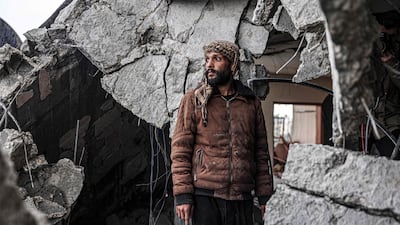
A man stands in the rubble of a building hit by overnight Israeli air strikes in Rafah, where more than a million Palestinians have sought shelter. AFP -
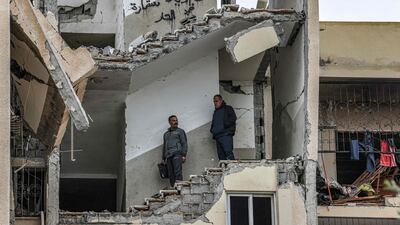
A building destroyed by overnight Israeli strikes on Rafah. AFP -
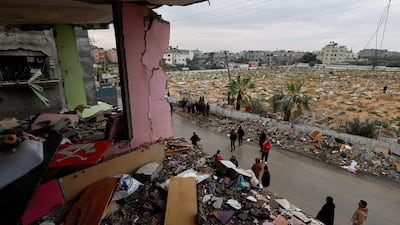
The heavy bombardment caused widespread panic in Rafah because many people were asleep. Some feared Israel had begun its anticipated ground offensive on the city. Reuters -
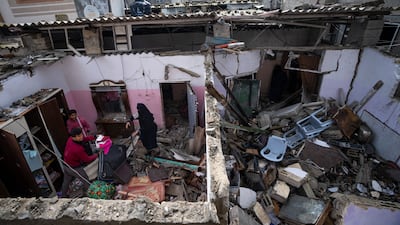
A building destroyed by overnight Israeli strikes on Rafah. AP -
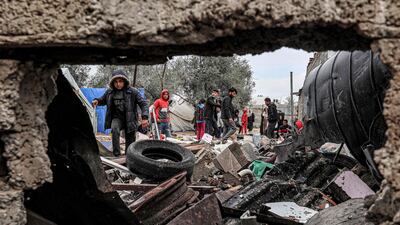
Displaced Palestinians inspect the remains of their shelters at the Rafah refugee camp following overnight Israeli strikes. AFP -

Shelters erected outside a damaged apartment building in the Rafah refugee camp, where food, water and medicine are becoming increasingly scarce. AFP -
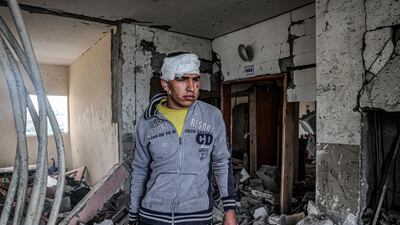
An injured boy inside a building damaged by overnight Israeli strikes on Rafah. AFP -
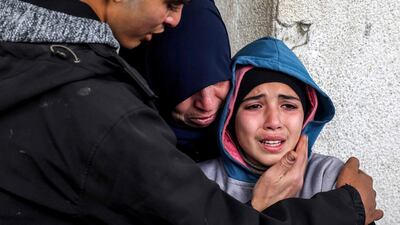
A woman and a man embrace a crying girl at Al Najjar Hospital in Rafah as they mourn relatives killed during the overnight bombardment. AFP -
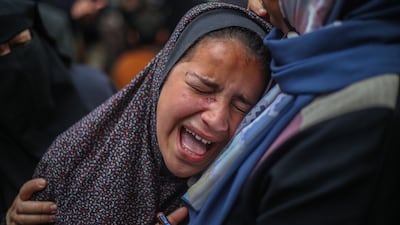
A mourner cries as the dead bodies of victims are received in Rafah, where hospitals say their morgues are full. Getty Images



