



Look up on April 8: a solar eclipse is coming to North America.
The celestial phenomenon is expected to be visible from Mexico's Pacific coast before skies darken over Texas and 14 other US states. It will then wrap up over parts of north-eastern Canada.
Here, The National tells you all you need to know about the rare event:
What is a total solar eclipse?
An eclipse happens when the Moon passes between the Sun and Earth, entirely covering the Sun's face along a small path across our planet's surface.
This is called the “path of totality”.
The daytime sky turns dark, akin to dusk or dawn. Birds start to roost and nocturnal animals have been known to wake up, tricked into believing night has arrived.
In places on the path of totality, people will be able to view the Sun's corona – its outer atmosphere – that typically is not visible due to solar brightness.
People observing from outside the path of totality will see a partial eclipse in which the Moon obscures most of the Sun's face but not all of it.
What's the eclipse path?
According to Nasa, the eclipse will begin over the South Pacific, with its path reaching Mexico's Pacific coast at about 11.07am local time before entering the US through Texas.
Its path then takes it through another 14 states: Oklahoma, Arkansas, Missouri, a tiny part of Tennessee, Illinois, Kentucky, Indiana, Ohio, a small part of Michigan, Pennsylvania, New York, Vermont, New Hampshire and Maine.
The path then enters Canada through Ontario and journeys through Quebec, New Brunswick, Prince Edward Island and Cape Breton, exiting continental North America on the Atlantic coast of Newfoundland at 5.16pm local time.
A partial eclipse is due to be visible for people in all 48 contiguous US states, Reuters reported.

What are the best spots to see the eclipse?
Major cities and their metropolitan areas lay within or near the path of totality, making many densely populated areas some of the best spots to view the eclipse.
These include San Antonio, Austin, Waco, Fort Worth and Dallas in Texas; St Louis in Missouri; Detroit in Michigan; Buffalo, Rochester and Syracuse in New York; and Toronto and Montreal in Canada.
How long will the eclipse last?
The full eclipse will last longer than usual because the Moon will be 360,000km from Earth, one of the year’s closest approaches. The closer the Moon is to Earth, the bigger it appears in the sky from our perspective, resulting in an especially long and intense period of Sun-blocked darkness.
Totality will last the longest over Mexico at 4 minutes, 28 seconds.
Elsewhere along the track, such as in Syracuse, New York, totality will last only 90 seconds.
How can you safely watch an eclipse?
Experts warn it is unsafe to look directly at the bright Sun without using specialised eye protection designed for solar viewing. Viewing an eclipse through a camera lens, binoculars or telescope without making use of a special-purpose solar filter can cause severe eye injury.
They advise using safe solar-viewing glasses or a safe hand-held solar viewer, noting that regular sunglasses are not safe for watching the event. The only moment it is considered safe for people to remove eye protection during a total solar eclipse is the brief time when the Moon completely blocks the Sun's surface.
Will there be a comet during the eclipse? Will other planets be visible?
During totality, some people may be able to spot a comet along with four planets: Jupiter will be to the left of the Sun and Venus to the right, and then Saturn and Mars will be to the right of Venus. Three other planets will be in the vicinity but virtually impossible to see with the naked eye.
Comet 12P/Pons-Brooks is swinging past Earth, as it does every 71 years. It will be near Jupiter during the eclipse.
“There is lots to see and not that long a time,” Anita Cochran of the University of Texas at Austin told AP.
When was the last total solar eclipse in the US?
-

Tourists using a handmade protective viewing filter sheet to watch the partial solar eclipse, at the Phoenician ruins, in the southern port city of Tyre, Lebanon. AP -
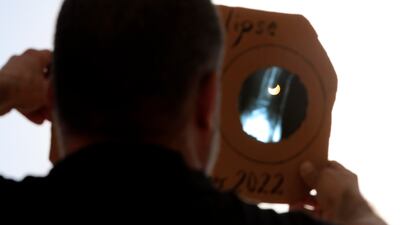
A man using handmade protective viewing to watch the eclipse in Tyre. AP -

A camel herder is silhouetted against a partial solar eclipse in Pushkar, in the western Indian state of Rajasthan. AP -

People gather at the Al Thuraya Astronomy Centre in Mushrif Park to watch the partial solar eclipse. Antonie Robertson/The National -
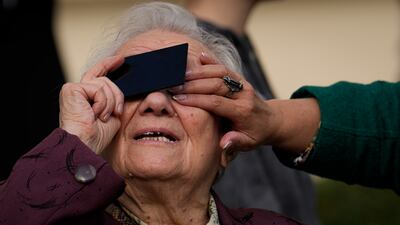
An elderly woman looks through a welding filter during a partial solar eclipse in Bucharest, Romania. AP -

People watch a partial solar eclipse in Mumbai, India. AP -
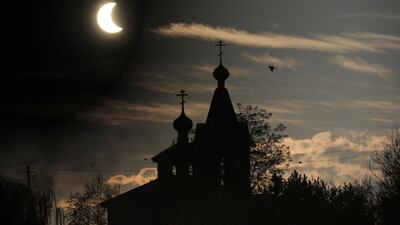
A partial solar eclipse over a Christian church in the Almaty region of Kazakhstan. Reuters -

A view of the partial solar eclipse behind the pods of a Ferris wheel at an amusement park in Dohuk in Iraq's autonomous Kurdistan region. AFP -
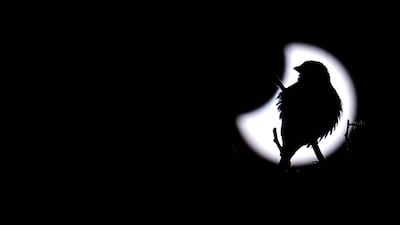
A view of the partial solar eclipse visible behind a bird on a tree in Istanbul. AFP -
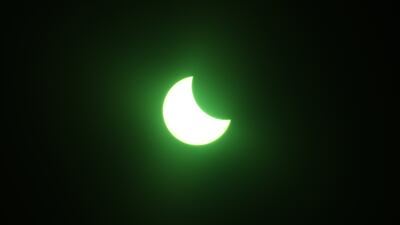
A partial solar eclipse as seen from Al Thuraya Astronomy Centre in Dubai. EPA -

The partial solar eclipse is framed by youngsters jumping on a trampoline in the outskirts of Lahore, Pakistan. AP -
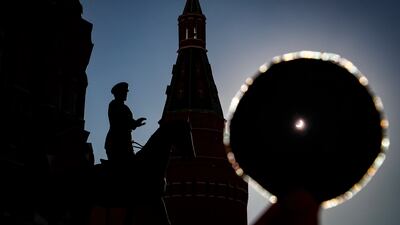
A partial solar eclipse as seen in Moscow. EPA -

People wear protective glasses to observe the celestial event in Kuwait city. EPA -

A statue of goddess Minerva is backdropped by the sun during a partial solar eclipse in Bucharest. AP -
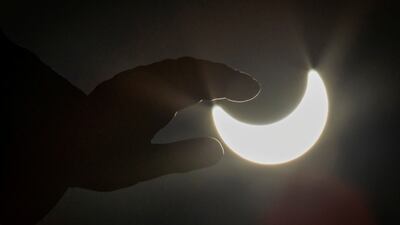
A fragment of a monument to Soviet World War Two commander Marshal Georgy Zhukov is pictured during a partial solar eclipse in central Moscow. Reuters -
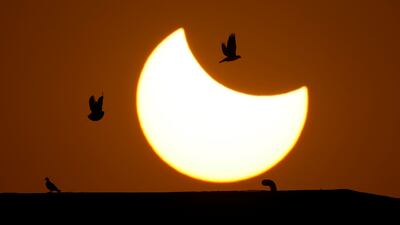
Pigeons fly past a partial solar eclipse in Ahmedabad. AP -
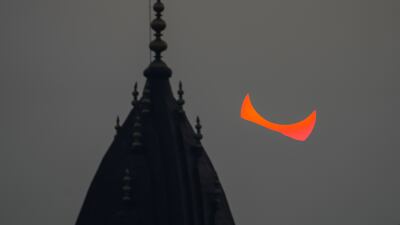
A partial solar eclipse behind the centuries-old Raghunath Hindu temple in Srinagar, Indian-controlled Kashmir. AP -
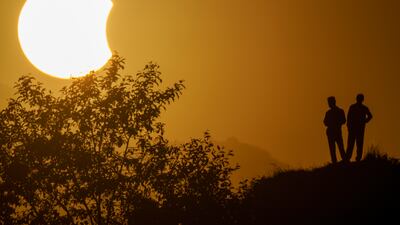
People are silhouetted against a partial solar eclipse seen from Kathmandu, Nepal. AP -
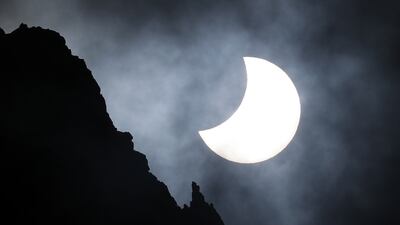
A partial solar eclipse as seen in the Tatra Mountains, southern Poland. EPA -

The celestial event in Hede-Bazouges, western France. AFP -
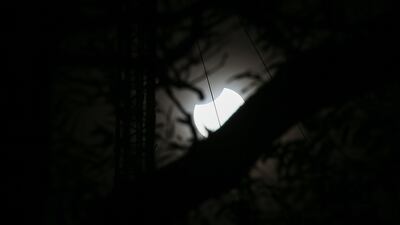
A partial solar eclipse in Huddersfield, England. EPA -
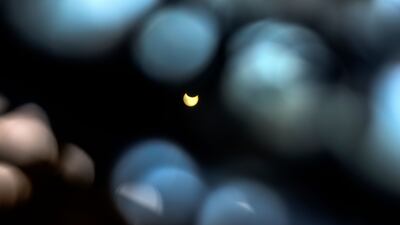
The Moon partially obscuring the Sun as seen from Gaza city. AFP -
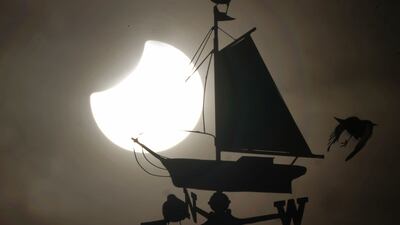
A partial solar eclipse is visible over Cullercoats Watch House in North Shields, England. AP -
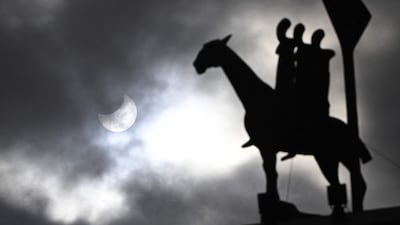
A partial solar eclipse is pictured in Malmoe, Sweden. AFP -
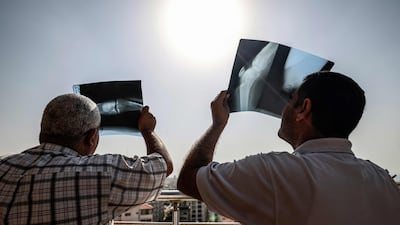
Men use X-ray images as filters to view a partial solar eclipse visible from Gaza city. AFP -

A statue on top of the Bernini's colonnade is pictured during a partial solar eclipse in St Peter's Square at the Vatican. Reuters -
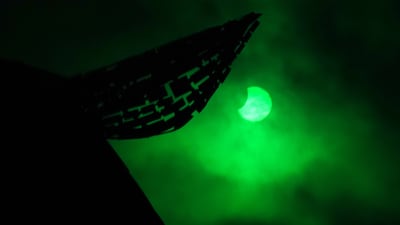
The Moon passing in front of the Sun during a partial eclipse viewed through glass from a welding visor at the Kelpies near Falkirk, Scotland. PA -
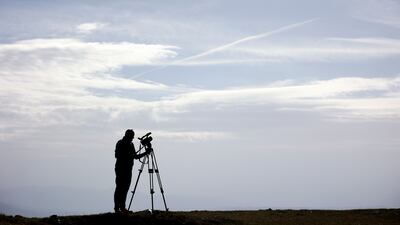
A cameraman records a partial solar eclipse near Travnik, Bosnia. AP Photo -
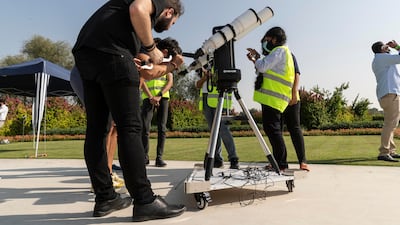
People gather at the Al Thuraya Astronomy Centre in Mushrif Park to watch the event. Antonie Robertson / The National


The US has not experienced a total solar eclipse since August 2017.
A “ring of fire” solar eclipse crossed a part of the country in October.
When is the next solar eclipse?
The next total solar eclipse will not be until 2026, when it will graze the North, touching Greenland, Iceland and Spain.
The next one in 2027 will march across Spain and northern Africa, with totality lasting 6.5 minutes.
North Americans will have to wait until 2033 for another total solar eclipse but it will be limited to Alaska. In 2044, western Canada, Montana and North Dakota will have front-row seats. And in 2045, the US will once again experience a coast-to-coast total solar eclipse.

