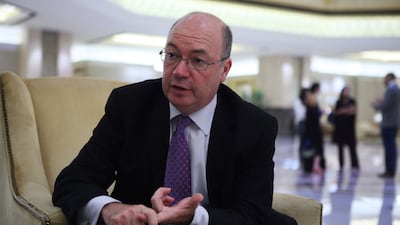

The UK's newly appointed hostage envoy wants to build international alliances to prevent state hostage-taking.
Alistair Burt, who became the UK’s first special envoy for complex consular affairs last month, warned that state hostage-taking was on the rise, but that countries could work together to prevent it.
He said he had met with counterparts among the Five Eyes Group and the Gulf states in the hope of strengthening the network of countries affected by state hostage-taking.

“I want to advance the international process. Actually preventing this, persuading the states that do it, this is not the way that will bring them any success,” he said on Monday.
“The rise in state hostage-taking has been noticed. That is what has increased international interest in this and how things can be tackled collectively. I’m building that up,” he told MPs of the Foreign Affairs Committee, which scrutinises the government’s foreign policy.
The UK hopes to host the “core group” of hostage envoys from the Five Eyes alliance in the UK next year. “It would give (the meeting) greater prominence. We would want high-level representation at such a meeting. It would add to the visibility of the UK being extremely concerned about such a practice,” he said.
Mr Burt served as the Tories' Minister for the Middle East from 2017 to 2019, a crucial period during which the UK was seeking the release of British nationals detained in Iran, including Nazanin Zaghari-Ratcliffe and Anoosheh Ashoori.
The position of special envoy for hostages was created last month after growing demand from families and their MPs. The American diplomat Roger Carstens, who served as US presidential envoy for hostage affairs, is widely seen as the precursor to the role that was created in the UK.
Mr Burt said the role would consist of providing more support for the families of people who have been arbitrarily detained or face cruel treatment in prison. He would also be advising the government on alternative solutions to secure the detained person’s release.
One high-profile case was that of Craig and Lindsay Foreman, who are being held in an Iranian prison after being given 10-year sentences for espionage. The couple and the UK government have rejected the accusations, insisting that they were innocent tourists.
The couple's family – who met with Mr Burt last month – have repeatedly accused the government of failing to act quickly enough to secure their release. The case is complicated by the US-Iran war, and repeated alleged Iran-backed attacks on British soil that have strained relations.
Mr Burt said he could not speak publicly about individual cases without the family's consent. But he warned that the role must not replace the work of the government’s consular services, who already deal with other states directly on these matters.
“Every case is handled by a competent consular team who are already doing everything they can in every circumstance. What would be wrong would be to give an impression that the engagement of the envoy materially changes that,” he said.
That concern had previously been voiced by Ms Zaghari Ratcliffe, who was detained for six years in Iran’s Evin prison. Ms Zaghari-Ratcliffe welcomed Mr Burt’s appointment last month but said she feared the role could quickly become an “excuse” for government inaction.
“We don't want to see that the government is hiding behind the fact that now we have got this team, we have got Alistair, we've got this kind of entity which is looking after the families of hostages, but then pretending that that's it, and we can’t do anything else,” she said in September.
Mr Burt acknowledged that the families of hostages faced impossible and frustrating situations when dealing with the British government on securing the release of their loved ones.
“At the end of all this, there is only one measure of success for the families: they want someone back,” he said. “It’s the one thing that is outside the gift and the control of the UK. We are not detaining people – others are.”

