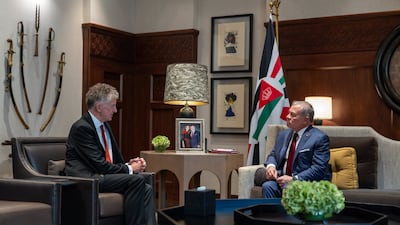

The UK's top national security official visited Israel last week in a futile bid to prevent the closure of the British Consulate General in Jerusalem, which was ordered by the Israeli government last month.
National Security Adviser Jonathan Powell held talks with Israeli officials but failed to reach an agreement to keep the mission open.
The Foreign Commonwealth and Development Office said it would not comment on the National Security Adviser's mission, which also included a visit to Jordan to meet with King Abdullah II.

The pair discussed Israel's “dangerous violations” in the occupied West Bank and Jerusalem, as well as security needs in Lebanon and Syria, parts of which are also under Israeli occupation, a statement from Al Husseiniya Palace said.
The UK is said to be considering the expulsion of Israeli diplomats from Britain should the closure go ahead, according to Reuters. Around 30 British staff are attached to the Consulate, which opened in 1838.
Asked about Mr Powell's visit and talks with London over the consulate, a representative of Israeli Foreign Minister Gideon Saar said the diplomatic mission would close on Thursday as announced.
Mr Powell has long-standing connections in the Middle East due to his work as a mediator before his appointment to the Downing Street role. The UK's current Middle East Minister Stephen Doughty was appointed to the role last week.
Israel ordered the closure of the British Consulate General in Jerusalem in response to the UK’s announcement of a new sanctions package targeting Israeli settlements in the West Bank, which many deem illegal. The Israeli government has repeatedly accused UK Foreign Secretary Ed Miliband, who announced the sanctions on September 8, of damaging relations between the two countries.
Emily Thornberry, the veteran Labour MP who heads the Foreign Affairs Committee, said the UK must do what it can to prevent the closure.

“Beyond the fact that the closure of the British consulate in East Jerusalem – occupied Palestinian territory – is not in Israel’s prerogative, it is yet another attempt by this far-right Israeli government to block a two-state solution. It is illegal, and the UK must resist it,” she wrote on X on Monday.
The consulate is in the Sheikh Jarrah neighbourhood of East Jerusalem and the mission was first established more than a century before the State of Israel. It handles the country’s relations with Palestinians in the city, as well as the West Bank and Gaza, while also providing consular services to Palestinians.
Last week, Dominic Grieve KC, who was the government’s senior legal adviser from 2010 to 2014, said the closure was “an unlawful assertion of Israeli sovereignty over occupied East Jerusalem”.
He wrote to the Foreign, Commonwealth and Development Office to argue that Israel was furthering its agenda to annex East Jerusalem by closing the British consulate.
“The UK’s settlement sanctions are an excuse; sovereignty over Jerusalem is the object,” Mr Grieve wrote in an advisory paper commissioned by the Britain Palestine Project, a charity that advocates a British peacemaking role in the conflict.
“Israel’s method in the city has been to create facts on the ground through unlawful settlement building and property seizure. The closure should be challenged as a further attempt to exercise powers out with those permitted to an occupier.”
European countries that recognise Palestinian statehood have long sought to protect their consulates in Jerusalem. Their continued presence is important in protecting British and European Union policies of rejecting the annexation of East Jerusalem and Israeli claims to the entire city as its capital.
Israel has yet to respond to French and Spanish restrictions on trade with illegal settlements but there is concern over the status of their consulates.