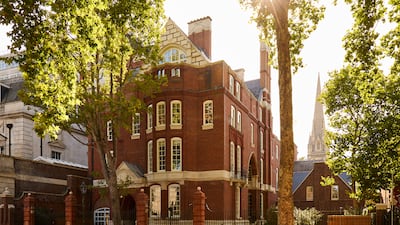

A boutique super-prime development of six residences just a stone’s throw from London’s Kensington Palace launches today.
One Palace Green, where prices start at £15 million, overlooks the gardens of the palace, which is home to several members of the UK royal family. The Prince and Princess of Wales keep an apartment in the building as their official London home, though their main residence is in Windsor. Prince William’s brother Harry and his wife Meghan also lived in a cottage on the grounds when they were first married, as did the brothers’ mother Diana after her divorce from Prince Charles.
The 150-year-old 19,200 sq ft home, built in the Arts and Crafts style, is an immediate neighbour of the Israeli embassy, while the ambassadors’ residences of both France and Norway are a short distance up the road.

Current or previous owners of homes on the road, which merges into Kensington Palace Gardens, include billionaire steel magnate Lakshmi Mittal, socialite Tamara Ecclestone, businessman Len Blavatnik and oligarch Roman Abramovich.
The embassies and presence of super-wealthy individuals mean the street is ultra-private, with highly secured properties. Photography is forbidden nearby, while manned barriers prevent vehicles from entering the broad tree-lined avenue from Kensington High Street.

Heritage
The redevelopment of the building has taken developer Redd Real Estate five years due to its Grade II listed status, which meant there were exceedingly tight restrictions on the alterations that could be made.
Heritage officials insisted it remain as true to its original appearance as possible, even down to the colour of the paint on its stone stairs and the motifs on the walls of the dining room. The restoration has reversed unsympathetic alterations introduced during the building’s years as offices.
Fortunately, several archive images existed which allowed the developers to piece together which were original features among the alterations made over the decades.

Artistic life
The building was completed in 1870 and started life as a single home for landscape painter and politician George Howard, later the 9th Earl of Carlisle, and his wife Rosalind, a radical political and temperance campaigner with whom he had 11 children. Howard was friends with Alfred, Lord Tennyson, served as a trustee of the National Gallery, sat in the House of Commons as an MP, and presided over his ancestral home of Castle Howard in Yorkshire.
The Howards were part of the influential Holland Park Circle, a group of artists, architects and patrons who made this corner of west London a centre of Victorian artistic life.
Designed by architect Philip Webb, known as the father of the Arts and Crafts movement, Howard’s London home strayed from typical designs of the time by creating bright rooms designed to be used as an artist’s studio or gallery rather than the servants’ quarters usually found on upper floors.
The interiors of the time were shaped by William Morris and Edward Burne-Jones, who together revolutionised Victorian interior design with handcrafted, nature-inspired items, jewel-toned stained-glass windows, block printing and rich tapestries.

Transformation
The National was given a tour of the development – five apartments and a coach house – to see how it has been brought back to life by the Martin Kemp Design team and architects Pilbrow & Partners.
A freshly commissioned portrait of the Howards sits in the concierge area, while armchairs, desks and even doorknobs nod to Morris’s signature style.
The walls are adorned with art curated by Daniel Morris Art Advisory and include three paintings by Howard, believed to have been created during his time at One Palace Green. This has been matched with botanical illustrations and contemporary works, including a series inspired by the Munich Olympics.
The standout room is the meticulously restored dining room, which is the centrepiece of the duplex apartment and spans the ground and lower-ground floors, including a patterned ceiling, deep jewel-toned colours and gilded panelling. The words to Morris’s epic poem Earthly Paradise are inscribed on the wall, bringing one of the house’s most important historic interior features back to life.

Howard’s original studio, in another residence, has been transformed into a spectacular living room with a ceiling height of 4.5 metres (15 feet).
The development includes enhanced security, five-star concierge and property management, private parking, branded lifestyle partnerships and landscaped gardens. The building also has a state of the art ground source heating and cooling system providing energy across the entire site, with no gas entering the development.

Back to life
Russell Smithers, chief executive and co-founder of REDD, said he was proud to bring back the character of the original building, which had gradually been lost over the years. He said: “One Palace Green has all the ingredients that are almost impossible to bring together in London: an extraordinary history, exceptional architecture and a position on Kensington Palace Gardens.
“The Arts and Crafts philosophy feels more relevant than ever 150 years later. We are living in a world where buyers value craftsmanship, authenticity, natural materials and things that have been made to last. Those were the principles behind this house when it was built, and they are just as important to its next chapter.”
Designer Martin Kemp said: “The challenge with a project of this significance is knowing when to restore, when to reinterpret and when to quietly step back. Our role was never to compete with the architecture, but to continue its story, creating interiors that feel as though they have always belonged while meeting the expectations of contemporary living. The finest heritage projects don’t preserve buildings as museum pieces. They allow them to evolve with sensitivity and integrity.”
Beauchamp Estates, Savills and UK Sotheby’s International Realty are appointed as joint selling agents.


