

The collapse of the Syrian army has been swift, decisive and astonishing, but not without precedent in the Middle East and beyond. In just 12 days, the country has gone from what appeared to be an enduring status quo to the total collapse of the Al Assad dynasty.
So, why was a country whose army appeared to have a strong grip over the areas it controlled routed?
While there are strong and recent historical parallels, there is also the unique context of 2024 in which the region has seen seismic events that will shape it for many years to come. Following a decade of civil war, President Bashar Al Assad had become entirely reliant on three foreign allies to prop up his government.
Iran, Russia and Hezbollah have been almost entirely absent during the long week in which the rebels, largely led by Hayat Tahrir Al Sham, have stormed through the country. The absence of leadership from the commander in chief also proved significant, with Mr Al Assad failing to make any appearance or attempt to bolster morale, bar offering a 50 per cent army pay rise.

Moscow muted
While there were a few sorties by Russian warplanes, with some bombs dropped on the advancing rebels, they lacked the precision or force to halt them. The contagion of defeat that clearly gripped the Syrian army infected Moscow’s troops, whose ruthless military approach had for so long kept Mr Assad in office, leading them to decamp their sophisticated air defence systems and leave.
The Russia fleet appears to have fled its leased port of Tartus, either sailing to Libya or back to the motherland, where the war in Ukraine is demonstrably the Kremlin’s priority. The coming period will reveal how much reputational damage Syria has done to Russia’s standing in the Middle East and also if it impacts on its "Africa Corps" operating in the Sahel.
Iran runs away
The Syrian collapse will certainly lead to the diminished status of Iran and its once revered Islamic Revolutionary Guard Corps (IRGC). Instead of intervening to support the Al Assad regime, Iran ordered the emergency evacuation of its military and diplomatic staff from Damascus over the past week. Those officers had previously stiffened the sinew of the Syrian army and their absence in the last week has been conspicuous.
Like Moscow, and on a more dangerous scale for its rulers, Tehran has suffered yet another reputational blow. The repercussions of that could well prove significant after the deeply unpopular regime suffered continuous setbacks this year that might threaten its future.
Hezbollah absent
In the triangle of support for Syria, it has been the evisceration of its key ally Hezbollah that has come after two intense months of fighting the formidable Israeli military that has left it in a state of inertia. It was from 2011 that Hezbollah played and key role in training the Syria army and providing it with troops to take back or hold territory. But the once formidable military force has been denuded both of its leadership and foot soldiers from the Israeli war, leaving Syria near defenceless.
On paper, the Syrian army should have been able to hold its own with its hundreds of tanks, artillery and missiles. Yet, it appears to resemble the Iraqi army of 2014 that was marked by corruption and absence, where officers sent soldiers home on furlough but still took their pay leaving battalions so weakened that they were unable to halt the ISIS advance that took Mosul and then Tikrit.
On that occasion, the Baghdad government was largely saved from collapse by the intervention of precise heavy bombing from the US warplanes and special forces.

Lightning advances
Even the US and Nato-trained armies have proven to be vulnerable to the advances of motivated and disciplined adversaries. Despite the billions of dollars in advanced US equipment given to the Afghan army, and two decades of training, there was little will or strong leadership to prevent the Taliban takeover in just ten days in 2021 after the Americans suddenly pulled out.
Leadership is critical when armies come under pressure and soldiers need faith in the officers giving them commands that could lead to their death. Stalin’s purges of the Red Army meant there were very few experienced officers left to defend against the lightning Nazi Germany offensive of Operation Barbarossa in 1941, that left millions dead or captured until the invaders were halted just outside Moscow.
A year later, Britain too suffered its heaviest military defeat, when a smaller Japanese force of 30,000 stormed through Singapore in just eight days, capturing 85,000 soldiers.
Those were seismic events that shaped world politics, as undoubtedly the Syria army’s defeat will do in December 2024, proving that the unfolding drama of Hamas’ October 7 attack will continue to run.
-
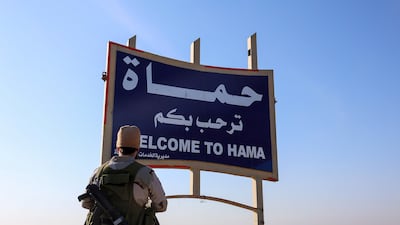
A member of the Syrian opposition passes a Hama governorate sign on the Damascus to Aleppo motorway on Tuesday. EPA -
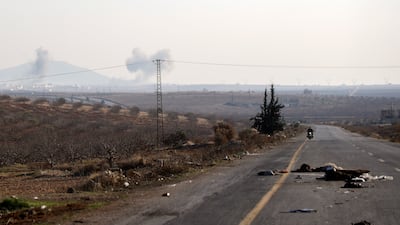
Signs of fighting in Hama. AP -
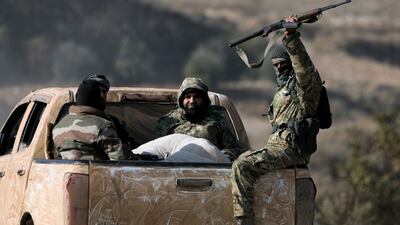
Anti-government fighters in the town of Suran, between Aleppo and Hama. AFP -
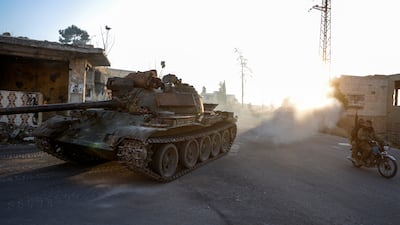
Syrian opposition fighters with a tank taken from the army in the town of Maarat Al Numan, south of Idlib. AP -
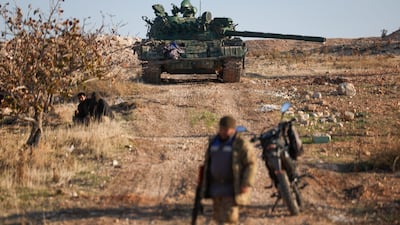
An abandoned Syrian army tank on the outskirts of Hama. AP -

More abandoned tanks on the highway to Damascus, near the town of Suran, north of Hama. AFP -
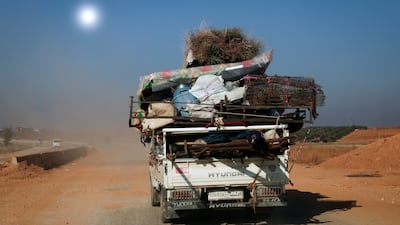
Civilians escape the fighting in Suran. AP -
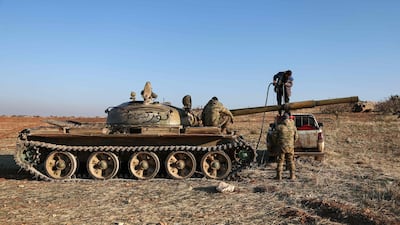
Anti-government fighters take possession of a Syrian army tank in Suran. AFP -
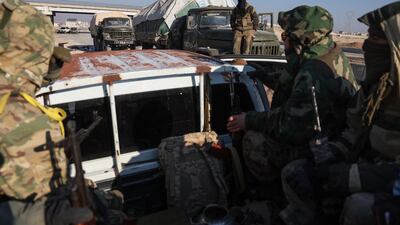
Anti-government fighters on the highway to Damascus. AFP -
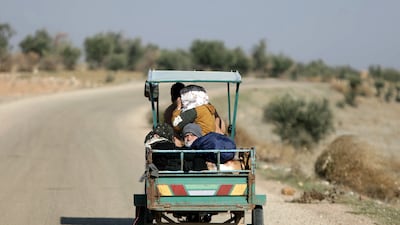
Civilians flee fighting in Suran. AFP -
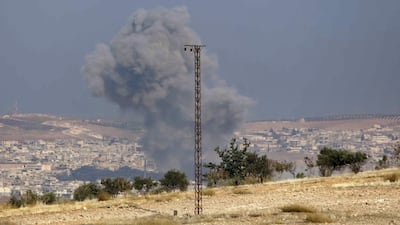
Fighting rages in Suran. AFP -
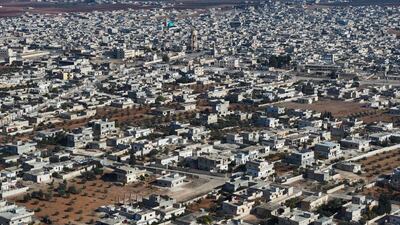
An aerial view of Suran. AFP



