Nobel peace laureate Malala Yousafzai has used a UK Parliament meeting to call on global leaders to introduce a law banning gender discrimination, to end the “cruel” Taliban abuse of women in Afghanistan.
With a tranche of new laws against women brought in by the extremists, who took power more than three years ago, she demanded “a decisive, strong international response” as the abuse was “a severe crime against humanity”.
Malala, who was shot in the head by the Pakistan Taliban in 2012, spoke in the presence of Britain’s Middle East Minister, Hamish Falconer. He disclosed to the all-party parliamentary group on women, peace and security, that Britain was now reviewing its relationship with the Taliban after failed dialogue under the previous Conservative government.
The rise of Malala, the youngest ever Nobel laureate - in pictures
-

Malala Yousafzai opens the new Library of Birmingham at Centenary Square on September 3, 2013, in Birmingham, England. Malala was shot in the head by a Taliban gunman two years ago for insisting that girls as well as boys have the right to an education. Christopher Furlong / Getty Images -
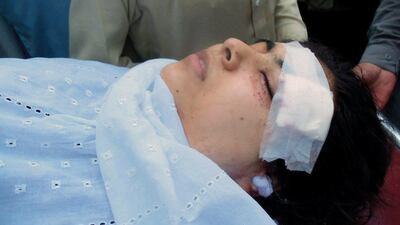
On October 9, 2012, Pakistani hospital workers carry injured Malala Yousafzai, then 14, on a stretcher after her assassination attempt by gunmen in Mingora. Mohammed Rehman / AFP Photo -
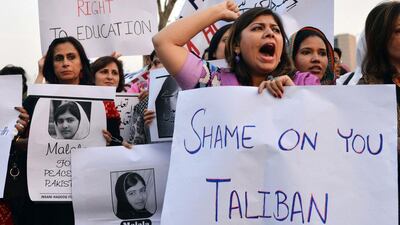
News of her shooting led to protests in Pakistan and other countries on October 10, 2012. Aamir Qureshi / AFP Photo -
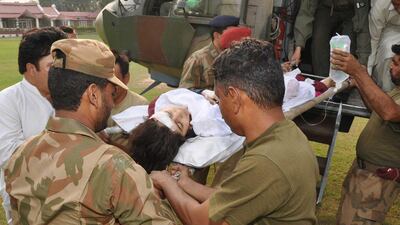
Pakistani soldiers carry Malala from a helicopter to a military hospital in Peshawar, Pakistan. She whould be later transferred from Pakistan to the UK via Abu Dhabi for life-saving treatment. Inter Services Public Relations Department / AP Photo -

Malala Yousafzai recovers in Queen Elizabeth Hospital in Birmingham, England, on October 12, 2012. University Hospitals Birmingham NHS Foundation Trust / AP Photo -

Malala with her family on October 26, 2012, her brothers Khushal Khan, third right, and Apal Kha, right, and father Ziauddin Yousufzai, at the hospital in Birmingham. Queen Elizabeth Hospital / University Hospitals Birmingham / AFP Photo -
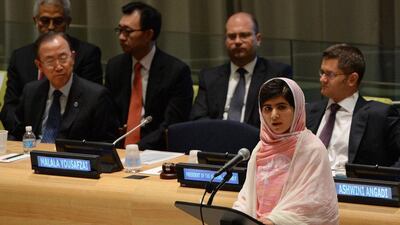
On July 13, 2013, Malala Yousafzai speaks before the United Nations Youth Assembly at UN headquarters in New York as UN Secretary General Ban Ki-moon, left, and Vuk Jeremic, right, President of the UN General Assembly listen. Stan Honda / AFP Photo -

On March 19, 2013, Malala Yousafzai is pictured holding a backpack in Birmingham as she returns to school for the first time. Liz Cave / Malala Press office / AFP Photo -
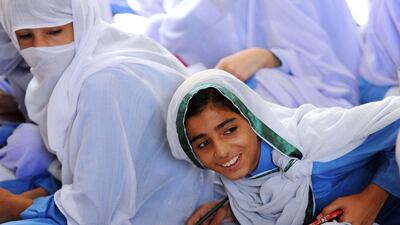
Former classmates at Malala Yousafzai’s hometown of Mingora in Pakistan in September 2013. It was thought she was going to win the Peace Prize in 2013. Aamir Quereshi / AFP Photo -

Malala Yousafzai won other awards, pictured here on October 7, 2013, by the Daily Mirror newspaper, David Beckham presents a Mirror Pride of Britain Teenager of Courage Award to Malala. Philip Coburn, Daily Mirror / AP Photo -

Malala Yousafzai gives a copy of her book, I Am Malala, to Britain’s Queen Elizabeth II during a reception at Buckingham Palace on October 18, 2013. Yui Mok / AP Photo -
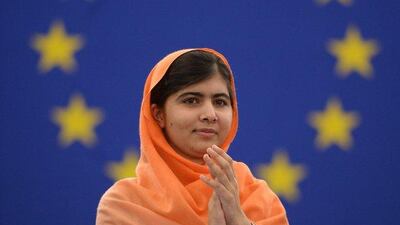
Malala Yousafzai receives the Sakharov Prize at the European Parliament in Strasbourg, France, on November 20, 2013. Patrick Seeger / EPA -
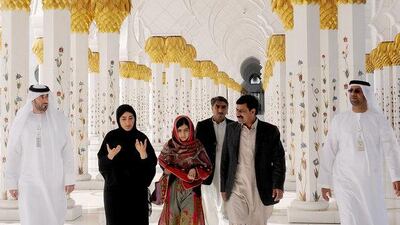
Malala Yousafzai visits Sheikh Zayed Grand Mosque in Abu Dhabi on January 2, 2014. WAM -
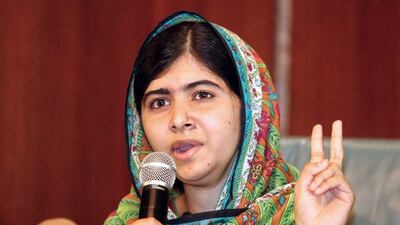
Malala Yousafzai giving a press conference after meeting with the Nigerian president in Abuja on July 14,2014. The Malala Fund focuses on improving education in Pakistan, Nigeria, Syria among others. Wole Emmanuel / AFP Photo -

Pakistani activist Malala Yousafzai meets UN secretary general Ban Ki-moon at United Nations headquarters. Stan Honda / AFP Photo / August 18, 2014 -
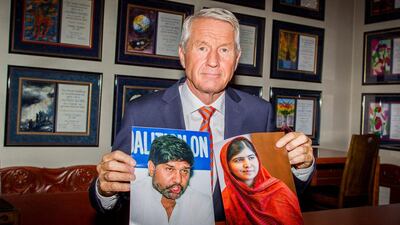
Chair of the Norwegian Nobel Committee, Thorbjorn Jagland holds photos of children’s rights activists Malala Yousafzai of Pakistan, right, and Kailash Satyarthi of India, winners of the Nobel Peace Prize 2014. Vegard Wivestad Grott, Scanpix / AP Photo


But the minister was told by Malala that “this has got to be at the top of the global agenda” and that defining gender apartheid as a crime would be “a watershed moment for the future of Afghanistan”.
“Women and girls are systematically being erased from public life by the Taliban,” she told the Westminster meeting. “The situation is getting worse and at the same time the perpetrators remain unaccountable.”
There had been a “systematic exclusion of women” from all public life and education. “It’s an organised system that drives women and girls from all aspects of society,” she added. “The Taliban is bringing in edicts to change the law to limit women from every possible position.”

There had also been a surge in suicides among girls in Afghanistan with more that 1.5 million aged between 12 and 18 not allowed to go to school, causing a severe mental health impact, the meeting was told.
Furthermore, as one of the world’s poorest countries, the Taliban were harming the Afghan people by banning women from work costing the economy $6 billion a year, according to the World Bank.
The British government was called on to use its powers to do more to protect the rights of Afghan women and girls.
Mr Falconer, whose role includes special responsibility for Afghanistan, told the audience made up largely of women that the situation was “even worse than in the 90s when gender apartheid first came about”.
He announced the review into the UK’s relationship with Afghanistan after the previous government had explored possibilities of renewing relations with the Taliban without success.

“We are a new government and Afghanistan is very much on my mind,” he said. “We are undertaking a review on our position to the Taliban.”
Mr Falconer, who as a foreign office official helped in hostage negotiations with the Taliban, stated that the extremists now wanted to “eradicate Afghan women and their voices”, adding “even their vocal cords cannot be exercised in public”.
Women who had been employed as doctors, engineers, politicians, journalists and aid workers had now not been in work for nearly four years, the “Countering Gender Apartheid in Afghanistan” meeting was told.
If they broke the Talban’s “cruel decrees” they were “beaten, harassed and punished,” Malala said.