British Prime Minister Keir Starmer has promised to “put the Brexit years behind us” during a trip to Brussels on Wednesday as he seeks a closer relationship with the European Union.
Mr Starmer is hoping for a better trading relationship and greater co-operation on defence and security.
Brussels is putting pressure on the UK to agree to its calls for a deal on youth mobility which would allow young EU citizens greater freedom to come to the country to study and work and vice versa, something Mr Starmer has so far resisted.
The Prime Minister will hold separate meetings with European Commission President Ursula von der Leyen, European Council President Charles Michel and the European Parliament President Roberta Metsola during his visit.
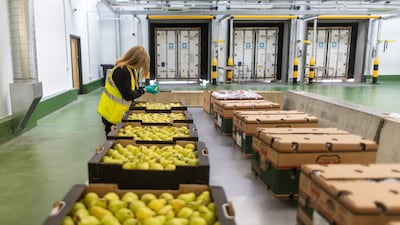
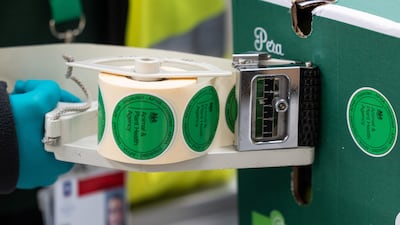
Inside a Brexit border control post – in pictures
“The UK is undeniably stronger when it works in lockstep with its closest international partners,” Mr Starmer said before the trip.
“This has never been more important – with war, conflict and insecurity all knocking on Europe’s door.
“We will only be able to tackle these challenges by putting our collective weight behind them, which is why I am so determined to put the Brexit years behind us and establish a more pragmatic and mature relationship with the European Union.
“Better co-operation with the EU will deliver the benefits the British people deserve – securing our borders, keeping us safe and boosting economic growth.”
No firm announcements are expected from what is the first formal meeting between Mr Starmer and the Brussels chiefs as part of his plan to reset UK-EU relations.
The European Commission said the meeting with Ms von der Leyen would be “the beginning of a conversation”.
The Prime Minister’s red lines for the reset rule out a return to the single market, the customs union or freedom of movement.
But pro-EU campaigners have pushed for him to give ground on a youth mobility scheme, something he has so far said he has “no plans” to agree to.
“Dismissing the idea of reciprocal youth mobility simply means letting down British young people, who face all sorts of economic difficulties and have seen their horizons curtailed by Brexit,” Sir Nick Harvey, chief executive of European Movement UK, said.
“Young people want and deserve the chance to study or work in Europe. The government owes it to them to make sure they get that chance.”
Cal Roscow, from Best for Britain, said: “Brexit robbed young Brits of irreplaceable opportunities to experience new cultures, meet new people and learn new languages while working, travelling and studying in Europe.
“The new government has the chance to give these formative experiences back to young Brits, with this universally popular scheme that the European Commission is already open to agreeing.”

Ten tax points to be aware of in 2026
1. Domestic VAT refund amendments: request your refund within five years
If a business does not apply for the refund on time, they lose their credit.
2. E-invoicing in the UAE
Businesses should continue preparing for the implementation of e-invoicing in the UAE, with 2026 a preparation and transition period ahead of phased mandatory adoption.
3. More tax audits
Tax authorities are increasingly using data already available across multiple filings to identify audit risks.
4. More beneficial VAT and excise tax penalty regime
Tax disputes are expected to become more frequent and more structured, with clearer administrative objection and appeal processes. The UAE has adopted a new penalty regime for VAT and excise disputes, which now mirrors the penalty regime for corporate tax.
5. Greater emphasis on statutory audit
There is a greater need for the accuracy of financial statements. The International Financial Reporting Standards standards need to be strictly adhered to and, as a result, the quality of the audits will need to increase.
6. Further transfer pricing enforcement
Transfer pricing enforcement, which refers to the practice of establishing prices for internal transactions between related entities, is expected to broaden in scope. The UAE will shortly open the possibility to negotiate advance pricing agreements, or essentially rulings for transfer pricing purposes.
7. Limited time periods for audits
Recent amendments also introduce a default five-year limitation period for tax audits and assessments, subject to specific statutory exceptions. While the standard audit and assessment period is five years, this may be extended to up to 15 years in cases involving fraud or tax evasion.
8. Pillar 2 implementation
Many multinational groups will begin to feel the practical effect of the Domestic Minimum Top-Up Tax (DMTT), the UAE's implementation of the OECD’s global minimum tax under Pillar 2. While the rules apply for financial years starting on or after January 1, 2025, it is 2026 that marks the transition to an operational phase.
9. Reduced compliance obligations for imported goods and services
Businesses that apply the reverse-charge mechanism for VAT purposes in the UAE may benefit from reduced compliance obligations.
10. Substance and CbC reporting focus
Tax authorities are expected to continue strengthening the enforcement of economic substance and Country-by-Country (CbC) reporting frameworks. In the UAE, these regimes are increasingly being used as risk-assessment tools, providing tax authorities with a comprehensive view of multinational groups’ global footprints and enabling them to assess whether profits are aligned with real economic activity.
Contributed by Thomas Vanhee and Hend Rashwan, Aurifer
How The Debt Panel's advice helped readers in 2019
December 11: 'My husband died, so what happens to the Dh240,000 he owes in the UAE?'
JL, a housewife from India, wrote to us about her husband, who died earlier this month. He left behind an outstanding loan of Dh240,000 and she was hoping to pay it off with an insurance policy he had taken out. She also wanted to recover some of her husband’s end-of-service liabilities to help support her and her son.
“I have no words to thank you for helping me out,” she wrote to The Debt Panel after receiving the panellists' comments. “The advice has given me an idea of the present status of the loan and how to take it up further. I will draft a letter and send it to the email ID on the bank’s website along with the death certificate. I hope and pray to find a way out of this.”
November 26: ‘I owe Dh100,000 because my employer has not paid me for a year’
SL, a financial services employee from India, left the UAE in June after quitting his job because his employer had not paid him since November 2018. He owes Dh103,800 on four debts and was told by the panellists he may be able to use the insolvency law to solve his issue.
SL thanked the panellists for their efforts. "Indeed, I have some clarity on the consequence of the case and the next steps to take regarding my situation," he says. "Hopefully, I will be able to provide a positive testimony soon."
October 15: 'I lost my job and left the UAE owing Dh71,000. Can I return?'
MS, an energy sector employee from South Africa, left the UAE in August after losing his Dh12,000 job. He was struggling to meet the repayments while securing a new position in the UAE and feared he would be detained if he returned. He has now secured a new job and will return to the Emirates this month.
“The insolvency law is indeed a relief to hear,” he says. "I will not apply for insolvency at this stage. I have been able to pay something towards my loan and credit card. As it stands, I only have a one-month deficit, which I will be able to recover by the end of December."
The specs: 2018 Ducati SuperSport S
Price, base / as tested: Dh74,900 / Dh85,900
Engine: 937cc
Transmission: Six-speed gearbox
Power: 110hp @ 9,000rpm
Torque: 93Nm @ 6,500rpm
Fuel economy, combined: 5.9L / 100km