


Live updates: Follow the latest news on the UK general election
The UK needs to recover the “art of grand strategy” to reinstate its overseas influence in a troubled world, drawing inspiration from countries such as France, India and the UAE, its shadow foreign secretary has said.
David Lammy outlined his prospective foreign diplomacy strategy on Friday at an Institute for Government event, with Labour hoping to emerge victorious in a general election expected later this year.
The UK could learn from France’s “hard-headed” economic diplomacy, and the “WhatsApp diplomacy” of President Emmanuel Macron, he said.
“We need to set out our own efforts – not only in the context of our closest competitors, such as the French, whose economic diplomacy can often feel more hard-headed and realist than our own.”
Other countries have risen on the world stage due to their ability to strike deals with all of the world’s great powers, he said.
“We also need to sometimes learn from the increasingly dynamic diplomacy approaches of countries like India, Brazil and the UAE,” he said.
Mr Lammy made several trips to the Middle East after October 7, as he sought to shape the Labour party’s response to the war in Gaza.
Last week, he made Labour's first call for a “pause” in arms sales to Israel, and shifted the party's position earlier this year when he called for an “immediate sustainable ceasefire” in Gaza.
The UK government’s relations with these Middle East countries were often strained over Gaza and other conflicts in the region.
“We absolutely need to work with the Gulf; this is hugely important for security in the Middle East. It’s important in relation to our economic growth missions,” he said, citing recent trips to Qatar and Saudi Arabia.
Asked whether relations with the Gulf could be improved, Mr Lammy said a Labour government would work towards this.
“I'm hugely concerned that at this time … the UAE and the United Kingdom, because of this government and missteps in this government, seem to have relations that are at an all-time low,” he said.
“That is not acceptable and is not in the UK's national interests. We will seek to repair that,” he said.
Labour Party through the years – in pictures
-
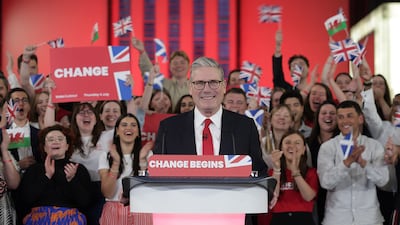
Labour leader Keir Starmer celebrates winning the UK general election with a speech at Tate Modern in central London in July. All photos: Getty Images -
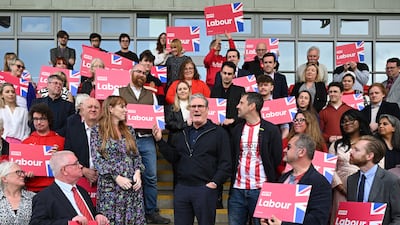
Deputy Labour leader Angela Rayner, and Mr Starmer meet party supporters in Harlow in May -
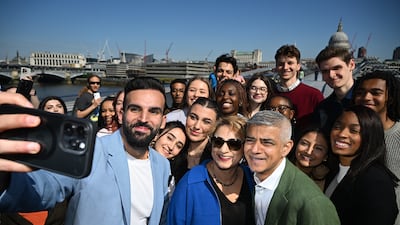
London Mayor and Labour incumbent Sadiq Khan, and his wife Saadiya Khan, pose with supporters after Mr Khan was re-elected in May -
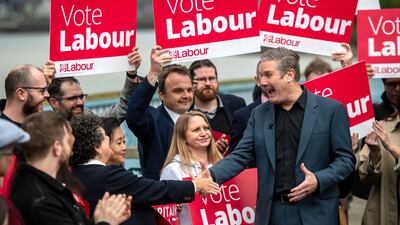
Mr Starmer meets and greets supporters in Chatham in 2023 -
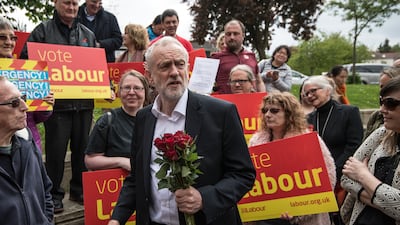
Then-party leader Jeremy Corbyn during a 2017 visit to Oxford -
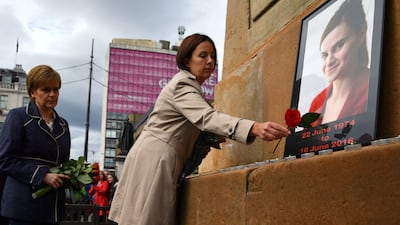
First minister of Scotland Nicola Sturgeon, left, and leader of Scottish Labour Kezia Dugdale place roses at a memorial for murdered Labour MP Jo Cox, in Glasgow in 2016 -
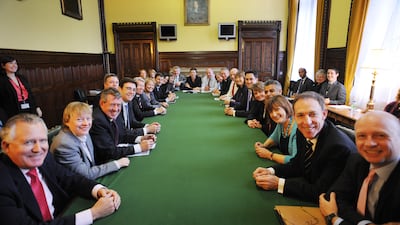
Labour leader Ed Miliband, sixth right, holds his first shadow cabinet meeting at the House of Commons in 2010 -
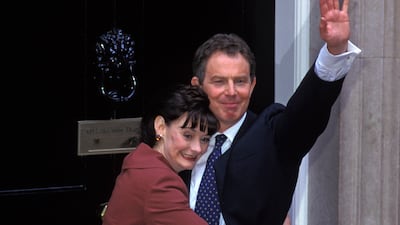
Newly elected Labour prime minister Tony Blair stands on the steps of No 10 Downing Street with his wife Cherie in 1997 -
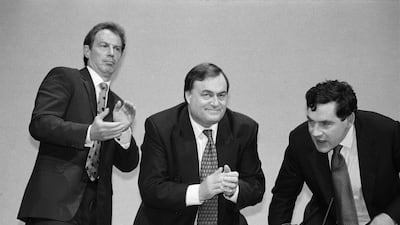
Mr Blair, John Prescott and Gordon Brown at the Labour Party Conference in 1997 -
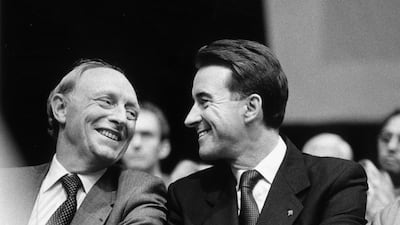
Former leader Neil Kinnock, left, shares a joke with Peter Mandelson, a key figure behind the party's 1997 general election landslide victory, at the party conference in 1997 -
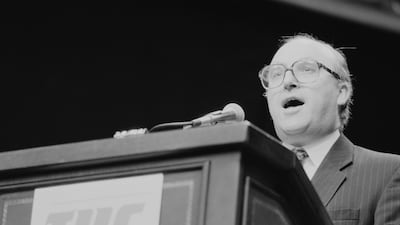
Leader John Smith addresses a miners' rally in Hyde Park, London, in 1992 -

Mr Kinnock with a group of youngsters publicising Labour's jobs And industry campaign in 1985 -
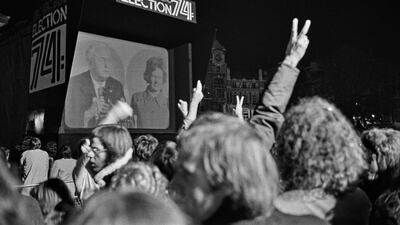
BBC TV coverage of the October 1974 general election, with Labour prime minister Harold Wilson and his wife Mary visible on a screen in London -
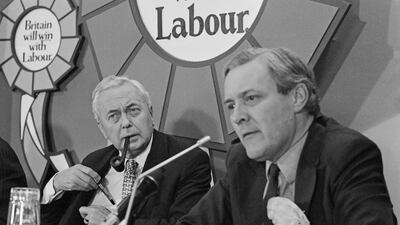
Mr Wilson, left, and Labour politician Tony Benn speaking at a press conference during the 1974 general election campaign -
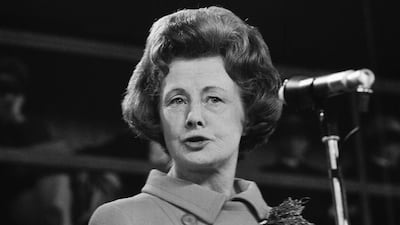
Barbara Castle speaking at the Labour Party Conference in 1969 -

Mr Wilson waving outside No 10 in 1964 -
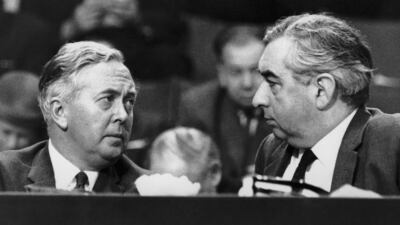
Mr Wilson, left, with deputy leader George Brown in 1963 -
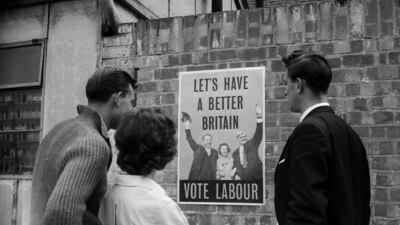
A campaign poster issued by the Labour Party depicting leader Hugh Gaitskell arm-in-arm with Barbara Castle and Aneurin Bevan in 1959 -
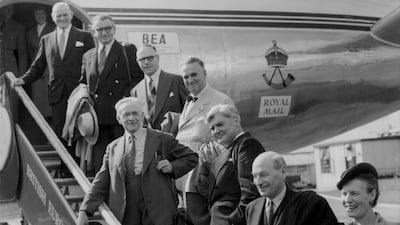
Party leader Clement Attlee with a Labour delegation, boarding a plane on their way to China in 1954 -
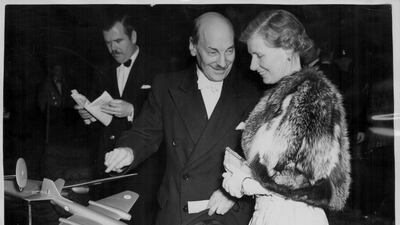
Mr Attlee and his wife Violet attending a film premiere in London in 1952 -

Members of the Labour cabinet at No 10 in 1929: Clockwise from top left: Tom Shaw, Arthur Greenwood, Noel Buxton, Sidney Webb, Arthur Henderson and prime minister Ramsay MacDonald -
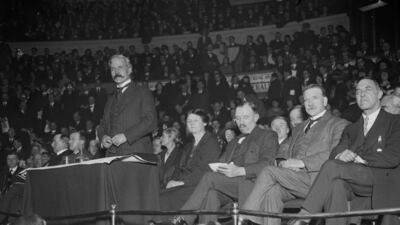
Mr MacDonald addressing a Labour victory meeting at the Royal Albert Hall, London, in 1924 -

From left, Mr Henderson, William Brace, William Adamson, Vernon Hartshorn and James Henry Thomas outside Unity House during a coal workers' strike, in London, 1920 -
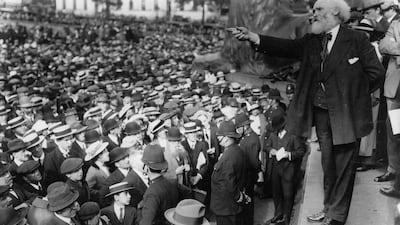
Scottish Labour politician James Keir Hardie addressing a peace meeting in Trafalgar Square, London, in 1914 -
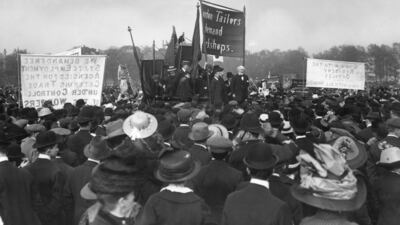
Mr Hardie speaks at a tailors' rally on May Day in Hyde Park, London, in 1912


Progressive realism
Called “progressive realism”, Mr Lammy's vision seeks to challenge global threats such as Russia's invasion of Ukraine, while also acknowledging the need for co-operation on climate change issues with China.
He said it was a practical, forward-thinking approach that would seek to find “common cause” with even the most divisive of leaders among UK allies, such as Donald Trump, if he were to be re-elected as US President.
The UK’s foreign and international development policies suffered from the merger of its two diplomatic arms into Foreign Commonwealth and Development Office in 2020, Mr Lammy said, speaking at the Institute for Governance.
Brexit, insufficient foreign investment in the UK and cuts in the UK’s overseas development spending meant the country “lost influence” on the world stage.
Conflicts in Ukraine and the Middle East, growing Chinese influence at the expense of the US and the need for global alliances to combat climate change are among the challenges that UK is grappling with, he added.
“At present neither the FCDO nor the National Security Council is delivering the sharp, coherent international strategy that the country urgently needs,” Mr Lammy said, days after returning from a trip to Ukraine.
“Without such strategy, we should expect to be buffeted by the tides of superpower competition, not only between the United States and China, but also by the many rising powers who are threatening our competitive advantages economically and militarily.”
With a potential Labour government making growth its priority, so would the UK’s diplomatic arms focus on economic relations, Mr Lammy said.
“On a whole host of areas – on AI, on climate, on rare earth minerals – we have to be front and centre-focused. It’s that alignment that I want to see from the FCDO,” he said.
He promised that Labour would establish a “college of diplomacy”, teaching courses in areas such as languages and AI (artificial intelligence), which would be open to all of Whitehall, as well as foreign mandarins “from friendly countries”, as part of a Foreign Office shake-up.
The college, which would replace the Diplomatic Academy, would seek to set the “global gold standard” for both diplomacy and development, Mr Lammy said.
More Foreign Office staff should be working in the field, rather than from the headquarters in London, and AI could be used to free up time for diplomats to concentrate on “front-line activity”, he added.
Labour will create a “soft power council” that will bring arts professionals and academics to work with the British Council and the BBC World Service to “advance national interests”, Mr Lammy said.

