


Among the millions of visitors who will gather in Paris for the Olympics, few will notice police officers carrying the latest weapon in the battle to ensure the showpiece event runs smoothly.
It looks like a bazooka and the way it works can be compared to a Spider-Man-style web flinger.
The shoulder-mounted device, called SkyWall Patrol, can fire a net high into the air, trapping any drones hovering above the French capital.
Developed by the UK's OpenWorks Engineering, the handheld anti-drone equipment will be used alongside GPS jammers and other high-tech technology to help keep the skies safe across the French capital.
France will be on its highest security alert amid tension in Europe over the war in Gaza, escalating violence across the Middle East and the Russian invasion of Ukraine.
Tough-talking Interior Minister Gerald Darmanin has appeared in public holding the anti-drone equipment, aiming to show the world that the French government means business when it comes to keeping the Paris 2024 Games safe.
The threat of drones is one of the many security headaches the city faces, beginning with the opening ceremony, which this year will depart from the convention of being held in a stadium, but will instead be focused on the Seine river.
defence consultant
That leaves a much greater area to defend and, say analysts, opens the door to a drone threat.
“Drones have a huge potential at these mass events. Explosives can be carried on a typical drone,” industry expert Chris Bigwood told The National.
SkyWall Patrol is designed to ensure any drones considered a threat are brought down harmlessly, rather than being shot out of the sky, which raises the risk of debris injuring people.
An on-board system locks in the target drone, automatically compensating for speed and range, before a projectile is launched using highly compressed air.
Once the projectile hits the drone, a net is released to capture it. Both the drone and the projectile then drop gently to the ground using a parachute.

OpenWorks says its invention is better because traditional weapons often fail to intercept drones and do not offer a proportionate response to the threat.
Using electronic jammers alone can often result in the drone simply returning home.
“Unfortunately, the threat of drones to public safety continues to grow,” the company said.
Mr Bigwood said hand-held systems are part of the “wide variety of anti-drone applications in place”, including electronic warfare and “they all have their unique place in the counter-drone arena”.
“The protection available today is highly effective, there are multiple solutions that the government, police and defence forces are using, both electronic and physical. With a combination of these I would feel safe at a gathering like the Paris Olympics.”
He said that law enforcement and other authorities are always striving to keep ahead of the drone threat “which they don’t always advertise”.

The Russian invasion of Ukraine and use of drones has greatly accelerated the development of technology in the past two years.
“With every threat there is a counter-threat and another threat on top of that. The dark characters of the world are always looking for more counter solutions. I've attended events testing these systems and the counter systems are incredible,” said Mr Bigwood.
Security operation
The arrival of the Olympic flame in Marseille has set the ball rolling for the large-scale French security operation for Paris 2024.
About 6,000 law enforcement officers, snipers and dog units secured the city's Old Port for the event, which served as a stress test for the Games organisers.
-
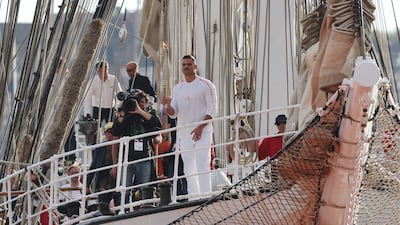
French swimmer Florent Manaudou carries the Olympic flame as it arrives on Wednesday at Marseille port, France. Getty Images -
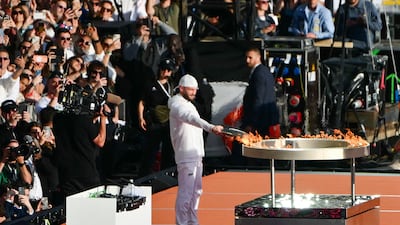
French rapper Julien 'Jul' Marie lights the Olympic and Paralympic Torch Relays cauldron at the Old Port in Marseille. AFP -
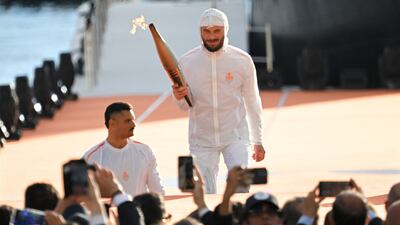
Jul holds the Olympic Torch next to Manaudou during the arrival ceremony. AFP -
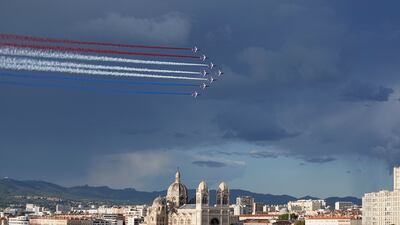
The Patrouille de France aerobatics team leave a tricolour trail of smoke as the Belem, the three-masted sailing ship bringing the Olympic flame from Greece, enters the Old Port in Marseille on Wednesday. AP -

Fireworks erupt at the Old Port during the arrival ceremony. AFP -
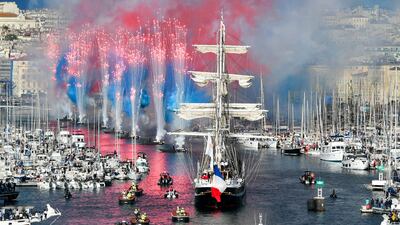
Fireworks follow in the wake of the French 19th century barque Belem as it arrives in the Old Port of Marseille with the Olympic Flame. AFP -

The three-masted Belem enters the Old Port in Marseille, southern France. AP -
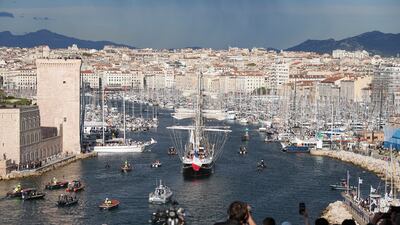
Crowds watch the Belem's arrival from Greece. AP -
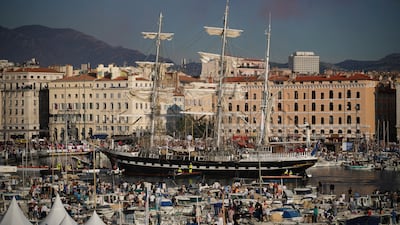
The Belem enters the Old Port on Wednesday. AP -
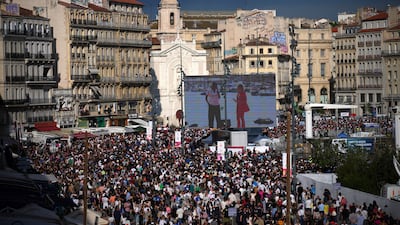
Crowds watch the welcoming ceremony for the Belem and the Olympic Flame in Marseille. AP -
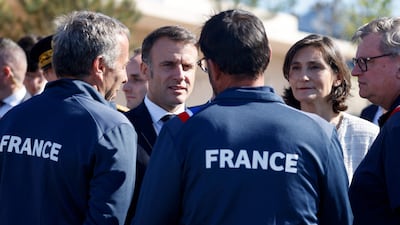
French President Emmanuel Macron and Minister for Sports and Olympics Amelie Oudea-Castera meet Olympics federation officials and French sailing team managers in Marseille. AFP -
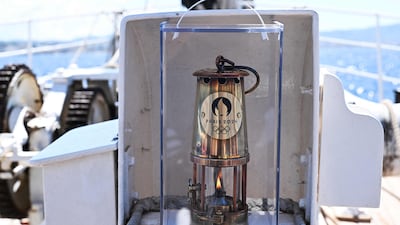
And here it is ... the flame remains lit! AFP -

The Olympic torch has arrived in France. Getty Images -

The Belem carried the Olympic flame into Marseille. AFP -
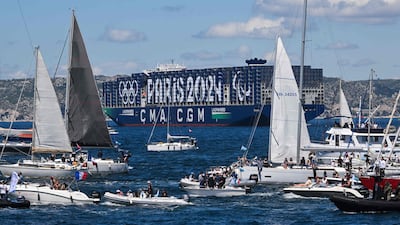
The arrival was met with a parade of boats in the Mediterranean of France's southern coast. AFP -

The nation is getting geared up to host the Olympic Games in summer. AFP -
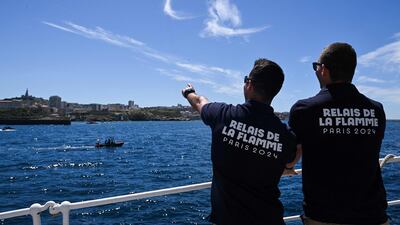
It is now only 79 days until the opening ceremony takes place in Paris. AFP -
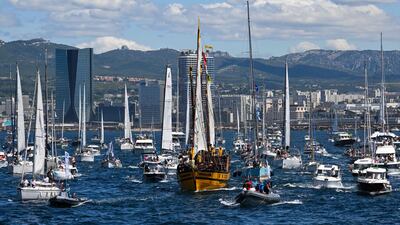
The torch will now complete its 12,000km journey by being carried through mainland France. AFP -
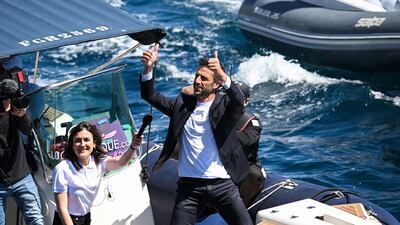
Tony Estanguet, president of the Paris 2024 Olympics and Paralympics Organising Committee, greets the French 19th-century three-masted Belem on its arrival. AFP -
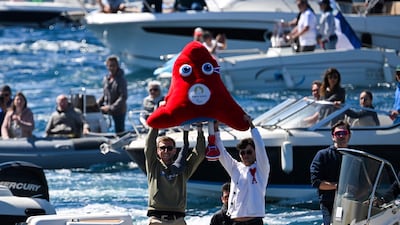
The Olympic 'Phryge' mascot makes an appearance. AFP -
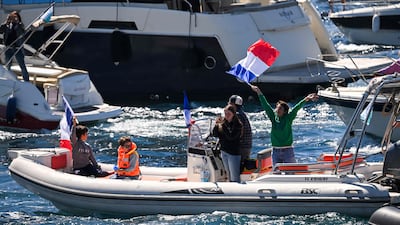
A French flag is unfurled as the excitement builds. AFP -

The Mucem museum offers an ideal vantage point from which to see the Belem sailing into Marseille. AP -

France is now gripped with Olympic fever. AFP


Surveillance and robots
The French authorities have placed technology at the heart of their security operation, including the use of artificial intelligence.
Four companies – Videtics, Orange Business, ChapsVision and Wintics – have developed AI software that analyse video streams coming from existing surveillance systems to help identify potential threats in public spaces.
Their algorithms are trained to detect predetermined “events” or abnormal behaviour and send alerts accordingly. Humans then decide if the alert is real and whether to act on it.
The technology could be pivotal in thwarting an attack similar to the bombing at the 1996 Olympics in Atlanta or the Nice lorry attack in 2016, officials say.
Robotic dogs will be used before the Olympics by the RAID French national police unit that specialises in searching for explosives.
The threat of drones came into sharp focus during last year’s Rugby World Cup, which served as a dress rehearsal for the French police’s measures.
At least 24 drones were neutralised by jamming during the seven-week event.

There are an estimated three million drones in France, many of them privately owned, and the police and the Interior Ministry said they are working hard to prevent any unauthorised flights over the capital.
“Drones represent a very high-level threat because they are easy to use, there are a huge number of them in France and converting them into weapons is simple and very affordable,” said defence consultant Marc Chassillan.
“It doesn't require much logistical organisation.”
In the lead-up to the games, an anti-drone co-ordination centre has been set up at a military base at Villacoublay, just outside Paris, where police, gendarmerie and army officers will work together to contain threats.
Officers will monitor air traffic during the Olympics to identify drones, either with radar or pictures sent by officers on the ground at the Olympic sites.
Some of the drones will be identified as "friends" while others will be taken down.

Gen Arnaud Bourguignon, the officer in charge of air and anti-drone protection for the Games, explained some of problems facing his teams.
“Drones can be used to carry out a protest, or with a terrorist intent. We've seen that it is easy to use a drone for other purposes and turn it into a weapon,” he said.
“Some drones are being used by the media, but also to referee some events, so we cannot just ban them altogether.”
Hiccups
Preparations have so far not gone entirely smoothly and according to recent reports the Parade drone detection system has been hit by glitches.
During an exercise, Parade was reportedly only able to detect one out of three malicious drones sent to test it at a distance of 800 metres.
Mr Chassillan said urban environments make the job of anti-drone radar “extremely difficult”.
Trees, buildings and monuments act as a screen and allow a drone to appear at the last moment,” he said.
“The other big fear is a swarm of drones and their saturation effect.
“If 150 drones attack the crowd during the opening ceremony and one of them passes through, it's enough to spoil the party.
"Especially as the Seine is like a canyon, with plenty of perpendicular streets that can act as access corridors for drones.”

