

Live updates: Follow the latest on Israel-Gaza
A UK-led team of emergency doctors was among the last to flee Gaza after Israel announced its imminent attack on Rafah, the strip’s last place of refuge.
Led by British surgeon Prof Nick Maynard, the team of doctors from the UK, Egypt and Kuwait had been in Gaza on a two-week mission with Medical Aid for Palestinians (MAP), a UK charity, and the International Rescue Committee.
Though the team had originally planned to leave Gaza on Monday, they did so under more difficult circumstances after the Israeli military ordered an evacuation of eastern Rafah that morning.
The team drove into Rafah and towards the border crossing, where an Israeli military air strike landed “very close” to its convoy, an MAP representative said.
Naufal Rashid, a British doctor and anaesthetist with the team, witnessed harrowing scenes as Palestinians sheltering in Rafah were forced to pack their belongings once again – with no certainty about where to go next.
“The situation in Rafah was extremely tense yesterday,” he told The National on Tuesday, after his safe arrival to Cairo. "There was a palpable sense of fear among the population, who essentially had nowhere safe to go."

The team had been working from Gaza’s Al Aqsa Hospital, in Deir Al Balah in the central Gaza Strip, to support hospital staff and the capacity of the healthcare system.
Though the evacuation had only been ordered that morning, the journey from Deir Al Balah through Rafah and to the crossing was not safe. “We encountered non-stop bombing surrounding the crossing – close enough that the buildings were shaking,” he said.
“We were very uncertain as to whether we would be allowed to cross at all but permission came suddenly after two hours and we safely went on to the Egyptian side."
Israeli forces took control of the border crossings on Monday, and the doctor feared they could have narrowly missed their chance to leave. “We subsequently found out that a few hours after we crossed, Israeli tanks had entered the Gazan side of the crossing and we were probably the last people out,” he said.
Rafah is said to be sheltering an estimated 1.5 million people, many of whom have been displaced several times since the beginning of the war.
Agencies warn that an offensive in the city would have devastating implications and people in Rafah have nowhere else to go.
“As we moved towards the border crossing we saw people leaving east Rafah, carrying all their belongings by foot, on carts pulled by donkeys, by any means they could,” Dr Rashid said.
“With children lugging heavy bags, tractors and carts transporting mattresses, essentially anything they can take with them."
Calling on the UK government to help stop an assault on Rafah, Dr Rashid said: “This invasion of Rafah is a catastrophe and the limited aid that has been entering will be further disrupted. What remains of the civilian infrastructure will be destroyed and the number of civilians killed will continue to rise.
“The UK government must work urgently to stop this assault on Rafah and work to achieve a permanent ceasefire."

This was MAP and the IRC’s sixth emergency medical team into Gaza since December, when the charity was first able to send overseas doctors into the strip. MAP has said it will continue operations inside Gaza.
Marah, a Mercy Corps aid worker whose full name was withheld, said she and her family did not know where to go.
After the bombing of the Nuseirat refugee camp in central Gaza, her options had narrowed to Deir Al Balah. “The shelter in Deir Al Balah isn't ready yet for us to move there, but I consider it to be a safer choice [than Rafah]."
She and her family were considering giving up some of their belongings so they could move faster out of Rafah.
Saleem, another Mercy Corps aid worker, told The National he was struggling to plan the next steps.
“Evacuating Rafah and moving to the middle of the strip is one of the most challenging things right now,” said Saleem, whose real name has been withheld for security reasons.
He is among the 1.5 million people who will be seeking to flee Rafah northwards at the same time.
“If you manage to secure transport, the cost is exorbitantly high, often tens of times greater than usual,” he said, adding that the average price for a ride to central Gaza was now 1,000 shekels ($270), with the cost rising daily.
He feared the famine and widespread disease seen in the north of Gaza – where Israel’s campaign had been centred in the first months of the war – would soon in emerge in the south.
“There's a genuine concern for a repeat of the famine scenario seen in the north,” he said. "We anticipate similar repercussions, such as the collapse of the health system, where even moderate infections resulted in fatalities.
“The hospitals in the north were more extensive and better equipped in terms of staff and resources than the south."
The cost of food had “skyrocketed” on Monday, said Nader, another aid worker with Mercy Corps.
“Just a few weeks ago, I was able to buy sugar for 10 shekels due to increased availability. However, yesterday, the price of a pack of sugar reached to 70 shekels,” he said.

Efforts were under way to relocate some hospitals and medical aid organisations to areas such as Al Mawasi or near Khan Younis, he added.
Warehouses, distribution sites and transport routes risked being in the “line of fire” should the city become the new epicentre of the fighting, said Milena Murr, a Beirut-based spokeswoman for Mercy Corps.
“If that happens, the prospect for a continued aid response reaching any Gazans with life-saving assistance is grim,” she added.
Aid workers sheltering in Rafah faced an “impossible choice”. “They can stay and face bombardment or attempt a perilous journey to an unliveable area with virtually no remaining infrastructure or access to aid. 24 hours is clearly not enough time,” she said.
-
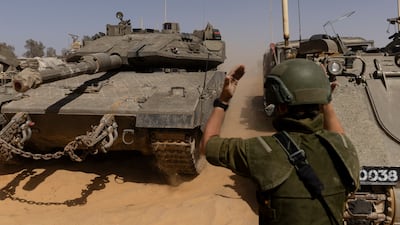
An Israeli soldier directs a tank near Israel's border with southern Gaza. Getty Images -
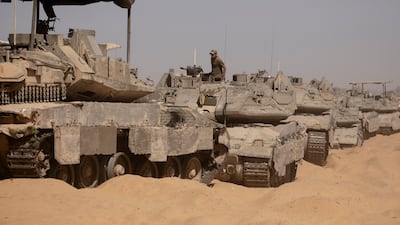
An Israeli soldier stands on a tank in southern Israel. Getty Images -
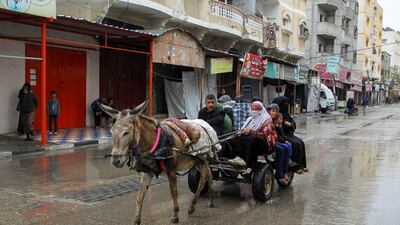
People flee the eastern parts of Rafah ahead of a threatened Israeli incursion. Reuters -
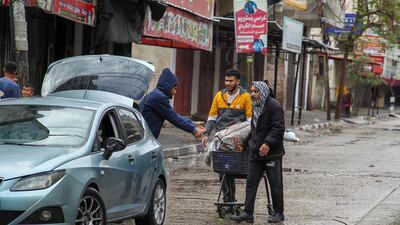
Palestinians leave ahead of a threatened assault on Rafah. Reuters -

Palestinians search for casualties in the rubble of a house destroyed in an Israeli strike in Rafah. AFP -
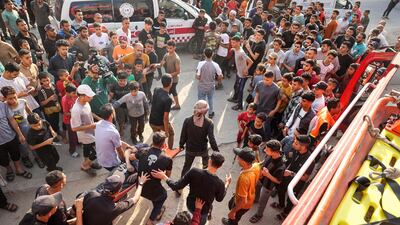
Palestinians carry an injured man who was pulled from the rubble of a house destroyed in an Israeli strike in Rafah. AFP -
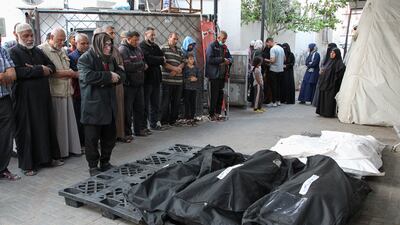
Mourners next to the bodies of Palestinians killed in an Israeli strike in southern Gaza. Reuters -
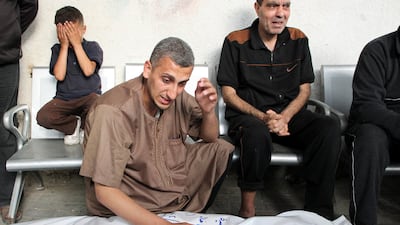
Mourners at Abu Yousef El-Najjar Hospital in Rafah. Reuters



