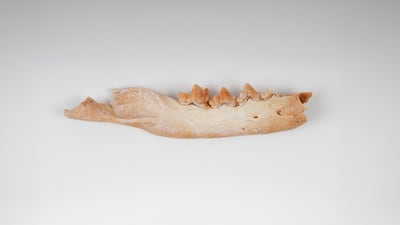

A new carnivore species that lived about seven million years ago has been discovered at a fossil site in Al Dhafra region of Abu Dhabi – and the creature has been named after the emirate.
Known scientifically as Promegaviverra abudhabiensis, the creature, a type of civet, was identified from part of a jawbone discovered on Shuweihat Island about 265km west of Abu Dhabi city.
The animal, which may have weighed at least 20kg, represents an important link for scientists, as it provides evidence that giant civets migrated through ancient Arabia from Asia to Africa.
Palaeontologists at the Natural History Museum Abu Dhabi who found the fossil have revealed details of the creature in a paper in the Fossil Record journal, co-written with a carnivore specialist who identified it as a new civet species at a Spanish university.
It is the first viverrid – a family of carnivores that includes civets and genets – found on the Arabian Peninsula.
Hanneke Jacobs, a collections management senior specialist at the museum, discovered the first fragment of the jawbone at the Shuweihat 2 fossil site in late February.
An intensive search of the area took place and, within about a metre of where the original fragment was discovered, a team of scientists including Dr Mark Beech, the museum’s head of geoscience, and Dr Luca Bellucci, the museum’s palaeontology curator, found three more fragments.
The four pieces fitted together to form the carnivore’s right hemimandible, or lower jaw.
“We worked all around where the first specimen was found and we were super happy when we realised this one joined to this one,” Dr Beech said. “It was great that we found that. It shows that you really have to be persistent.”
Then the scientists had to identify what creature the hemimandible belonged to.

Digging up answers
Their first suspicion was that it could be from a wolverine, a small to medium-sized mammal whose present-day representatives are known for their ability to kill much larger prey, but they determined that the teeth were different to those of a wolverine.
A carnivore specialist, Dr Alberto Valenciano, an assistant professor at the Complutense University of Madrid, was brought in to identify the animal.
“That’s the thing about science. You find a new specimen and it leads you on a detective trail and that detective trail led us to Alberto,” Dr Beech said.
Rather than sending the specimen, the Abu Dhabi researchers forwarded a digital 3D model for Dr Valenciano to analyse.
“Sharing of models and specimens is not like the old days, because the technology is so great now,” Dr Beech said. “It’s normal when you do palaeontology publications to share the 3D model of the specimen as well. Many museums now have 3D printers so you can print your own replica to help visual and direct comparisons.”
Dr Valenciano said the creature was identified by eliminating other carnivores known to have lived in the area, among them sabre-toothed tigers and hyaenids as well as wolverines.
“The single option we had left was the viverrid,” Dr Valenciano said. “Then we performed a specific analysis to see how is the relationship with other viverrids, and we had the conclusion it was a new genus and a new species.”
Named after Abu Dhabi
The species name, abudhabiensis, translates as "of or from Abu Dhabi" in Latin.
Just a year earlier, Dr Valenciano had suggested in a scientific paper that animals like the one discovered had passed through the Arabian Peninsula on their way from Asia to Africa.
Although the fossil site is near the coast, seven million years ago, during the late Miocene geological sub-epoch, the adjacent sea did not exist and the landscape was unrecognisable from today.
“You have to imagine a flatter landscape with giant rivers running through the area, savannah grasslands, wooded tree areas … so you have a sort of riverine fauna, which is hippos, crocodiles, fish, catfish and turtles in the river,” Dr Beech said.
“In the savannah grasslands you’ve got hipparions grazing. Hipparions are the ancestral three-toed horse. Those are the most common fauna.”

Shuweihat 2 contains material from the Baynunah Formation, which is made of sands, clays, and other materials deposited by rivers, and the new specimen was preserved by being buried beneath the surface. Dr Beech has been visiting the site for decades.
“It’s so exciting that I was there 20 years ago and [now] we find something that’s a new genus and a new species,” Dr Beech said.
The researchers are keen to highlight that only people with the required permits are allowed to search for material at the site.
“Not everyone can go and collect fossils. It’s not like Indiana Jones. It’s important to be authorised,” Dr Bellucci said.
He added that the find was especially welcome as it was made only a short time after Abu Dhabi Natural History Museum opened in November 2025 and details are being published around the museum’s first anniversary.
The museum brings together a range of Miocene fossils, Dr Bellucci said, and displays original fossils and, behind them, models of the animals they came from.
Future display
The newly discovered fossil is not yet on display, but it is likely to be on show in the future. “Now I have to ask Alberto to help us to work together to do the model of this animal. We should try to reconstruct,” Dr Bellucci said.
Dr Valenciano will present details of the new find at a palaeontology congress in South Africa at the end of this month. He is the first author of the Fossil Record paper, which is also written by Dr Bellucci and Dr Beech.
In March next year, Dr Beech and his colleagues plan to carry out more fieldwork at the Shuweihat site, opening the possibility of other interesting finds.
“Hopefully we’ll have more surprises to announce,” Dr Beech said. “We’ve been visiting this site for 20 years and it’s amazing that we’re still discovering new fossils.”

