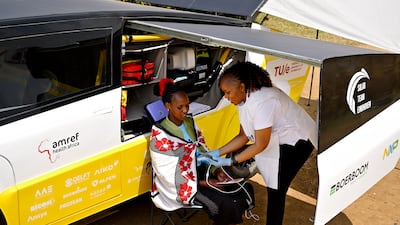

Access to medical treatment is a challenge for people in remote areas that lack health infrastructure, but two companies are harnessing technology to provide care to those off the grid or on the front lines.
Solar Team Eindhoven was started by 23 students from Eindhoven University of Technology, in the Netherlands, who saw a critical gap in preventive health care and decided to fill it.
The result is Stella Juva, billed as the world's first solar-powered ambulance. The off-road vehicle, on display at Dubai Future Week, was built and tested during a self-funded gap year.

“Everyone stopped their studies for a year to build this car,” Thomas Derks, 22, structural engineer at Solar Team Eindhoven, told The National. “We just joined the team because everyone is passionate about this goal.”

“We can basically drive anywhere in the world. We are not dependent on roads and electricity,” Mr Derks said. “With this vehicle we don't bring people to the hospital, but we bring health care to the people themselves.”
While it cannot provide a sterile environment for surgery, Stella Juva can take preventive medicine and first aid to areas lacking access to health care. The vehicle has a range of more than 700km on a sunny day.
“We have an X-ray, we have an echo, an ultrasound [scanner], but we also have a cooling box in the back of the car to carry medicine or vaccines, so for that you can provide anything just by the solar energy.”

The ambulance has been tested in several parts of rural Kenya in collaboration with Amref Health Africa, a large health development organisation, and it showed it could provide medical care to around 200 people over two days.
“This could truly be a game-changer,” said Geoffrey Sadera, project lead for maternal and child health at Amref Health Africa. “If we could deploy Stella Juva in these areas, the potential impact could be enormous: we could identify risks earlier, intervene sooner, and ultimately save lives.”

Critical link from front lines
While providing medical care physically in remote areas is critical, another company is supplying a quick digital connection to specialists for life-saving treatment in combat zones and isolated locations.
Military medics treating wounded soldiers on the battlefield could soon receive real-time guidance from specialist doctors hundreds of kilometres away, using a communications system unveiled in Abu Dhabi.
Developed by US medical technology company LifeBot, the Medical Command Network allows front-line personnel to share patients’ vital signs and medical information with doctors at remote command centres, helping them to make potentially life-saving treatment decisions.
The system, unveiled at the World Congress of Military Medicine at Adnec, is built to operate in deployed and remote care settings where communication networks may be unreliable, using a diverse range of connections. It is designed to ensure patients receive continuous care as they are evacuated from the battlefield.
“The goal is to increase the quality of service offered, and to save lives. Usually the problem is that the medic is in one place and the physician is in a different place,” Sherif Mohallal, president and chief executive of LifeBot, told The National.
Artificial intelligence is used to analyse medical information and recommend treatments, but the company says doctors will always have the final say.
“We don't think that the time will come that you can totally replace the medical personnel,” Mr Mohallal said. “AI can offer them a lot of support, but at the end the physician has to take the decision of what needs to be done.”

How it works
Made up of linked stations, the network connects nurses on the ground – along with the patient's live vital signs and video feeds – to a command centre with doctors and patient records.
The communications layer within each station, called the Intelligent Communications Management, switches between networks, from Wi-Fi to cellular to satellite to data radio, for example, based on availability.
“If the connectivity is lost for any reason, the systems continue working, capturing the data, and once the connectivity back, it streams everything back to the medical facilities and authorities,” Mr Mohallal said.
The region was a natural launching point for the project, he said, given the current war, which has required swift medical responses. The company has been deploying systems in the region for more than 10 years.
“The region here adapts, and adjusts the technology for its needs. It is very well educated and knows exactly what it needs. We see a lot of potential coming with what's happening here, because this technology has become a necessity,” he said.
Cyberattacks on the infrastructure are difficult for enemy actors to carry out, because the system is encrypted and run securely through closed military networks, Mr Mohalla added.

