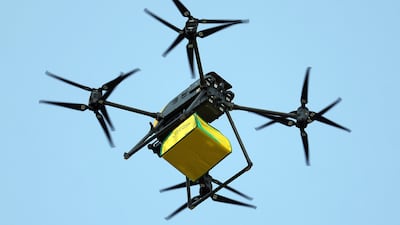
Dubai residents living in villa communities will soon be able to receive food deliveries directly by drone, avoiding delivery riders completely.
Keeta Drone is introducing a new delivery system in Nad Al Sheba and Sobha Hartland, under which drones will fly to and hover above homes, then lower packages to customers by cable.
The technology was showcased at Dubai Future Week on Wednesday, where a drone delivered a package from Sobha Hartland to Museum of the Future as part of a live demonstration.

The service aims to reduce delivery times and ease traffic on Dubai's roads. It could also help delivery riders avoid working outdoors during the hottest hours of the day in high summer.
Unlike existing drone delivery services, which require customers to collect orders from designated stations, the new system is designed to deliver packages directly to people.
Junwei Yang, general manager of Keeta Drone, told The National the technology would make deliveries more convenient for residents and could eventually become a common sight across Dubai.
The new drones have completed document reviews and flight testing under the supervision of the Dubai Civil Aviation Authority, confirming they are ready to begin operations in the emirate.
How will it work?
The new M-Drone 4L uses a cable system to lower food and other packages while hovering about 15 metres above the ground. Customers can collect their orders without the drone needing to land outside their homes.
Mr Yang said the system was particularly suited to villa communities, where residents tend to have outdoor space to receive packages.
Keeta already operates drone delivery services in parts of the emirate, including Dubai Silicon Oasis, RIT University Dubai and Dubai Land Residential Complex, but customers have to pick up orders from designated kiosks rather than from their doorsteps.
The new drone can carry packages weighing up to 4.5kg and travel up to 20km one way. It flies at an average speed of about 43kph and can operate at night.

The company says flying directly to customers could save time compared with deliveries by road, particularly in communities farther from restaurants and shopping centres.
The technology will eventually be used to deliver groceries, medicine and other everyday essentials.
Keeta has previously signed an agreement with Sobha Realty to introduce drone deliveries across its residential communities.
Sobha Hartland is expected to become one of the first residential communities in Dubai in which customers can order drone deliveries through the Keeta app.
The company plans to expand the service next year.
How safe are drone deliveries?
Mr Yang said safety remained one of the biggest priorities, particularly as the company prepares to fly drones closer to people's homes.
The drones have several systems designed to prevent accidents if something goes wrong during flight.
They are fitted with eight propellers and can continue operating if one fails. An automatic parachute can also be used in an emergency to reduce the impact if a drone falls.
A separate monitoring system can send instructions to a drone if it experiences technical problems and help it return safely.
Mr Yang said the company had designed and manufactured its own drones to ensure the equipment can operate reliably in varying conditions. This included testing them in extreme heat, humidity and cold weather.
The company has worked closely with the authority since 2024 to assess the risks of operating drones in residential areas.

The authority has now completed its review of the latest drone and supervised flight tests ahead of its introduction in Dubai.
"We have been constantly working with DCAA to make sure before launch we cover all the parts related to the safety issues and the risk issues," said Mr Yang.
Staff are also trained to handle emergencies and follow procedures if a flight encounters problems.
Will drones replace delivery riders?
Mr Yang said drones were intended to support existing delivery services rather than replace riders.
He said the technology could be particularly useful during summer, when delivery riders face difficult working conditions because of extreme heat. "We are not going to fully replace the human delivery," he said. "We are just one way of complementing the ground service."
The company also hopes the service will reduce the number of delivery vehicles making short journeys through residential neighbourhoods.
However, Mr Yang said making drone deliveries cheaper than traditional services was not the company's immediate priority.
For now, Keeta is focusing on improving the service and making it easier for customers to receive orders.
He said costs could fall as the company improves its technology and completes more deliveries.
The company is also exploring deliveries to parks, beaches and other public spaces, where customers could collect orders from designated stations.
He believes drone deliveries could eventually become part of everyday life in cities around the world, including Dubai.
"When we expand, we can learn and then adapt so that it will increase the pace for future adoption here," he said.

