A senior Abu Dhabi environmental leader has spoken of her pride at how the country proved “ready and prepared” to protect precious natural resources at the height of the Iran war.
Dr Shaikha Al Dhaheri, secretary general of the Environment Agency Abu Dhabi (EAD), said critical efforts to limit the impact of the sustained conflict highlight the importance of the emirate's commitment to guarding against future threats.
She said “risks were mapped and our action plans were ready” – even before the consequences of the onset of the war on February 28 were laid bare.

“I'm so proud that Abu Dhabi and the Emirates as a whole were very ready and prepared for any environmental circumstances that could emerge,” Dr Al Dhaheri said, in an interview to mark the 30th anniversary of the EAD.
“We have already built up people to be ready to respond, we have built systems that predict what could be coming, and also we were ready to take the actions if, God forbid, [something] happens. I would say we were prepared.”
Stepping up defences
At the peak of the war, Iran struck the UAE and other Gulf states with a barrage of ballistic missiles and drones in an attempt to strike civilian infrastructure, including energy sites and airports.
The prolonged attacks had a severe cost, not only in human life but also for the environment, due to fears over the impact of tanker strikes and port and refinery attacks on delicate marine ecosystems.
Such concerns were brought into sharp focus when an oil spill caused by a suspected Iranian drone attack on a supertanker in the Arabian Gulf in October prompted a major environmental response, with beaches closed and fishing activities halted across the Emirates to allow for a major clean-up operation to take place.

The challenges of the past year have reinforced Dr Al Dhaheri's proactive approach to bolstering the capital's environmental defences.
“This situation has given us a new lens to look into how far we can uplift our capabilities and be further prepared,” she said.
Maitha Al Hameli, acting executive director of territorial and marine biodiversity at EAD, agreed that preparedness was put to the test and that they came out stronger.
“Even though it was a challenging year, it was a time for us to test all our programmes, test all our systems, and we were on point on everything. We're flexible and agile,” said Ms Al Hameli.
Landmark achievements
The agency is reflecting on milestone achievements and looking forward to the future with hope as it celebrates 30 years as the main custodian of Abu Dhabi's natural world.
Over the past eight years, Abu Dhabi’s sustainable fishing index has risen from 8 per cent to 100 per cent, while the agency has planted more than 75 million mangroves across the emirate and maintained 20 per cent of marine and terrestrial areas as protected areas.

Ms Al Hameli is particularly proud of Abu Dhabi's dugong conservation programme – the emirate's waters are home to the second-largest population of the species in the world.
“I've seen the dugong population throughout the years, how it's been growing. Today we are at 3,500, the biggest dugong population in the Gulf and the biggest dugong population outside of Australia,” she said.
In Ms Al Hameli's 18 years with the agency, she said she has witnessed an encouraging rise in interest among Emiratis in the environmental sector, which she describes as her proudest achievement.
“It's very heartwarming, and sustainable at the end of the day. The people of the country are the people who are leading the environment conservation,” she said.
“The environment is the reason our forefathers survived here. This was a harsh environment, but it was the environment they survived on.”

Looking to the future
Abu Dhabi is on a mission to become one of the world's most liveable cities, and the environment is at the heart of that aspiration.
Abu Dhabi Executive Council has allocated Dh42 billion to the next phase of Abu Dhabi’s Liveability Strategy, with the EAD eager to play its part in improving quality of life for all.
“Our priority would definitely be making Abu Dhabi liveable when it comes to its environment,” said Dr Al Dhaheri.
“For that we would really focus on issues related to climate change, making the city ready and resilient to face any of the unprecedented weather events, as well as issues to do with direct public health like air quality,” Dr Al Dhaheri said.
-
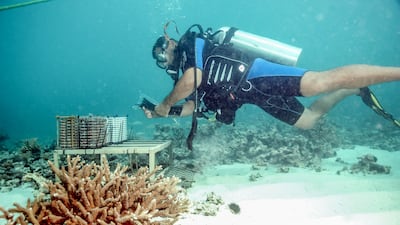
Environment Agency Abu Dhabi's marine ecosystem preservation and rehabilitation programmes have been ranked among the world's best. All photos: Environment Agency Abu Dhabi -

Abu Dhabi is home to a rich and abundant natural ecosystem. -

The Environment Agency Abu Dhabi plays a crucial role in protecting and championing the emirate's natural resources. -

Sea turtles are regularly rehabilitated by Environment Agency Abu Dhabi -

The emirate’s waters host a population of more than 700 dolphins, most of which live in marine protected areas — including the largest group of Indian Ocean humpback dolphins in the world


The agency launched its Strategic Plan 2026–2030 in January to further incorporate AI and predictive environmental actions into its work, with nine priorities and 170 benchmarks set out.
“For our next journey, it focuses on a strategy that is built around science, innovation, and of course, advanced technology to make sure that Abu Dhabi is resilient but also thriving for many generations to come,” Dr Al Dhaheri said.
In her 26 years with the agency, the secretary general has seen just how critical environmental work across the emirate has become. The data she collected as a field scientist is now part of an expansive body of data used to monitor and improve the emirate's environment.
“We have seen [Abu Dhabi's] biodiversity thrive, whether it's dugong, dolphins, or fish, and because of such richness, it puts a bigger responsibility on us to make sure that the quality of life for the species as well as people is well protected. It should be thriving in harmony with the fast pace of development and the economy."