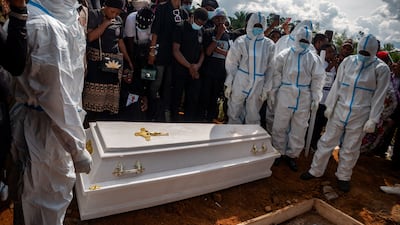

The Ebola outbreak in the Democratic Republic of the Congo is still not under control, six months after it was declared, Doctors Without Borders' (MSF) emergency co-ordinator has said.
Anna Halford, who has spent many weeks in the DRC helping to manage the organisation’s response, said that most incidents were “surprise cases”, showing that contact tracing was not keeping track of the disease’s spread.
The World Health Organisation declared the outbreak a public health emergency in May, although the disease is thought to have been spreading since the beginning of this year.

Ms Halford’s comments to The National come after MSF released a statement in which its international president, Javid Abdelmoneim, said staff were “often left speechless by dysfunctions” in the response to the outbreak, which has killed more than 5,400 people.
Dr Abdelmoneim said “urgent improvements in oversight, staffing, and operational support” were essential. Statements from the Congolese authorities about improvements in transparency and oversight must translate into real-world changes, MSF said.
Unaccounted money
Previous reports citing figures from the Africa Centres for Disease Control and Prevention indicated that out of $962 million (Dh3.53 billion) passed on to organisations dealing with Ebola, $700 million was unaccounted for.
MSF said many front-line workers were left without vital equipment and there were “critical shortcomings” in the response despite the hundreds of millions of dollars coming from the international community.

There are untrained and unpaid personnel, a lack of fuel for vehicles including ambulances, supposed surveillance teams “that are nowhere to be seen on the ground” and healthcare staff who do not have supplies or technical support to deal with suspected cases.
Ms Halford said there continued to be “shortcomings in different areas”, including healthcare workers on the edges of the outbreak not having “the most basic equipment”.
“They’re in flip flops,” she said. “[There are] surveillance teams who have got motorbikes but don’t have the fuel to travel. Community awareness workers who haven’t been paid. A lot of healthcare workers haven’t been paid.
“It is complex but we know what needs to be done. Somebody needs to make sure it is being done.”
There are two important indicators that the response to the outbreak “is not working”, according to Ms Halford. The first of these is that most cases within treatment centres are “surprise cases”.
“They do not have a known epidemiological link to any other case,” she said. “While that remains the situation, it is an absolute sign that we do not have this under control. You should not have the majority of your cases coming out of nowhere.”
Another key concern is that most deaths from Ebola are happening in the community rather than in treatment centres. Each time this happens, there are opportunities for the disease to spread.
“The epidemic is not mathematically out of control in terms of numbers, but the spread of it is slowly growing. It’s not slowing down, it’s spreading out. That brings more challenges for the response,” Ms Halford added.

As previously reported, epidemiologists at MSF’s offices in Dubai have helped to keep track of the disease, supporting work carried out by staff in Africa.
With around 11,000 people having been infected, the current outbreak is second in size only to the 2014-16 West African outbreak, during which there were 28,600 reported infections.
The latest Ebola outbreak is caused by the Bundibugyo virus. According to the US Centres for Disease Control and Prevention, it is one of three ebolaviruses behind most large outbreaks in Africa, alongside the Sudan virus and the Zaire Ebola virus – the deadliest strain – which kills up to nine out of 10 people who are infected.
Conflict complicating response
The virus causes a fever characterised by bleeding, known as a haemorrhagic fever.
Ms Halford said the control of the outbreak, which initially hit the DRC’s North Kivu and Ituri provinces, had become more complex as it spread, affecting highly rural areas through to urban locations, requiring different approaches.
“It was complex even when the outbreak was limited to the main two provinces that it hit. Now we’re talking about an outbreak that’s hit eight, of which five are active,” she said.
Conflict has hampered efforts to get on top of the outbreak, although Ms Halford said it was one among many difficulties.
She indicated that there was “no magic bullet” to improve the response and get the outbreak under control.
“It needs sustained and consistent resources directed as needed,” she said. “It’s not a lack of money.”
Despite the many failings in the response highlighted by MSF, she said there had been “a lot of progress”, such as improvements in information flow, the deployment of diagnostic facilities and community engagement. Surveillance in particular needs to improve.
“We still need some big improvements in some of the basic elements before we start to say with any confidence this is under control,” she said.
As of the end of October, MSF employed nearly 1,500 staff in the DRC to deal with the Ebola outbreak, more than eight out of 10 of whom were Congolese. The organisation also finances the employment of more than 1,400 staff who work under the DRC’s health ministry.
Although deadly within the areas where it is spreading, Ebola is thought to pose only a low risk to the world as a whole, as the disease is not highly contagious and the virus that causes it is not spread by airborne particles.
Ali Alessandro Ayach, a UAE-based partner at the consultancy Arthur D Little who analyses health care, said that concerns for the wider world were modest, “as long as countries continue on the way of early detection to prevent any spread at the borders”.
“The WHO highlighted the risk as low, so I would rely on that,” Dr Ayach said.
Despite this, a recent report from the Independent Panel for Pandemic Preparedness and Response said that the world was at risk of another global health emergency in part because it had failed to learn lessons from Covid-19.

