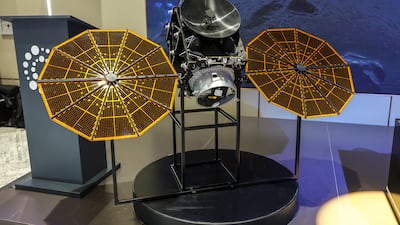
A UAE-built probe for the Emirates Mission to the Asteroid Belt has completed vibration testing and is undergoing thermal tests as preparations intensify for the mission’s launch in March 2028.
Sheikh Hamdan bin Mohammed, Crown Prince of Dubai, Deputy Prime Minister and Minister of Defence viewed a flight-identical model of the probe, developed by Abu Dhabi’s Technology Innovation Institute, at a press conference on Thursday.
Faisal Al Bannai, Adviser to the UAE President for Strategic Research and Advanced Technology, said the mission would build local expertise as well as advance scientific understanding.

“Having a product does not mean you have sovereignty. Having sovereignty means you know the tech. You’re able to evolve it. You’re able to change it. You’re able to use that knowledge in other missions and other programmes that you want to develop,” said Mr Al Bannai, who is also Secretary General of the Advanced Technology Research Council.
The Technology Innovation Institute's Propulsion and Space Research Centre led the design, construction and testing of the probe in the UAE. This included the integration of core hardware, on-board processing, software and systems needed for the probe to operate as a single-mission platform.
Landmark voyage
The MBR Explorer is set to launch during a three-week window in March 2028 on an eight-year, five-billion-kilometre journey, reaching the 269 Justitia asteroid in 2036.
It will use gravity assists around Venus, Earth and Mars to reach the main asteroid belt, conducting fly-bys of six asteroids before its final encounter with Justitia. The spacecraft will then deploy the TII-built probe, the mission’s only deployable payload.
Dr Ahmad Al Falasi, Minister of Sports and chairman of the UAE Space Agency, said deep-space missions should be judged not only by what they discover, but also by what they leave behind.
“In order to sell deep-space missions, I always say it’s what’s left behind: the technology developed, the people developed, and also the interest in space overall,” he said.
TII executive director Anton Ivanov said the flight model had completed vibration testing and was undergoing thermal cycles inside a vacuum chamber at a university in Al Ain. Comprehensive performance tests and a flight-readiness review remain before shipment to Colorado later this month.
Vibration testing uses a shaker table to simulate some of the forces a spacecraft experiences during launch. Thermal testing in a vacuum chamber checks how its components respond to extreme temperatures in space-like conditions.
The programme will then move towards final integration with the MBR Explorer.
Window of opportunity
Mohsen Al Awadhi, the mission's director, said the team was not preparing a backup plan for the March 2028 window being missed because the planned trajectory would no longer work.
“We always calculate the schedule from launch, and launch cannot be moved,” Dr Ivanov said.
“If, God forbid, we miss that, we basically don’t have a mission,” Mr Al Awadhi said.
The probe is designed to separate from the MBR Explorer at Justitia and operate independently during the final encounter.
It will descend on a ballistic trajectory and has no propulsion system to slow it down. The descent is expected to take two to three hours, with the probe striking the asteroid at between 15 and 27 metres per second.

Two cameras will take images during the descent. An on-board system will rank them so the most useful can be relayed through the mission architecture.
The probe has been kept relatively simple by design, while the MBR Explorer carries more sophisticated instruments to study the asteroid’s composition.
The probe is also designed to operate autonomously, making key operational decisions on-board rather than waiting for immediate instructions from Earth. Its on-board processing supports functions, including imaging decisions, image selection and power management.
Artificial intelligence could help with tasks such as assessing and selecting images, but the team would not use it for operations that required precise, predictable outcomes, Dr Ivanov said.
The probe is not expected to survive the impact, although its battery and communications system are designed to continue working for 20–50 minutes if it does.
The impact could excavate a small crater, giving scientists an opportunity to observe material beneath the asteroid’s exposed surface.
“We always knew that the impact velocity will be quite high, around 60km per hour,” Dr Ivanov said. “We don’t know what we’re going to find. That’s the exploration issue. We’re very excited.”
Unravelling mysteries of space
Justitia is scientifically unusual, with a spectrum that more closely resembles objects in the distant Kuiper Belt than neighbouring asteroids in the main belt.
Scientists believe it may have formed farther out in the Solar System before migrating inward.
Studying its composition could offer clues to how water, volatile materials and organic compounds were distributed as the planets formed. The mission’s wider science goals include improving understanding of the origins and evolution of water-rich asteroids.

The probe project involved about 40 people over 18 months, TII chief executive Najwa Aaraj said. Twenty UAE engineers are also gaining mission-level experience through the eight-year interplanetary programme, according to TII.
UAE-based partners include HEX20, Khalifa University and the National Space Science and Technology Centre at UAE University, alongside the UAE Space Agency and wider mission collaborators. The MBR Explorer is being developed with partners in Colorado.
Dr Aaraj said about 80 per cent of the work on the probe was being done by UAE engineers.
“If 80 per cent is being done by our engineers today, the next mission will be fully developed here,” she said.
The mission brings together the Space Agency, TII, universities, the Mohammed bin Rashid Space Centre and other partners.
“We don’t have one team. We have a team called the National Team,” Mr Al Awadhi said.

