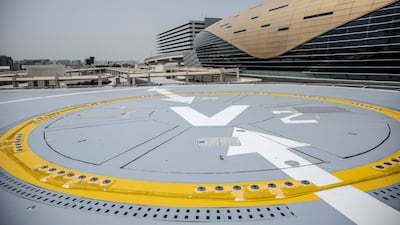
The UAE aviation authority has introduced new rules that cut domestic heliport registration processing time to just two working days, down from up to 135 days.
Under the new system, domestic heliports will no longer require certification and can instead register through a simplified process, reducing bureaucracy while maintaining aviation safety standards.
It reduces unnecessary procedures and simplifies the regulatory journey for domestic heliport operators, in line with the UAE Government's Zero Government Bureaucracy Programme, the UAE General Civil Aviation Authority said.

"The transition from certification to registration for domestic heliports reflects the maturity of the UAE’s aviation sector and demonstrates our confidence in a modern, risk-based regulatory approach, said Saif Mohammed Al Suwaidi, director general of the GCAA. "By significantly reducing regulatory procedures, we are creating a more enabling environment for investment and development."
Previously, all heliports in the UAE, including those serving domestic operations, were required to obtain GCAA certification, a comprehensive process that could take up to 135 days to complete. Now, domestic heliports will instead be registered with the GCAA through a streamlined process that can be completed in two working days.
International heliports, as well as other heliports where certification remains necessary, will continue to be regulated under the applicable certification framework in accordance with national regulations and international requirements.
The initiative is expected to support continued investment in vertical aviation infrastructure, encourage innovation, assist in the introduction of new aviation services and contribute to the UAE's broader economic development.
Vertical aviation infrastructure
The changes come as the UAE steps up efforts to expand its air mobility and vertical aviation infrastructure. Dubai and Abu Dhabi are investing in heliports and vertiports to support a growing range of helicopter, air-taxi and electric vertical take-off and landing (eVTOL) operations, with new facilities being developed alongside the country’s existing heliport network.
Abu Dhabi plans to build a network of 10 vertiports to support upcoming air taxi and eVTOL (electric vertical take-off and landing aircraft) services, as part of the emirate's push into smart and sustainable air mobility.
Zayed International Airport and Al Bateen Executive Airport have been confirmed as major locations within the broader network, with additional sites and inter-city routes to be revealed in later phases. The network will connect vital urban, business and tourism hubs, including Zayed International Airport, Al Bateen Executive Airport, Yas Island and Saadiyat.
The emirate is also developing infrastructure to support both conventional helicopters and eVTOL aircraft, reflecting the gradual integration of new aircraft technologies into the existing aviation network.
Dubai is also developing an initial network of four vertiports to support planned air-taxi services at Dubai International Airport, Downtown Dubai, Dubai Marina and Palm Jumeirah. The first purpose-built commercial vertiport at Dubai International Airport has received GCAA certification, while three additional facilities are being developed to form the initial network
The GCAA has developed regulations that allow the integration of eVTOL aircraft into the UAE's civil aviation system, while also adapting existing heliports as part of a comprehensive infrastructure to support air mobility

