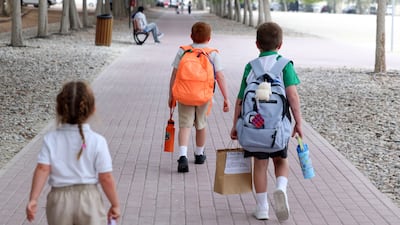

Pupils between kindergarten and year 2 at UAE public schools will receive no homework during the new academic year, the Minister of Education announced on Wednesday.
Meanwhile, year 6 classes will not use screens during English, Arabic, science and maths lessons, Sarah Al Amiri told The National at a conference in Dubai.
“Children at all public schools, from kindergarten to year four, don’t use any devices in the classroom except when they are learning to use tools for specific lessons. That was already a policy. Now we are looking at middle school,” she said.

The decision was made after a study revealed the effects of screen time on pupils’ cognitive development.

During the study, 2,500 pupils at nine public schools were analysed to identify the effects of regulation of digital tools. The results indicated that children who did not use screens showed a clear improvement in academic performance across all year groups, particularly in maths, science and Arabic.
There was also a marked improvement in behaviour, discipline and focus in the classroom.
“Those students who were in device-free classes, their retention nearly doubled, their behaviour overall was better, and interpersonal relationships and friendships formed because of the reduction in screen time,” Ms Al Amiri said.
Encouraging good habits
According to the minister, cancelling homework for the youngest pupils is aimed at improving the quality of learning and promoting a healthier balance between education and family life.
Ms Al Amiri predicted that the move would also encourage children to read more at home and to build skills from an early age.
“Last year, we talked about a transformation from an ecosystem that focuses solely on gaining knowledge, to one that builds knowledge and skills at the same time,” she said.
The two initiatives currently apply only to public schools.

Other plans for the new academic year include projects to evaluate all public and private schools licensed by the Ministry of Education, and the launch of a training week for teachers and school leaders.
The methods used to assess pupils between years 9 and 12 will also change, with central exams and school-based assessments to be equally weighted. Last year, school-based assessments were weighted more heavily, at 70 per cent.
“Right now, it’s going to be 50 per cent [each], providing schools with more agency in assessing students and enhancing the assessment process,” Ms Al Amiri said.
Ready to resume
Another key addition this year is the inclusion of diagnostic tests in schools, enabling teachers to determine pupils’ academic levels and identify those who require additional support.
“We are adding diagnostic, benchmark and baseline assessments, so the teachers have the tools they need to assess students very early in the academic year. They will be able to tweak their lesson planning and teaching methods to cater to the students.”
Ms Al Amiri said more than 26,700 new pupils had been enrolled in public schools for the coming year, while 11 new education complexes had opened. The total number of pupils in the Emirates’ public schools this year is 1,277,000, she added.
Schools across the country will welcome pupils back to the classroom on Monday, after a year in which educational institutions moved between classroom and distance learning due to disruptions caused by the US-Iran war.
“As of now, it’s back to school on August 31,” Ms Al Amiri said. “We continue to assess the situation with the relevant authorities. Schools are ready with their different plans that were put in place last year.
“We’ve got schools to continue enhancing those plans, and they are able to transition between the two models of learning. We’ll take stock of the situation as it moves forward.”