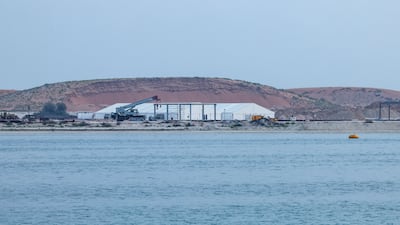

An Abu Dhabi island left largely untouched for decades is primed for transformation in the latest step forward in the capital's long-term expansion drive.
Eagle Hills Properties, one of Abu Dhabi's leading real estate companies, has confirmed it is overseeing a development project on the man-made Lulu Island. The island, which is about 500 metres from Abu Dhabi's Corniche, was built in the 1990s to serve as a breakwater against high tides and is only accessible by boat.
With large beaches, clear waters and panoramic views of the city, it has long been earmarked as a site with huge potential for major residential and development projects. Previous masterplans over the years have failed to get off the ground, but the prospect of the sprawling island welcoming its first residents in the years to come is becoming a reality.

“We can confirm that the development will be undertaken by Eagle Hills Properties,” the developer told The National, without disclosing specific details of its plans for the island. “Further information regarding the project, including any additional details, will be communicated in due course through our official channels and those of our partners,” they added.

Boats from Blue Shark Boat Rental have been ferrying workers to the island, where many cranes and excavators are already in use. A handful of show homes have popped up in recent weeks facing the city.
The real estate developer is headed by Mohamed Alabbar, the Emirati real estate giant behind Emaar and projects such as Burj Khalifa and Dubai Mall. Eagle Hills has projects in more than 20 countries and is the developer behind the masterplanned Ramhan Island, a luxury waterfront community in Abu Dhabi.

A history of Lulu Island
Named Al Lulu, or pearl in Arabic after the pearls for which Abu Dhabi was famed, the 400 hectare island was created from reclaimed sand. Work on the project started in 1986 and was completed in 1992.
Contracts to develop the island were awarded as far back as 2002, when Al Geemi Contracting won a Dh25 million development contract. In 2007, the island opened to the public with a few facilities, including two restaurants, four coffee shops, a track for camel and horse riding, two artificial lakes and a passenger ferry service connecting it to the city.
In the same year, Sorouh Real Estate appointed Miami's Arquitectonica to conceive the masterplan for the island. The 2008 financial crisis halted progress, and Sorouh merged with Aldar Properties in 2013. In January 2009, the ferry service halted, and the island was made less accessible to the public.
In 2023, the island was opened to visitors daily during Public Art Abu Dhabi. Buses brought visitors around the abandoned land, and art installations breathed life into the island's sand and shrubs.

What could the future hold?
The Plan Abu Dhabi 2030 framework, part of the government's broader Vision 2030, provides some insight into possible development of the island. Figures show the island's projected population is an estimated 20,000 people. Beaches and green spaces could be abundant. Recent aerial photos show a canal being formed through the middle of the island.
“Al Lulu Island is identified as perhaps the most important element of the Capital City Framework. Situated at the head of Abu Dhabi Island, every trip to the downtown ends with a view of it. It has immense symbolic importance and is proposed as a primary site for unfolding the story of Abu Dhabi’s history, achievements, personality and culture,” reads the document.

Prime location
Lasse Frederik Pedersen, a senior investment adviser at Dubai's Equiti Real Estates, believes ambitious plans could swiftly take shape.
“What we're aware about is that they want low-rise buildings and hopefully, in the next 12 months, we should be allowed to have information about apartments, villas and mansions coming to the islands for maximum three or four-floor low-rise buildings,” he said.
Bridges are expected to connect Lulu Island to Abu Dhabi Island, making the location prime real estate and providing a connection to the Mina Zayed development.
“Lulu Island's convenience is its location,” added Eyal Ashur, a UAE property sales consultant and founder of Nooma Properties. “The fact that you have three [potential] connections; you can have a connection to Marina Mall, you can have multiple entries to the Corniche and also to Mina Zayed.”
Property boom
In recent years, Abu Dhabi has witnessed numerous off-plan launches including developments on Ramhan Island, projects in Saadiyat Island and even private villas on the grounds of the Emirates Palace. Experts say that even during the war and the rent freeze currently in place, demand remains.
“During the conflict, so many hedge funds and family offices have been set up,” Mr Pedersen said. “So the fundamentals are absolutely prime for Abu Dhabi.” Mr Pedersen cited examples from recent months when sales in Hudayriyat Golf Estates broke sales records, even during the war.
“Modon managed back in June this year to sell more than 1,800 units in six days as a sales record in the UAE. People really believe in Abu Dhabi,” he said. He said investment in buying property in the capital has grown since freehold ownership by foreigners was permitted in 2019.
Mr Ashur agreed that there is plenty of space on the market, and it has not become oversaturated.
“There is a huge shortage of ultra-luxury residential buildings in Abu Dhabi,” he said. “Abu Dhabi is changing and attracting high net-worth individuals looking for big houses of high quality. They want to be next to a golf course, next to water, and they want to have their own private space.”
Mr Pedersen believes that Lulu Island will be “next level” when completed and highlighted Abu Dhabi's growing appeal for investors.
“I think Abu Dhabi wanted to build slowly, quietly, and respect nature. It is what attracts all the high-end people coming. They want quietness, they want wellness and nature,” he said.