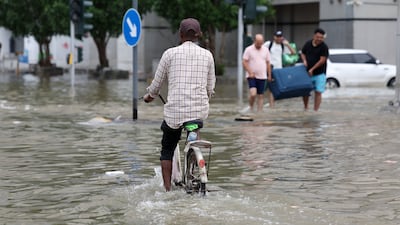

Rainfall in the UAE is likely to become less frequent but more intense, potentially making flooding more likely, a new study has found.
The work by scientists at UAE University (UAEU) in Al Ain suggests that, by the end of the century, the wettest days could have twice as much rain as they do now.
On average, rainfall on wet days could be more than five times what it is now, the analysis in the journal Water Cycle predicts.

Projections vary according to which computer model is used and how global carbon emissions change, but a common finding is that the wettest days will become wetter.
Under a high emissions scenario, by the last decade of the century the average rainfall on wet days could increase up to 466 per cent compared to the average for 1995 to 2014.
Over the same time the annual maximum daily rainfall – the amount of rain that falls during the wettest day of the year – could increase by 106 per cent, which is more than a doubling.
Long-term forecast
According to the research – by Abdalmonem Alkhawaga of UAEU in Ain and Tanta University in Egypt, and Prof Mohamed Mohamed of UAEU – “the future climate is expected to experience fewer rainy days”.
“In contrast to the projected decrease in the number of rainy days, rainfall intensity on wet days generally increases at most [UAE weather] stations,” the scientists wrote.
Dr Diana Francis, an associate professor and head of the Environmental and Geophysical Sciences Lab at Khalifa University in Abu Dhabi, said the trends in the new study were largely “in line with” her own research findings.
However, there is uncertainty in how rainfall patterns will change in the UAE, as some other studies have not indicated that rain will occur less often.
“Most of the indicators are showing tendency towards increase in rainfall in frequency and intensity with extreme events becoming more present,” said Dr Francis, who is not connected to the latest study.
Weathering the storm
Dr Francis’s research group found that the number of stormy days in the UAE has increased by up to two per year since 2000.
By the end of this century, compared to the “baseline” in 2015, there could be an additional three to four stormy days annually.
Bob Ward, of the Grantham Research Institute on Climate Change and the Environment, part of the London School of Economics, said that because warmer atmosphere can hold more moisture, “when it rains it rains harder than in the past”.
“Even in countries where the overall pattern is one of increased dryness … where rainfall occurs, it’s going to be harder,” he said.
-

Sharjah was subject to some of the most severe flooding following heavy rain on Thursday and Friday. All photos: Chris Whiteoak / The National -

After days of almost relentless rain, Majaz 3 area was one of the most severely affected parts of Sharjah -

The municipality sent out teams equipped with heavy duty water pumps to clear neighbourhoods of floodwater -

Sharjah Municipality said it had cleared floodwater from main roads and vital community areas -

In Sharjah, residents navigated the floods by whatever means they could find -

The cleanup continues in Sharjah, with more rain forecast for midweek -

Supermarket owner Hanif Khan managed to avoid major losses -

Noushad Ahmed, who has owned Jamal Al Tamimi Designing for two years, put waterproof foam on the glass display for protection -

Authorities are working to clear remaining water and restore services


Preparing for flood threat
The new study – titled Precipitation analysis under Climate Change Impacts over the United Arab Emirates – indicates that there will be consequences if rain falls less often but becomes more intense.
“Such changes are important for flood-risk assessment, stormwater infrastructure design, and water-resources planning, particularly in arid regions such as the UAE, where changes in rainfall extremes can have significant hydrological impacts,” the researchers wrote.
“In the arid built environment, an increase in rainfall can indeed increase the risk of flooding because the current drainage and stormwater management infrastructure is designed for low rates of rainfall,” Dr Francis agreed.
The UAE and Oman were hit by severe flooding in April 2024, when Al Ain received two years’ worth of rain in a single day. Many streets in Dubai were left underwater because of the deluge.
The country was hit by more powerful storms in March – though less severe than two years earlier – which caused flooding and travel disruption.
Following the unprecedented floods of 2024, Dubai unveiled the Dh30 billion Tasreef programme, which is designed to achieve an eight-fold improvement in drainage capacity.
Parts of this have already been completed, while Sharjah too is investing heavily in drainage to reduce flooding risks.
“We’ve been seeing countries in the Gulf region have been suffering with such events,” Mr Ward said.
“It can destroy infrastructure, … offices and homes. It can kill as well. Every country needs to be able to manage these risks.
“Because it’s being driven by climate change, these risks are going to continue to become worse and worse until the world comes to net zero.”
With many countries aiming to reach net zero carbon emissions by the middle of the century, Mr Ward said the effects of climate change on rainfall would intensify for at least the next 25 years.
Improvements countries are making in drainage and other ways of channelling water across the world “require significant investment”, Mr Ward said.
“It shows once again the world has made a bad calculation in thinking going slow [in reducing carbon emissions] is cheaper,” he said.
“We shouldn’t go slow. Now we’re paying the price for having gone slow.”

