

A mangrove-planting programme in Fujairah has offered a glimpse into how the green lungs of the waters are breathing new life into biodiversity efforts across the Emirates.
The seedlings of the white mangrove – or Avicennia marina – were planted in 2018 at Al Badiya, between Khor Fakkan and Dibba on the UAE’s east coast.
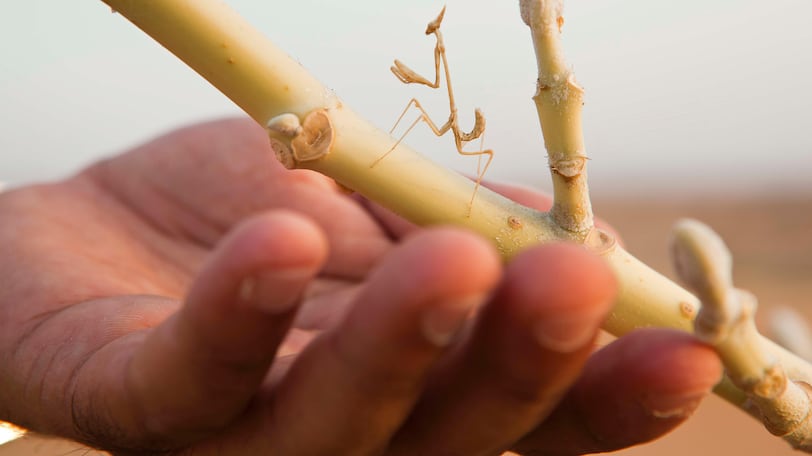
Research carried out in the years since has shown that the mangroves are helping to support a wealth of marine life, from fish and crabs to green turtles and even praying mantises.
The work by scientists in the UAE indicates that planted mangrove habitats cannot only increase biodiversity, but protect coastlines and capture carbon to guard against climate change.
The UAE aims to plant 100 million mangroves by 2030 in an effort to preserve and expand the ecosystem and boost progress towards net zero targets.
Teams from the Ministry of Climate Change and Environment found that the trees had established themselves and reproduced on the area’s “shallow, sandy and rocky” coastal areas, although modest soil depth and tidal inundation limited growth.
Analysis indicated that 28 per cent of seedlings planted in 2018 were alive two years later, a figure that remained stable, with the same number surviving when further surveys were carried out in 2024.
Thriving marine life

An array of fish species were discovered around the planted mangroves, including the common silver-biddy, the brightly coloured black-spot snapper, the spotted whiptail stingray and the goby.
Showing that the mangroves support a wide range of animals, crabs, sea slugs, bivalves and green turtles were also found.
Insects such as butterflies and the devil’s flower mantis, a praying mantis also known as the Egyptian flower mantis, were also discovered, demonstrating a link between the mangroves and land habitats.
“Collectively, these findings highlight a dynamic … ecosystem where both aquatic and terrestrial biodiversity benefit from the restored mangrove habitat,” the researchers wrote in the International Journal of Scientific and Research Publications.
They said Al Badiya had shown that the mangroves could establish, grow, reproduce and “foster complex ecological interactions” even under extremely arid intertidal conditions.
Mid-tide zones, with higher seedling survival, deeper soil and a denser mangrove canopy, “supported the greatest diversity and abundance” of creatures compared to high-tide and low-tide areas.
“These findings emphasise the importance of careful site selection, tidal monitoring, and habitat management for long-term restoration success,” the researchers wrote.
Race against time to protect mangroves
-
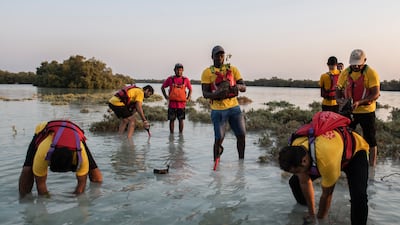
People plant mangroves during an event organised by Companies for Good on Jubail Island, Abu Dhabi. All photos: Vidhyaa Chandramohan -
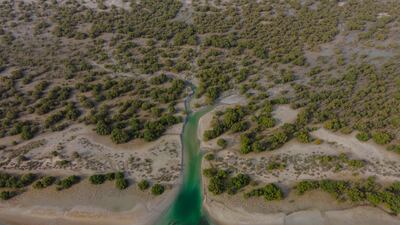
To fight climate change, the UAE is carrying out projects such as reducing emissions and planting mangroves. -
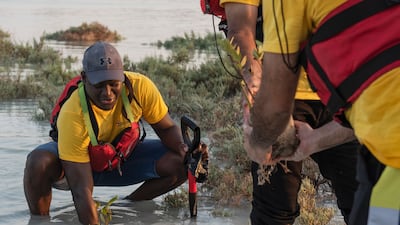
Mangroves, trees that survive in salty water, play an important part in the ecosystem. -
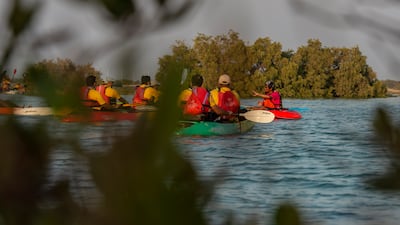
By 2030, the UAE intends to plant 100 million mangroves. -
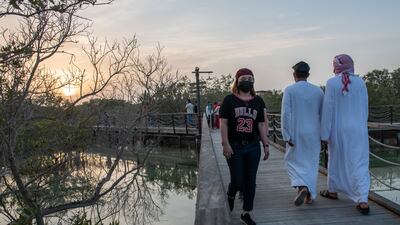
Visitors at Jubail Mangrove Park. Schools and businesses are planting saplings as part of the UAE's campaign. -
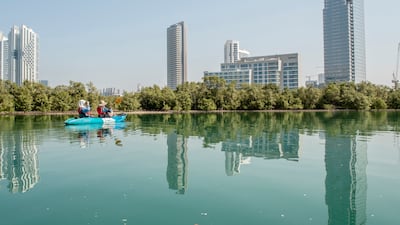
Volunteers during a mangrove clean-up organised by the World Wildlife Fund and Seahawk Abu Dhabi. -
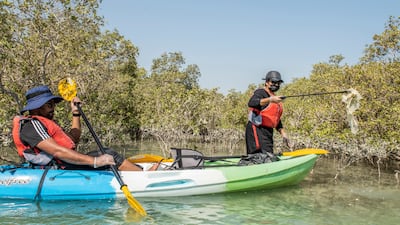
Young mangroves can be damaged by plastic and other waste dumped into the sea. -
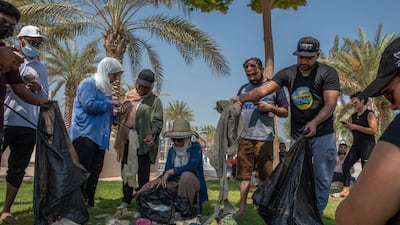
Volunteers sort rubbish gathered during a clean-up of mangroves in Abu Dhabi. -

After collecting debris from the mangroves, volunteers use an app to track their progress. -
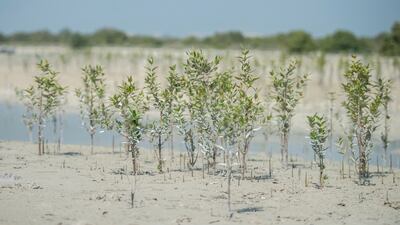
The grey mangrove is the species that grows extensively in UAE. -
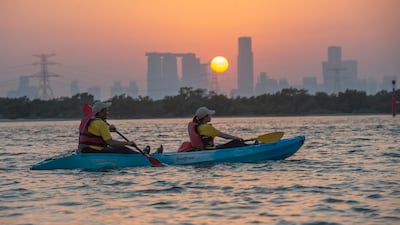
Visitors enjoy an evening paddle by the mangroves and a sunset view of Abu Dhabi.


While mangrove planting has taken place in the Gulf since at least the 1980s, an International Union for Conservation of Nature report published two years ago indicated that the area of the region covered by mangroves has shrunk 14.3 per cent since 1996.
If this trend continues over the next half century, the IUCN warned that the overall decline could reach 45 per cent.
Data from the online platform Global Mangrove Watch suggests that mangrove losses in the UAE have been much lower than average for the Gulf, with just a two per cent drop since 1996.
At the Cop26 climate change conference in Scotland in 2021, the UAE announced that it aimed to plant 100 million mangroves by 2030, and efforts have been under way across the country.
Nature knows best
Meanwhile, a study in Qatar has found that human-planted mangroves, even when decades old, do not create habitats to match those of natural mangroves.
In the study, released in Hydrobiologia, researchers from Qatar University and Texas A&M University compared natural mangroves off the country’s coast with mangroves planted in the 1980s.
Mangrove plants are foundational species, because they provide a three-dimensional habitat on which other organisms can grow, hide and create new microhabitats.
Differences in the carbon and nitrogen present in the habitats showed “enriched organic matter from a diverse variety of sources” in the natural mangroves.
“Our findings suggest that the ecological services provided by the mangrove planted four decades ago are likely inferior to those of natural forest,” the scientists wrote.
“Policymakers and restoration programmes concerned with the conservation of mangrove forests should consider the relative trade-offs of deforesting of ‘old’ growth forests for urban development versus the limited potential of afforestation on barren beaches.”
The first author of the study, Dr Yousra Soliman, an associate professor at Qatar University, told The National that the food chains between the natural and the planted mangroves were not the same, with the natural mangroves supporting more organisms.
A key reason for this is that the planted mangroves are in areas with higher salt content or salinity, which makes conditions more difficult for growth and causes the mangroves to be no more than one metre high.
However, Dr Soliman said, there seemed to be increased richness among the natural mangroves simply because they were natural.
Research in other countries too has indicated that planted mangroves offer less diversity than their natural counterparts, she said.
“If you go to the planted habitats, the mangroves are sparse, they have more spacing between each other, they are not the same height as the natural habitat, they don’t have the same productivity, indicated by the amount of organic carbon in the sediment,” Dr Soliman added.
“Organic carbon is a food, so there is not enough food in the planted habitat compared with the natural habitat.”
While the research suggests that natural mangroves create richer ecosystems, Dr Soliman said that it was still important to plant mangroves in suitable locations.
“Having less biodiversity is better than having no biodiversity, so rebuilding and conserving what we have, restoring what we destroyed, is a very important step in mitigating climate change and the carbon emissions,” she said.
In a cautionary note, Dr Soliman said that planted mangroves should not replace existing habitats that were worth conserving. Mudflats, for example, provide homes for a range of organisms.
“Planting mangrove in a mudflat is a replacement for another ecosystem, so this has to be done carefully and with assessment for the impacts on nearby ecosystems,” she said.

