

The era of artificial intelligence is "redefining human capabilities", the head of the World Governments Summit event has said.
Mohammed Al Gergawi, UAE Minister of Cabinet Affairs and chairman of the World Governments Summit Organisation, on Tuesday said AI was one of the four forces reshaping the world, along with advanced medicine, brain science and new digital environments.
“We are going through a moment where human capabilities are being redefined,” he said at the opening of the summit in Dubai on Tuesday.

He pointed to how AI was adding a layer of thinking and learning. He also said the next major discovery would not be in space, but in "the realm of new capabilities within the human brain itself".
Mr Al Gergawi reflected on advanced medicine and progress in the early detection of diseases. New digital environments are changing how people interact, he added.
-
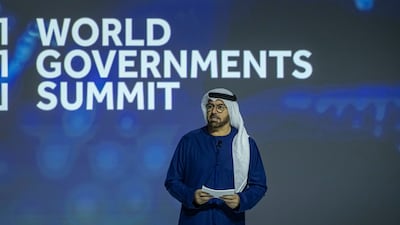
Mohammed Al Gergawi, UAE Minister of Cabinet Affairs and Chairman of the World Governments Summit, speaking at the opening of the summit in Dubai. He said AI was one of the four forces reshaping the world. Antonie Robertson / The National -
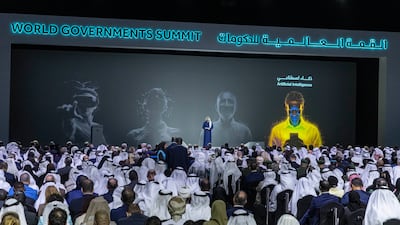
Mr Al Gergawi told the forum the next major discovery would not be in space, but in 'the realm of new capabilities within the human brain itself'. Antonie Robertson / The National -
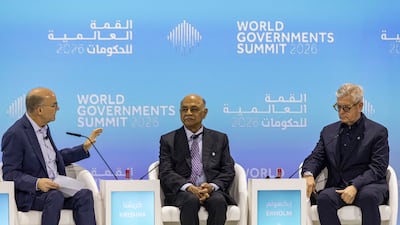
From left, Mike Allen, co-founder of American news company Axios, Arvind Krishna, chairman, president and chief executive of IBM, and Borje Ekholm, president and chief executive of Ericsson, on the first day of the World Governments Summit. Antonie Robertson / The National -
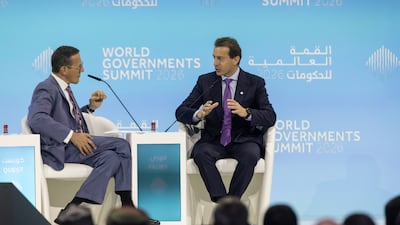
CNN journalist Richard Quest, left, talks to Airbus chief executive Guillaume Faury during a session titled How Do We Keep the World Connected? Antonie Robertson / The National -
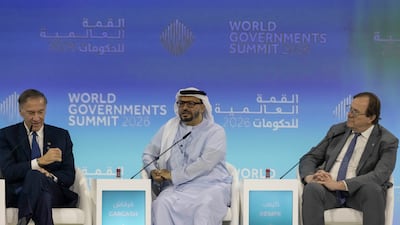
Dr Anwar Gargash, diplomatic adviser to the UAE President, with Mike Pompeo, former US secretary of state, left, and Frederick Kempe, president and chief executive of the Atlantic Council. Antonie Robertson / The National -
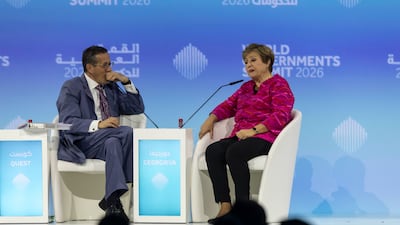
IMF managing director Kristalina Georgieva in conversation with Richard Quest. Antonie Robertson / The National -
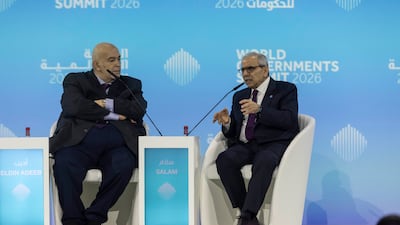
Lebanon's Prime Minister Nawaf Salam discusses the country's future with Emad Eldin Adeeb of Sky News Arabia. Antonie Robertson / The National -
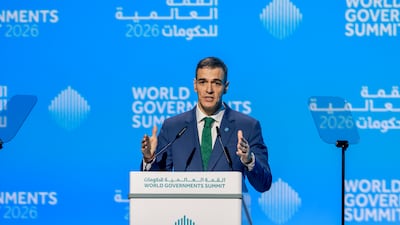
Spanish Prime Minister Pedro Sanchez speaks at the summit. Victor Besa / The National


He said governments needed to figure out how to respond to these changes. Governments need to move from bureaucracy to human-centred institutions, he said. “Are governments ready for the humans we have become?”
During his opening speech, Mr Al Gergawi also reflected on how human advancements through history have often been the subject of concern, pointing to how Greek philosopher Socrates had believed that writing weakened memory. But the future, Mr Al Gergawi said, belonged not to those who were afraid, but those who have “audacity and courage” and can adapt.
He said governments, however, still approached citizens with the tools of yesterday. "We are witnessing the first signs of this tension in the expectations of new generations, particularly Generation Z."
He said that by 2040 this generation would make up nearly 40 per cent of the global workforce and expected instant service, continuous learning and a balanced life – "not just a job and a salary".
"This is a historic opportunity for governments," he said. "But it requires governments that understand that their ultimate purpose, their first and last mission, is to serve the human being."
Leaders and decision-makers have gathered in Dubai for the summit, which runs until Thursday, at a time of geopolitical challenges.
Other big names set to speak on Tuesday include investor Ray Dalio, Airbus chief executive Guillaume Faury and Kristalina Georgieva, managing director of the International Monetary Fund.
The first day's agenda also includes Spain’s Prime Minister Pedro Sanchez, whose country has emerged as a powerhouse of the Eurozone economy, and Lebanese Prime Minister Nawaf Salam, whose government is battling to turn around the economy and disarm Hezbollah.
The summit also comes at a time of growing tension driven by wars in Ukraine and Sudan, as well as the threat of US strikes on Iran.
This year’s gathering is expected to have the largest leadership participation in its history, organisers said, bringing together more than 40 heads of state and government, 500 ministers and more than 150 governments. At least 6,250 participants are expected to attend.

