


Scientists have launched a platform that brings together artificial intelligence and blockchain to ensure that researchers from across disciplines share the economic rewards of their work.
The platform is known as Opensci and scientists will use the digital portal to catalogue and tracked their work using blockchain.
The system, which aims to tackle the costs of publication and funding gaps is powered by what is being described as a new type of AI dedicated to science.
It was revealed on Tuesday at a joint session of the World Laureates Summit and the World Governments Summit.
Prof Roger Kornberg, chairman of the World Laureates Association and 2006 Nobel laureate in chemistry, said the initiative would harness AI and show that civilisation's advancement is best served by a return to breakthroughs in basic science.
“Major technology companies [are] pursuing the development of AI,” Prof Kornberg told The National. “What we wish to do is make the best use of those tools … and make them available in the most convenient way to achieve the purposes of practicing scientists.”
More information about the portal is expected to be released but the initiative seeks to ensure those who make discoveries are given financial rewards at a time of cutbacks in funding for science and rampant disinformation.
It is also envisaged that researchers could receive funding as digital tokens and not just from governments but from organisations and private citizens.
It was also announced that the World Laureates Association - an organisation dedicated to the advancement of science - was now going to be headquartered in Dubai. It had been based in China.
-
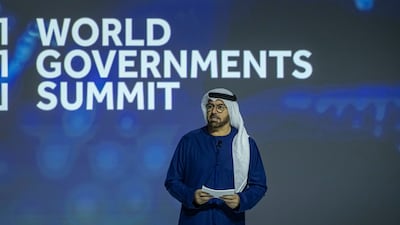
Mohammed Al Gergawi, UAE Minister of Cabinet Affairs and Chairman of the World Governments Summit, speaking at the opening of the summit in Dubai. He said AI was one of the four forces reshaping the world. Antonie Robertson / The National -
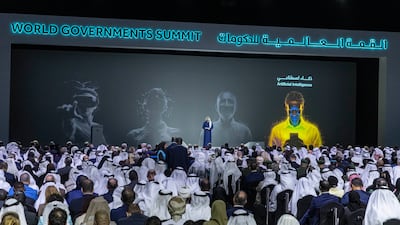
Mr Al Gergawi told the forum the next major discovery would not be in space, but in 'the realm of new capabilities within the human brain itself'. Antonie Robertson / The National -
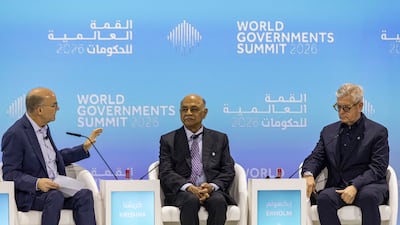
From left, Mike Allen, co-founder of American news company Axios, Arvind Krishna, chairman, president and chief executive of IBM, and Borje Ekholm, president and chief executive of Ericsson, on the first day of the World Governments Summit. Antonie Robertson / The National -
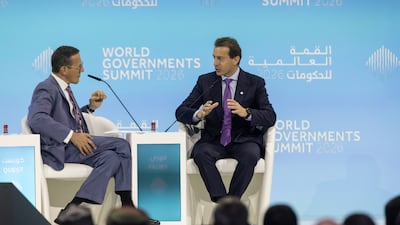
CNN journalist Richard Quest, left, talks to Airbus chief executive Guillaume Faury during a session titled How Do We Keep the World Connected? Antonie Robertson / The National -
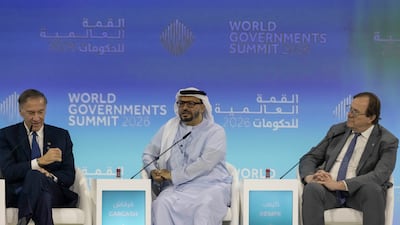
Dr Anwar Gargash, diplomatic adviser to the UAE President, with Mike Pompeo, former US secretary of state, left, and Frederick Kempe, president and chief executive of the Atlantic Council. Antonie Robertson / The National -
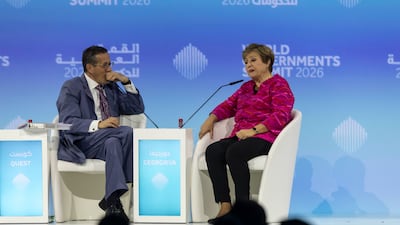
IMF managing director Kristalina Georgieva in conversation with Richard Quest. Antonie Robertson / The National -
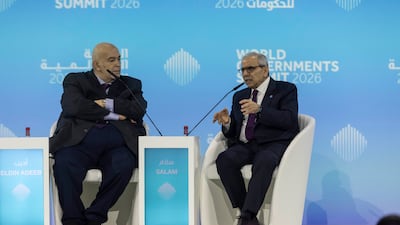
Lebanon's Prime Minister Nawaf Salam discusses the country's future with Emad Eldin Adeeb of Sky News Arabia. Antonie Robertson / The National -
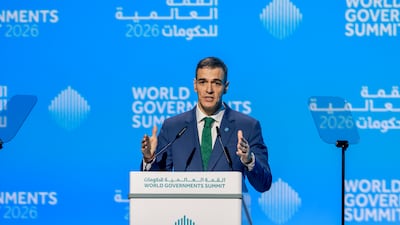
Spanish Prime Minister Pedro Sanchez speaks at the summit. Victor Besa / The National


Why the change is needed
Prof Kornberg, a US chemist who won the Nobel Prize for his work on DNA and RNA, also reflected on scientific research today.
His pioneering work in the 1970s would struggle for space in science journals today, he said, because today such publications are managed by people who are not practising scientists which “limits the distribution of scientific information”.
“You may make a discovery,” he said. “If you put that forward for publication in a journal, the chances are it will be rejected. Because discoveries by their nature go against the grain. Some of my most important work would never see the light of day today,” he said.
“The people who managed the magazine in which it was published were great scientists,” he said. “That could not happen today. There is no one like them managing any of the magazines today.”
The new platform could essentially fill the role once played by journals, where scientists can share work with their peers and announce discoveries while the authenticity of their research is protected by the data stamp secured by blockchain.
The role of AI
A topic dominating the halls of the World Governments Summit on its first day was the rise of AI. Prof Kornberg said there are limits to what it can do because it “cannot generate revolutionary ideas”.
“It is only a search mechanism,” he said while noting that one reason for the hype is the investments that have gone into the technology.
Prof Kornberg also reflected on the difficult scientific environment that exists now with funding cuts and criticised the moves by US President Donald Trump administration to cut funding for science in the US and around the world.
“Part of our purpose here is to push back against what I have referred to as a problem for science,” he said.
“The leadership here [in the UAE] is both appreciative and supportive.”
The World Laureates Summit, which formally ran from February 1 and 2, brought together more than 100 leading scientists, including Nobel Prize laureates, Turing Award recipients and leading scientists from across disciplines to address scientific challenges facing the world today.

