
Ukraine President Volodymyr Zelenskyy said it was too early to draw conclusions as talks between Ukraine and Russia in Abu Dhabi enter a second day.
The talks, brokered by the US, began on Friday with President Sheikh Mohamed receiving the heads of the delegations taking part in the meeting.
Mr Zelenskyy said the territorial dispute was a central issue for the talks in the UAE, which were scheduled to conclude on Saturday.

"The most important thing is that Russia should be ready to end this war, which it started,” Mr Zelenskyy said in a statement on the Telegram app, adding it was too early to draw conclusions from the first day of the talks on Friday, reported Reuters.
"We'll see how the conversation goes tomorrow and what the outcome will be.”
-
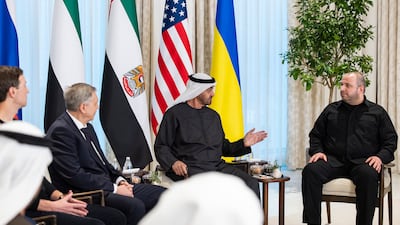
President Sheikh Mohamed receives the heads of delegations taking part in the UAE-hosted trilateral talks between Russia, Ukraine and the US at Al Shati Palace. Delegates include Jared Kushner, left, Igor Kostyukov, Chief of the Main Directorate of the General Staff of the Russian Armed Forces, second left, and Rustem Umerov, Secretary of the National Security and Defence Council of Ukraine, right. All images: UAE Presidential Court -
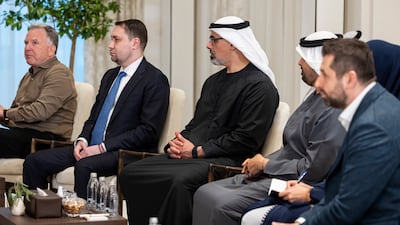
Sheikh Khaled bin Mohamed, Crown Prince of Abu Dhabi and Chairman of Abu Dhabi Executive Council, and Sheikh Theyab bin Mohamed, Chairman of the Office of Development and Martyrs Families Affairs at the Presidential Court, attend the Al Shati meeting with Steve Witkoff, US special envoy, and Kirill Budanov, Director of the Office of the President of Ukraine -
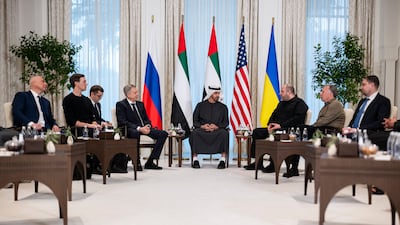
President Sheikh Mohamed receives the heads of delegations participating in the UAE-hosted trilateral talks between Russia, Ukraine and the US at Al Shati Palace. Delegates include Kirill Budanov, Director of the Office of the President of Ukraine, Steve Witkoff, US special envoy, Rustem Umerov, Secretary of the National Security and Defence Council of Ukraine, Igor Kostyukov, Chief of the Main Directorate of the General Staff of the Russian Armed Forces and Jared Kushner -
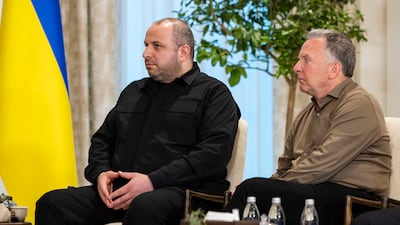
Rustem Umerov, Secretary of the National Security and Defense Council of Ukraine, left, and Steve Witkoff, US Special Envoy, at Al Shati Palace -
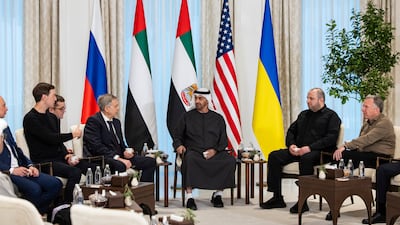
President Sheikh Mohamed receives the heads of delegations participating in the UAE-hosted trilateral talks between Russia, Ukraine and the US at Al Shati Palace. Delegates include Jared Kushner, Igor Kostyukov, Chief of the Main Directorate of the General Staff of the Russian Armed Forces, Rustem Umerov, Secretary of the National Security and Defence Council of Ukraine, and Steve Witkoff, US special envoy -
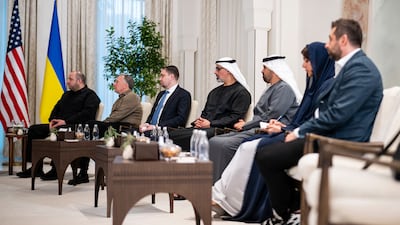
Sheikh Khaled bin Mohamed, Crown Prince of Abu Dhabi and Chairman of Abu Dhabi Executive Council, and Sheikh Theyab bin Mohamed, Chairman of the Office of Development and Martyrs Families Affairs at the Presidential Court, attend the Al Shati meeting. Also present were Kirill Budanov, Director of the Office of the President of Ukraine, Steve Witkoff, US Special Envoy, and Rustem Umerov, Secretary of the National Security and Defence Council of Ukraine


Attending the trilateral talks are US presidential envoys Steve Witkoff and Jared Kushner; Igor Kostyukov, head of the main directorate of the General Staff of the Russian Armed Forces; Kyrylo Budanov, Chief of Staff to the Ukrainian President; Rustem Umerov, Secretary of the National Security and Defence Council of Ukraine, and a number of senior officials from both Russia and Ukraine.
The first day of the talks involved a discussion on the parameters for ending the war and the "further logic of the negotiation process”, according to Mr Umerov, the head of Ukraine's delegation.
A White House official told The National that the meeting's first day had been "productive”.
The Emirates has mediated 17 prisoner exchanges between Russia and Ukraine since the war broke out, resulting in the release of 4,641 people.
Territorial talks
Moscow is steadfast in its demand that Ukraine give up its entire eastern area of Donbas.
A senior aide to Vladimir Putin said on Friday, after talks between the Russian President and US envoys, that there was no hope of ending the war until a resolution to the disagreements over territory is found.

The Abu Dhabi meeting is seen as a “notable development”, being the first trilateral meeting since the start of the war, said Karan Vassil, an analyst at intelligence company Sibylline.
There was a “slightly higher prospect” of a moratorium on air and missile strikes on civilian and energy infrastructure than a peace deal.

