


What was once a stretch of desert on the outskirts of Abu Dhabi city is being transformed into a gateway to the nation’s railway future.
Rising from the ground in Mohamed bin Zayed City, a new Etihad Rail station is nearing completion, and that will usher in an era of passenger rail.
Inside, workers are moving full steam ahead for the launch of passenger services later this year that will first link the capital to Dubai and Fujairah.

From Mohamed bin Zayed City, passengers will be able to travel across the country, reaching Dubai in about an hour and to Fujairah in about 90 minutes – a boost for inter-emirate connectivity, tourism and sustainable travel in a country whose population is surging and roads grow steadily busier.
“The station has been designed to feel open and intuitive, with spacious concourses, clear signage, comfortable waiting areas and staff on hand to assist,” Azza Al Suwaidi, deputy chief executive of Etihad Rail Mobility, told The National.
“Our aim is for Mohamed bin Zayed City station to show how national infrastructure can be designed around real communities, because when passengers feel confident here, they will trust the entire network.”
The National this week was granted access to the station following a train journey from Al Faya depot.
Passengers will have the choice of seating classes including a business section with food and beverage options and Wi-Fi.
Inside, the train is sleek and comfortable as it hits speeds of around 200kph. Along the way from Al Faya, the train passes farms, factories and rolling sand dunes on its way to Abu Dhabi.
Then, the driver turns on to the spur line that connects the Abu Dhabi station to the main line. As it slowly approaches Mohamed bin Zayed City it is clear to see why the location was picked.
Abu Dhabi is now a city of suburbs, expanding far beyond the island where it all began. And in Mohamed bin Zayed City, new hospitals, schools and residential developments have sprung up. It is also close to the sprawling Mussaffah neighbourhood and across the road from Dalma Mall.
“Station locations always begin with understanding how people move and where real demand exists,” said Ms Al Suwaidi.
“In Abu Dhabi, Mohamed bin Zayed City plays a central role in daily mobility patterns, while also supporting future growth and development.
“That’s why Mohamed bin Zayed City station was selected as the flagship station for the passenger network and the main starting point for services from Abu Dhabi.
“Accessibility, ease of use and proximity with surrounding communities were key considerations.”
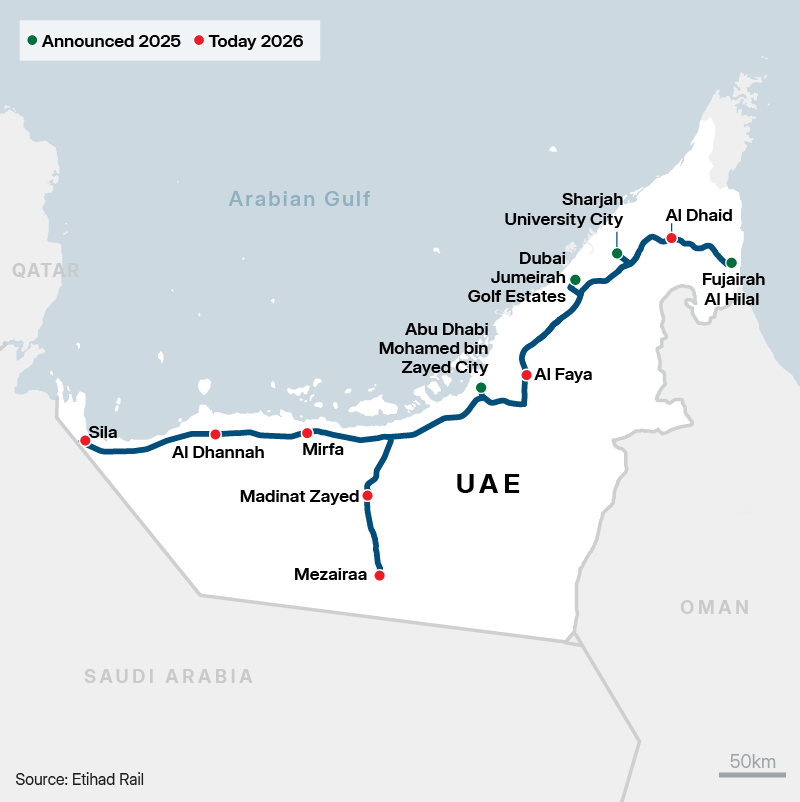
The station in Abu Dhabi is one of the anchor stations on the network. And, as the network expands in the years ahead, they can travel west, taking a train to Sila on the border with Saudi Arabia or down through the rolling dunes to Liwa.
Once the station is open, passengers can expect food and beverage outlets, shops, travel information boards, waiting areas and quick access to the platforms. Inside the station, the turnstiles, ticket machines and maps are being prepared. Around four million man hours has gone into its construction, Etihad Rail said.
Aside from areas primed for future growth, the choice of station locations aims to make the best use of the freight network and, crucially, not to compete with the separate high-speed rail between Abu Dhabi and Dubai announced last year that has yet to be built.
Etihad Rail is also working to connect stations to existing and future public transport such as the Dubai Metro and buses, while also incorporating space for bikes and other modes. Dubai’s station in Jumeirah Golf Estates, for example, is connected to the Metro.
“We are working very, very closely with all of the public authorities in each emirate,” said Ms Al Suwaidi, such as on bus routes, ensuring taxis are available when trains arrive and depart and the provision of e-hailing services.
“And not to forget also the passengers that live in the vicinity of the area so they'll be able to walk their way to the station or use the micro mobility [such as e-scooters] to reach the station.”
When the first passengers step on to the platforms at Mohamed bin Zayed City, they will be entering more than a new station. They will be boarding a network designed to reshape daily life, linking suburbs, cities and regions in ways not previously possible.
For Ms Al Suwaidi, a civil engineer who has spent years helping to bring the project to life, the moment carries personal and national significance.
“It's a megaproject and every megaproject has its challenges,” she said.
“But we are in the UAE and we have this opportunity. And we're very fortunate to have leadership support, and our local authorities working closely together in making this happen. It's a national project and I take pride to be a small part of it.”

