
A batch of Nestle baby formula products has been recalled across the Middle East - including in the UAE - as a safety precaution.
Action was taken after one of the raw materials used in production was found to contain traces of the Bacillus cereus bacteria, which can produce the toxin cereulide that can cause nausea and vomiting.
At least 37 countries, including most European states, as well as Australia, Brazil, China, Mexico and South Africa, have issued health warnings over the infant formulas possibly being contaminated.

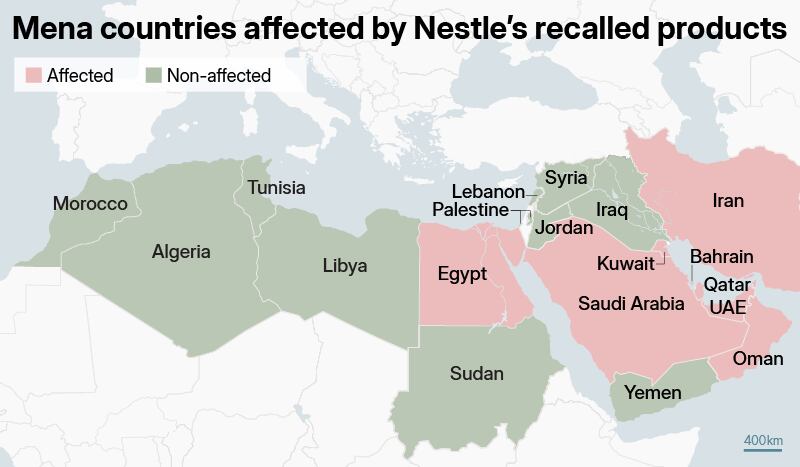
Regionally, the products have been recalled in the UAE, Bahrain, Egypt, Iran, Kuwait, Oman, Qatar and Saudi Arabia.
The Emirates Drug Establishment, the UAE's medical regulator, said on Wednesday that a “limited number” of infant formula products – NAN Comfort 1, NAN Optipro 1, NAN Supreme Pro 1, 2, 3, S-26 Ultima 1, 2, 3, and Alfamino – were being recalled in co-ordination with Nestle.
“No illness or adverse events linked to the affected batches” had been reported and all other Nestle products remain safe for consumption,” the authority said.
“Product safety and quality, particularly when it comes to children’s health, is the establishment’s highest priority,” state news agency Wam reported.
The EDE said that the affected supplies had been quarantined in Nestle's and its distributors' warehouses and that efforts were continuing to complete the recall.
It said the measures were being taken to protect public health and noted that the recall process was being carried out in partnership with other regulatory authorities in the UAE to ensure the complete removal of the products from all points of sale, including online retail platforms.
Nestle said it had co-ordinated what it described as a voluntary recall of the select baby formula products with authorities in affected countries.
A voluntary recall is when a company takes proactive steps to remove a product from the market because it has discovered a safety issue without being compelled to do so by a government agency.
"This voluntary recall is a precautionary measure that is due to the potential presence of cereulide in one of the ingredients from a supplier used in the batches concerned," Nestle said in a statement on its website regarding action taken in the Middle East.
"No illness has been confirmed to date in relation to this. Nevertheless, Nestle has decided to perform this precautionary product recall in full co-operation with the local authorities in each of the impacted countries and out of an abundance of caution and in line with Nestle’s strict quality and food safety protocols.
"Relevant customers and distributors holding the identified batches were notified, and standard instructions were issued to block and remove the affected quantities from store shelves."
What is the risk?
Paw Dalgaard, professor in predictive food microbiology at the Technical University of Denmark, said that Bacillus cereus was not typically one of the major causes of serious illness.
"It causes in general relatively mild disease," Prof Dalgaard said. "It's not one of the most frequent that you see. You definitely find others that are more serious."
He added that food safety regulations for baby and infant foods were particularly strict and had a "very, very high priority".
"There are very, very few cases [of safety scares with baby and infant foods]," he told The National.
"We have one now, but really a lot of attention has been given to that. When you look at the rules of safety for these products, it's extremely high ... It's a little surprising we have this case now."
Food companies do, he said, "spend a lot of money" and put "a lot of effort", into food safety, something that he said that made financial sense.
"When something like this happens, it's very damaging to their reputation," he said.
"It's just a business case to make sure this doesn't happen often. They have to be very, very careful."
Aside from the latest food safety scare, Nestle, which is known for products such as Nescafe, Kit Kat and Smarties, was in the headlines in the second half of last year when its CEO, Laurent Freixe, was sacked because he did not disclose that he was in a romantic relationship with a direct subordinate.
Mr Freixe had been running Nestle for just a year, having taken charge after nearly four decades with the company.
Just a month into the job, his successor, Philipp Navratil, announced that Nestle would be making 16,000 job cuts over the following two years, with the company deciding to focus on its products that offered the highest potential returns.
Based in Switzerland, Nestle is described as the world's largest producer of packaged food and drinks.

