

The UAE on Monday set out ambitious plans to use artificial intelligence to deliver a critical lifeline to millions of farmers bearing the brunt of the growing threat posed by climate change.
Abu Dhabi's AI Ecosystem for Global Agriculture Development will seek to use advanced technology to help farmers adapt quickly to extreme weather and give them access to the tools needed to cultivate a better future for the communities they support.
The high-tech strategy is the result of a major international collaboration between the UAE Presidential Court and the Gates Foundation. Its launch will build on the $200 million UAE-Gates Foundation fund announced at Cop28 in Dubai, which aims to accelerate agricultural innovation.
The announcement was made in the presence of Mariam Almheiri, head of the International Affairs Office at the UAE Presidential Court, and Bill Gates, chairman of the Gates Foundation.
Four landmark initiatives will serve as the foundation of the new ecosystem, including an agriculture and AI centre at the Mohamed bin Zayed University of Artificial Intelligence and the Agricultural Innovation Mechanism for Scale (Aim for Scale), under which an advanced weather warning system for farmers is already achieving success.
Driving global change
-

Internally displaced children Ali and Osman Abdulahi stand near carcasses of their family's livestock, killed by severe drought near Dollow, Somalia. Reuters -
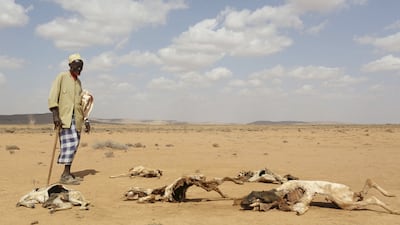
Quick distribution of climate funds agreed at Cop28 will help devastated populations get back on their feet, Somalia’s Deputy Prime Minister Salah Jama has said. Reuters -

Commuters ride on rickshaws on a flooded road after heavy rains in Dhaka, Bangladesh. Reuters -
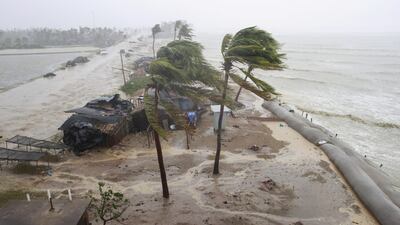
Cyclone Mocha makes landfall near Cox's Bazar, Bangladesh. A rise in extreme weather events around the world has been blamed on global warming caused by man-made greenhouse gases. EPA -
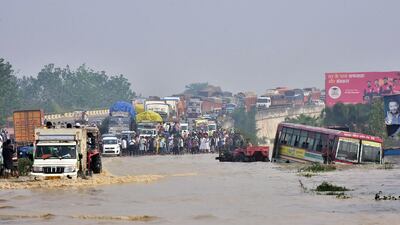
Commuters stand on a flyover, on a flooded motorway near Rampur, in India's Uttar Pradesh state, in 2021. AFP -
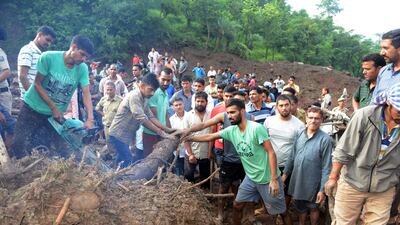
Monsoon floods and landslides killed about 100 people in Nepal and India earlier this year. AFP -
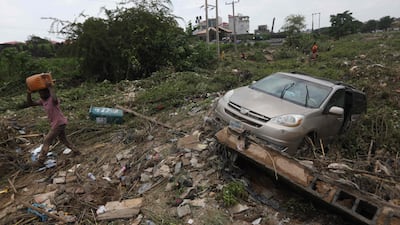
A man walks past a car swept by floodwaters in Abuja, Nigeria, in 2021. AFP -
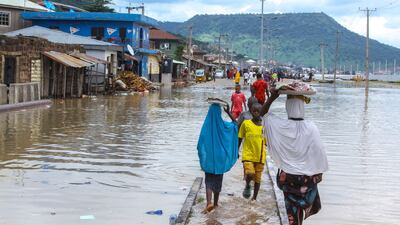
Flooding in Kogi, Nigeria, in October 2022. AP -
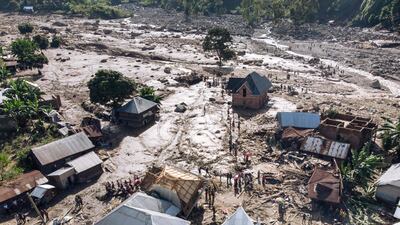
A landslide engulfs Nyamukubi village, eastern Democratic Republic of Congo. AFP -

A landslide in the Mont Ngafula district of Kinshasa, the capital of the Democratic Republic of Congo. AFP -
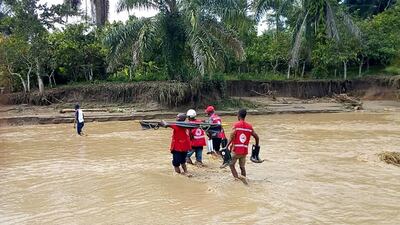
Aid workers crossing flooded areas in Bundibugyo, Uganda. Twitter/UgandaRedCross -
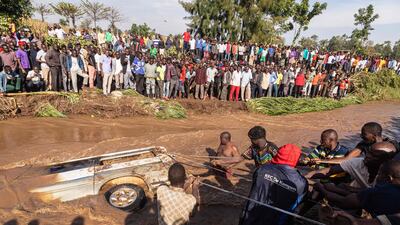
Villagers try to pull up a minibus in which 14 bodies were retrieved, in the river Nabuyonga in eastern Uganda, after flash floods. AFP


“The UAE is harnessing artificial intelligence for global good, to help protect the farmers and communities most exposed to climate volatility,” said Ms Almheiri.
“By connecting our national research and AI capabilities with leading global partners, we are turning science into real tools that reach people on the ground.
“Through our partnership with the Gates Foundation, we are advancing Agri-AI solutions that support millions of smallholder farmers facing unpredictable weather, helping secure a more stable and hopeful future for communities worldwide.”
Mr Gates emphasised the need to support farmers who are struggling to make a living and feed their communities in challenging conditions.
“Around the world, smallholder farmers are facing the harshest impacts of climate change with the fewest tools to adapt,” Mr Gates said.
“The AI for Agriculture Ecosystem helps change that by putting practical, data-driven solutions directly in farmers’ hands. I’m grateful for the UAE’s leadership: this initiative helps strengthen food security and support farmers in a warming world.”
The four AI-agriculture projects
The CGIAR AI Hub will be hosted in Abu Dhabi by ai71 – a leading AI company in the capital – in conjunction with CGIAR (Consultative Group on International Agricultural Research).
It aims to establish Abu Dhabi as a leading centre for AI in agriculture, benefitting from CGIAR's 50 years of extensive agricultural data and expertise.
The Institute of Agriculture and Artificial Intelligence will be based at MBZUAI and will provide digital advisory services, training programmes and technical assistance teams for both governments and non-governmental organisations.
It will focus on strengthening global food security by improving the lives and livelihoods of more than 43 million smallholder farmers.
AgriLLM, an open-source large language model developed by ai71 in Abu Dhabi, is designed to advance global agricultural intelligence.
It is trained on deep agricultural data, including 150,000 agricultural documents, 50,000 research papers and 120,000 real farming questions and answers, and is designed for multilingual understanding.
Aim for Scale, jointly funded by the UAE and the Gates Foundation and based at NYU Abu Dhabi, is delivering AI-powered weather forecasting and digital advisory services to small smallholder farmers.
This year, India provided monsoon forecasts supported by AI to 38 million farmers. MBZUAI and the University of Chicago have also launched an AI Weather Forecasting Training Programme in Abu Dhabi, educating officials from Bangladesh, Chile, Ethiopia, Kenya and Nigeria, with plans to expand to 25 more countries by 2027.
Sowing seeds of change

Timothy Baldwin, provost of MBZUAI and also professor of natural language processing, spoke of how efficiently using a treasure trove of data can boost productivity in agriculture.
“The data can range from crop yields for different strains, to livestock data, to weather patterns and how they correlate with changes in output,” he said.
“Soil nutrient information is also critical because soil quality shifts over time depending on fertilisers and other practices. Different organisations hold different pieces of this information. The power comes from connecting those fragments.
“Our role is to collect the data, make it openly available and build the models – while also helping others build their own. It’s not just about technology development, it’s about working with partners who can introduce these tools to farmers and help them understand how to use them.”
He said the university's expertise will be used to initially boost agriculture in Africa, before being rolled out in parts of South Asia.
Leading the way

Fatema Al Mulla, a senior specialist at the International Affairs Office of the UAE Presidential Court, said the Emirates was determined to address the consequences of climate change.
“The UAE has built a long history around food security – both our national efforts and our role in global agricultural development. Many countries are now pulling back from development commitments, and that creates an opportunity for us to step forward،” she said.
“An ecosystem like this allows international organisations to use Abu Dhabi as a hub for AI – a place where we can build capacity and develop tools that can be transferred to smallholder farmers in developing countries.
“A third of global greenhouse gas emissions come from food systems. We produce enough food to feed the world, yet a third is wasted and more than 700 million people still go hungry. To fix food systems, we need more efficient solutions. The technologies already exist – it’s about getting them to the right people at the right time.”

