An education task force has called on governments to introduce a mandatory artificial intelligence charter in schools and universities around the world – as a study found a majority of learners believe limits should be placed on its use.
The HP Futures Report, released on Tuesday, highlights the critical need for robust measures to protect pupils while harnessing AI's potential in a rapidly changing education sector.
The charter would aim to guarantee date privacy, establish safeguards for minors and prohibit exploitative uses of the advanced technology.
It cautioned against overreliance on AI by pupils, which could hamper critical thinking, but underlined the importance of future generations mastering its use to prepare them for the workplace.
“AI opens new avenues for delivering personalised, high-quality learning experiences to billions of students in low-income countries for the first time,” the report states.
“However, realising this potential requires secure, responsible and effective adoption.”
HP Futures is an education initiative led by technology company HP, T4 Education and the Global Learning Council, set up to address global challenges in education.
The report brought together 100 leading education, technology and policy experts to examine the adoption of AI in the classroom.
AI's growing influence
The survey, conducted in May and June of this year, gauged the views of about 3,000 students from 21 countries, including the UAE, Saudi Arabia, Qatar, the US, India and China.
The poll found while 71 per cent of students want limits to be placed on AI capabilities, they have also integrated it into their daily lives.
The study showed 60.5 per cent use AI to aid research, some 45 per cent use it for brainstorming and deep thinking and 36 per cent for studying and homework.
When asked what schools should teach about AI, 73 per cent said they wanted to learn how it can help them to research effectively, with 71 per cent wanting to be educated on its ethical use.
The report shared anecdotal evidence of how AI adoption in schools has led to a reduction of up to a 60 per cent in lesson-planning and marking, freeing up teachers to devote more time to working with students.
It emphasised that students should learn with AI and use it to enhance their learning experience, but should not “outsource their thinking”.
Promoting responsible use of AI
-

Mohamed bin Zayed University of Artificial Intelligence commencement of class 2023 ceremony at the Abu Dhabi Energy Centre on June 4, 2023. All photos: Khushnum Bhandari / The National -
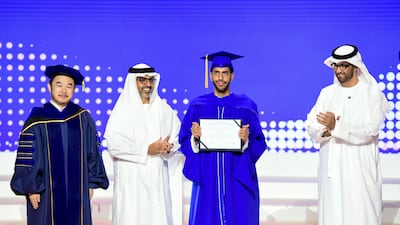
The ceremony was attended by Sheikh Hamed bin Zayed, director of Abu Dhabi Investment Authority, and Dr Sultan Al Jaber, Minister of Industry and Advanced Technology -

Guests in the audience during the Mohamed bin Zayed University of Artificial Intelligence commencement of class 2023 ceremony. -
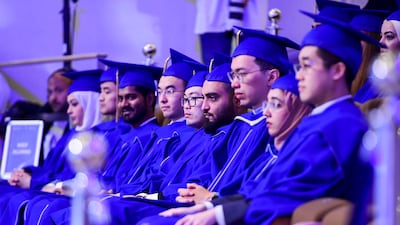
A commencement ceremony on Sunday saw 59 students receive their postgraduate degrees -

It is estimated that AI could contribute $320 billion to the Middle East economy in 2030, with the UAE seeing the greatest gain. -

Family and friends take photos with the graduates at the Mohamed bin Zayed University of Artificial Intelligence commencement of class 2023 ceremony. -
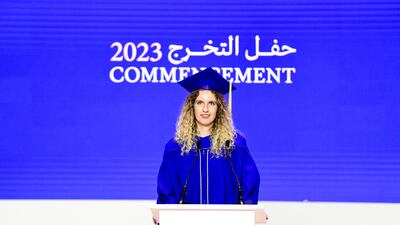
Klea Ziu, Master of Science in Machine Learning, Class of 2023 Valedictorian the Mohamed bin Zayed University of Artificial Intelligence commencement of class 2023 ceremony. -
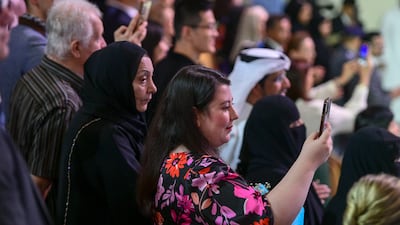
The graduating class comes from 25 different countries, including the UAE, China, Africa and other parts of the Middle East.


The UAE's commitment to AI was demonstrated when it established the Mohamed bin Zayed University of Artificial Intelligence in Abu Dhabi in 2019. The first students graduated in January 2023.
The Emirates is continuing to integrate AI into education and to provide teachers with additional training to help pupils to thrive.
The Teachers Track strategy is being promoted by the UAE's Artificial Intelligence, Digital Economy and Remote Work Applications Office in partnership with technology company Microsoft.
It is central to a wider drive announced last year by Sheikh Hamdan bin Mohammed, Crown Prince of Dubai, Deputy Prime Minister and Minister of Defence, to train one million people in AI by 2027.
The scheme aims to improve teachers' understanding of the technology and equip them with the skills needed to exploit its potential in the classroom.
In May, Sheikh Mohammed bin Rashid, Vice President and Ruler of Dubai, announced that AI was to be introduced as a subject across all stages of government education in the UAE, starting in the current academic year.
AI will be taught from reception to Grade 12 in the hope that generations can develop a “deep understanding of AI from a technical perspective”, Sheikh Mohammed said.
He added that an awareness of the ethics of its use and an understanding of its data, algorithms, applications and risks are leading facets of the education policy.