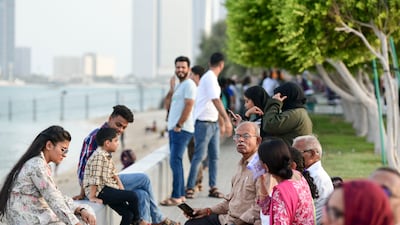

The Gulf has long embraced its status as a multicultural melting pot, with millions of people drawn from all corners of the globe calling the region their home from home.
Its rich cultural diversity is never more apparent when it comes to the sheer number of languages spoken, with English among the most common, even for those for whom it is not their native tongue.
But how does the English uttered by an expatriate from Manchester in the UK compare to a resident from Manila or Mumbai? And has bringing these distinct dialects together created its own language unique to the region, known as Gulf English?
For English-speakers in the Emirates, for example, phrases such as "do the needful" – meaning to do what is necessary – are sprinkled casually into conversation along with Arabic terms such as "Inshallah", meaning if God wills.
Evolving language
Researchers have been analysing the possible emergence of “Gulf English”, a form of the language with particular transnational and translingual influences.
Anyone who has dropped an Arabic word into their English speech, or who has been asked by a native Arabic speaker to “close the light” (a direct translation from the phrase in Arabic), may be witnessing and playing a part in the development of this new dialect.
A new book, World Englishes in the Arab Gulf States, explores whether Gulf English exists and considers how Arabic and the English spoken by expatriates, sometimes as a second language, have influenced what is spoken in the region.

“In the Gulf we have so many varieties of English,” said the book’s editor, Prof Kay Gallagher, of the Emirates College for Advanced Education, a teacher training college in Abu Dhabi.
“We have millions of speakers of English, highly proficient as an additional or second language from Asia, the Philippines. And hundreds of thousands of speakers of English as a first language.”
On top of these, she said, is a constantly changing and increasingly diverse cohort from other parts of the world for whom English is a foreign language.
“More Englishes are being used across the Gulf than ever before, but also more languages are being used across the Gulf, and English will continue to evolve and continue to accommodate multiple other languages,” Prof Gallagher said.
World of influences
She said Gulf English incorporates vocabulary, structure and pronunciation features from Gulf Arabic, but also from Indian and other languages. These are added to the varieties of English imported from India, Pakistan, the UK, US, Australia and other nations, as well as from global media.
“In terms of vocabulary, studies have found that English in the Gulf tends to be peppered with vocabulary from the Arabic language and other languages commonly spoken in society,” said Dr Sarah Hopkyns, a lecturer at the University of St Andrews in Scotland and the author of a chapter in the book.
“For example, religious expressions such as Inshallah (if God wills), Wallah (I swear to God) and Mashallah (with God’s blessing) are often interjected into otherwise English sentences.”
She said that most borrowing of Arabic words tended to be in areas such as religion, food, geographical features (such as jebel for mountain) and clothing (abaya, for example). Borrowings from India are also common, Dr Hopkyns said, citing karak (Masala tea) as an example.
Gulf English speakers often say “gonna” – an Americanism – while they may also use what linguists call unique nouns such as Emiratisation or Omanisation, words typically unfamiliar to English speakers without experience of the Gulf.

Also, “mass nouns” such as homework, information or hair are often turned into “count nouns” by being pluralised.
“You find British English mass nouns often used as count nouns. ‘We need new informations’ or something like that,” said Prof Peter Siemund, professor of English Linguistics at the University of Hamburg in Germany and the co-author of a chapter in the book.
It is unclear, Prof Siemund said, whether such uses were diagnostic of an emerging Gulf English or simply reflected normal use in Indian English, which is highly influential in the Gulf.
The tenses used in Gulf English may not be strictly correct, but Prof Gallagher said the important thing was to convey meaning rather than to adhere to strict pronunciation or grammatical norms.
For example, she said the present perfect tense tends not to be used, being simplified to the past simple tense, so, “I have seen her many times” instead becomes “I saw her many times”.
“Purists may baulk, but the purpose of language is to convey meaning, to share meaning together,” Prof Gallagher said. “This has been a huge change in how we might look at the Englishes that we teach here. We would make students more aware of the different types of English, as well as standard English.”
Spreading positivity

To be released at the end of this month by Routledge, a well-known academic publisher, the new book has chapters covering topics such as the interplay of Arabic and English, the use of English by Gulf youth, and how English was used during the World Cup in Qatar to showcase a tolerant image of Islam.
The English spoken by expat populations in the UAE, including one of the largest groups, Indians, and one of the smaller groups, the Irish, are also analysed. Chapters delve into how English is used across the six Gulf Co-operation Council states. The way multilingual workplaces may introduce a hierarchy of languages, prioritising the use of some over others, is discussed, as is the widespread use of English in education.
The study of world Englishes is, Prof Gallagher said, “a huge field” and there have long been academic journals dedicated to the field.
But, by comparison to some other forms of English, such as those spoken in Asia, Gulf English has until now not been as comprehensively analysed, with most research restricted to the past couple of decades.
“I’ve really enjoyed the privilege of reading, editing, being in conversation with these amazing academics who are all either based in the Gulf or have academic interests and do their research in the Gulf,” she said.
Prof Gallagher, who moved to the UAE in the 1990s and returned to the country after a spell in Hong Kong, finds that she herself incorporates Arabic words such as "Mashallah" into her speech, even when visiting her native Ireland.
But while Arabic has influenced Gulf English in ways such as this, Prof Gallagher said it was vital the UAE’s official language should not be swamped by English, which has become ever more widely used in education.
“Concerns for Arabic and finding ways to support and ensure Arabic does not get lost in the tsunami of English [are important]. We know that’s a huge priority for the Gulf,” she said.
The question of whether a distinctive Gulf English has really emerged remains open. Prof Gallagher said Saudi Arabia – where English is more clearly a foreign language than it is in some other Gulf nations – may be where there is the clearest evidence.
Prof Siemund and his co-researchers drilled down into the question of whether Gulf English exists in the UAE when they analysed hundreds of interviews carried out with students at the American University of Sharjah.
“It’s not entirely clear at the moment if Gulf English is a phantom, a myth, or something real. We’re still working on this,” he said.